
Detroit, MI bulk trash pickup: schedule, booking and rules
How does bulk trash pickup work in Detroit?
Detroit residents should enter their address in the city’s waste pickup tool to confirm the next bulk day. Current refuse guidance advertises weekly service, while some city pages still say biweekly. The dated 2026 flyer limits bulk to two cubic yards and 1,000 pounds, set out between 6 p.m. and 7 a.m.
Published · Updated
At a glance
- Schedule
- Use address lookup; city pages conflict on weekly versus biweekly
- Limits
- Two cubic yards and 1,000 pounds; follow packaging rules
- Fees
- Residential waste fee applies; extra removal needs a DPW quote
- How to book
- Routine route via lookup; paid pickup online or 313-876-0004
- Last verified
- November 12, 2026
- Source
- City of Detroit Department of Public Works (city website)
As of November 12, 2026, use the city’s address-specific instructions before moving bulky items outside. This independent SettleUSA guide explains the service, preparation rules and alternatives so you can choose the right route for your items.
In this guide
- How Detroit bulk pickup works
- Find the trash pickup schedule in Detroit
- What is accepted and not accepted in Detroit?
- Detroit bulk trash set-out time and placement
- Detroit bulk pickup limits, charges and fines
- How to arrange routine or paid collection
- Missed pickup and illegal dumping reports
- Bulk drop-off centers and reuse alternatives
- Hazardous waste disposal and recycling in Detroit
- Frequently asked questions
- Official sources

SettleUSA does not take bookings or payments.
How Detroit bulk pickup works
Detroit’s refuse collection page advertises weekly trash, recycling, bulk and yard-waste collection and links an address lookup. The residential guidelines still describe biweekly bulk service. Use the address tool and your assigned contractor to confirm the actual date instead of assuming a frequency from an older handout. Refuse Collection and schedule lookup.
Residential properties are subject to a solid-waste fee on their tax bill. The residential guidelines include a bulk allowance. Ask your building manager and the city whether the property uses municipal residential service before setting material outside. Residential solid-waste guidelines.
The dated 2026 Yard and Bulk Waste Guide is the main preparation reference here. It lists furniture, mattresses, appliances, water heaters, carpeting and large toys as bulk items. The city also offers paid removal for loads beyond the routine allowance; an oversized cleanout should be discussed with DPW in advance. 2026 Yard and Bulk Waste Guide.
Find the trash pickup schedule in Detroit
Start from the city refuse page and open Find Your Waste Pickup Schedule. Type the street address or select the home on the map, then choose My Schedule. Read the bulk entry specifically and check for current alerts before moving a pile outside. Detroit waste schedule tool.
The city also offers reminders by text: send your street address to 313-800-7905. Reminders are useful for your service address, but check the lookup or contractor if they conflict with a general webpage. No neighborhood-specific date is inferred in this guide. Address-based reminders.
For collection questions, the city lists Priority Waste for East and Southwest Detroit at 855-927-8365, and Waste Management for the west side at 844-233-8764. If the property’s provider is unclear, ask DPW Solid Waste at 313-876-0004 rather than choosing a contractor from the city name alone. Published collection contacts.
What is accepted and not accepted in Detroit?
| Item | Pickup rule |
|---|---|
| Furniture, mattresses, appliances and water heaters | Listed as bulk items; confirm special handling for very heavy or refrigerant items. |
| Carpet and padding | Remove nails and staples; roll and tie bundles no wider than 4 feet. |
| Small loose household items | The 2026 guide says to place clothing, toys and lamps in bags or boxes. |
| Wood, lumber, cabinets and paneling | The dated 2026 guide accepts properly prepared renovation materials; remove sharp fasteners and follow its packaging rules. |
| Toilets, tile and drywall | Listed in the dated guide; loose tile and drywall go in black contractor bags, with each bag under 50 pounds. |
| Concrete, brick, asphalt and shingles | Not accepted in the routine bulk pile. |
| Tires, auto parts, metal poles and pipes | Not accepted in routine bulk pickup. |
| Tree trunks, paint, liquids and hazardous material | Not accepted in routine bulk pickup. |
Source: 2026 accepted-item and packaging rules.
The dated flyer accepts selected renovation materials, while the general city disposal page broadly excludes construction debris. For a mixed renovation load, confirm acceptance with the assigned contractor before set-out. Concrete and shingles remain excluded in the dated guide; a limited drywall allowance is not permission for unrestricted demolition waste. Read the dated renovation guidance.
Detroit bulk trash set-out time and placement
The 2026 guide says to put bulk at the curb no earlier than 6 p.m. the evening before collection and no later than 7 a.m. on collection day. Place the items in front of your own household, separated from the refuse container, yard waste and recycling. Bulk set-out window.
- Keep different collection streams in separate piles; do not mix yard waste with bulk.
- Never use a vacant lot, vacant house or another property as your set-out location.
- Roll and tie carpet bundles within the published 4-foot rule.
- For renovation material, remove nails, screws and staples; keep each item, bag or bundle under 50 pounds.
- Keep renovation debris under 4 feet long; material thicker than 4 inches must be shorter than 2 feet.
- Prepare paneling in pieces no larger than 2 by 4 feet and follow the guide’s bagging or bundling instructions.
Source: 2026 bulk packaging requirements.
Appliances are listed as bulk items, but the general city disposal page additionally says to remove doors and properly dispose of refrigerants. Ask the contractor how to prepare your particular refrigerator, freezer or air conditioner. Do not try to vent refrigerant or assume a large appliance fits a general bag-weight rule. Appliance preparation guidance.
Detroit bulk pickup limits, charges and fines
The dated 2026 guide says piles exceeding two cubic yards or 1,000 pounds will not be collected. It compares two cubic yards to the size of two stoves. Treat volume and weight as separate limits: a small, dense pile can still exceed the weight allowance. 2026 bulk volume and weight limits.
For more than the routine allowance, request a quote from DPW at 313-876-0004 or use the Paid Pickup form linked from the city site. The dedicated paid-service page says the charge is based on debris size and weight. Obtain the estimate and service instructions before relying on a collection. Paid Pick-Up Bulk Collection Service.
A general disposal page advertises $40 per cubic yard for paid pickup, but the dedicated service page describes an individual estimate. Confirm the actual charge with DPW before agreeing to removal. This guide does not present the advertised unit rate as a guaranteed total for your pile. General paid-pickup rate information.
The 2026 flyer warns of fines up to $1,500 for a first offense and up to $10,000 for a fourth offense for exceeding the bulk limits. It also warns that placing bulk at vacant properties can result in a ticket. Arrange another route before leaving an oversized load at the curb. Published bulk enforcement warning.
How to arrange routine or paid collection
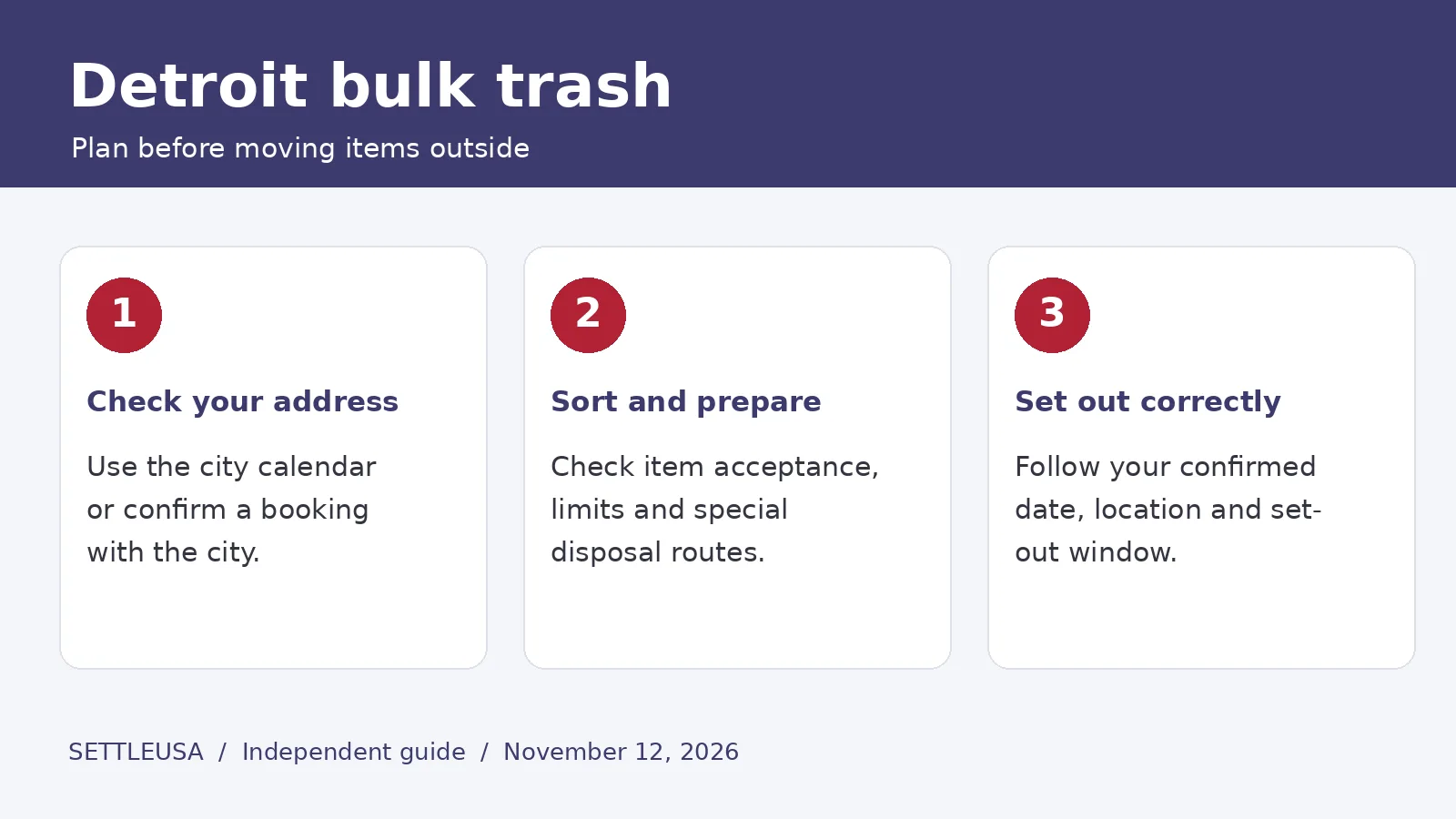
- Use the city address tool to confirm the bulk date and assigned provider.
- List the objects and estimate both pile volume and weight.
- Check the dated 2026 guide for acceptance and packaging; ask the contractor about unusual or heavy items.
- For a routine eligible load, prepare it for the confirmed route day within the 6 p.m. to 7 a.m. window.
- For extra removal, open the city Paid Pickup page and follow its form, or call 313-876-0004.
- Confirm the estimate, payment instructions and date before leaving a paid load outside.
Source: 2026 planning and set-out guidance.
The dedicated paid-service page says a DPW employee will respond within one business day with an estimate, followed by payment and removal. DPW accepts most debris types, including branches, renovation material and couches, but the load must be accessible from the front curb. Crews do not remove it from yards, garages or alleys. Paid pickup process and access.
Keep the quoted paid service separate from the normal route allowance. Tell DPW what the pile contains and where crews can access it. If you cannot move the material to the front curb, discuss that problem before paying; the published service does not include carrying items out of your building. Paid-service collection location.
Missed pickup and illegal dumping reports
The dated guide says to contact the solid-waste contractor about a missed collection on service day. After the service day, call DPW at 313-876-0004. Provide your address, expected bulk date, provider and what remained. Keep photos showing the pile’s preparation and location. Missed-collection reporting.
Before reporting, check that the date was a bulk collection entry and that the items were within the time, volume, weight and packaging rules. Explain any unusual material or access problem. Ask whether the pile needs correction and what to do with it while the report is reviewed. Bulk conditions and reporting route.
To report dumping or excessive debris, the dated guide publishes 313-876-0426. The city also links Improve Detroit from its refuse page. Use a location-specific report for waste dumped by someone else, and keep your own missed-collection request tied to the original service address. Illegal dumping contact.
Bulk drop-off centers and reuse alternatives
The dated guide lists Davison Yard at 8221 West Davison, Southfield Yard at 12255 Southfield Rd., and J. Fons Transfer Station at 6451 E. McNichols. Detroit residents need proper identification and are limited to 1,000 pounds per person per day. Construction debris is excluded except at J. Fons for a fee. 2026 bulk drop-off options.
The broader city disposal page gives seasonal hours for Davison and Southfield, with shorter winter days, and different hours for J. Fons. Check the current facility listing before leaving. It also excludes commercial vehicles from the free drop-off service; call ahead for a load that does not fit ordinary household disposal. Free disposal location conditions.
Tires need a different route from curbside bulk. The city’s free-drop-off page lists up to four tires per household per day at its resident service, alongside its bulk and yard-waste conditions. Confirm the chosen site accepts your tire load before traveling, especially if it is mixed with other material. Resident tire drop-off allowance.
For usable furniture, consider giving it away or arranging a confirmed donation before disposal. Ask about condition and transport and keep the collection date in view while waiting for a response. This is a practical reuse suggestion; no specific organization or free donation collection has been verified here. Compare with city disposal options.
Hazardous waste disposal and recycling in Detroit
Detroit’s Household Hazardous Waste Receiving Facility is at 2000 E. Ferry Street, near I-75 and I-94. The dedicated page says it is free for Detroit residents only, open Thursdays from 7:30 a.m. to 2 p.m. and every fourth Saturday from 8 a.m. to 2 p.m. Household Hazardous Waste Information.
The accepted list includes paint products, batteries, pesticides, automotive fluids, fluorescent tubes and many electronics, including computers and televisions. It excludes appliances, air conditioners, commercial waste, construction debris and standard household trash. Check the exact material list rather than taking everything from a garage cleanout. HHW accepted and excluded materials.
Call the facility at 313-923-2240 before traveling if an item is uncertain. The broad bulk flyer mentions several hazardous categories that the receiving facility itself excludes, including some explosive or medical materials. Use the facility’s specific acceptance rules and ask for another route where needed. Dedicated HHW facility rules.
Frequently asked questions
Is Detroit bulk pickup weekly or biweekly?
The current refuse page advertises weekly service, but some city pages still say biweekly. Confirm your exact date in the address tool or with your assigned contractor.
How much bulk trash can I leave in Detroit?
The 2026 guide limits routine bulk to two cubic yards and 1,000 pounds. It directs larger loads to a paid quote or another disposal option.
When can I set out bulk trash in Detroit?
The dated guide permits set-out from 6 p.m. the evening before until 7 a.m. on collection day. Use the curb in front of your own household.
Can drywall go in Detroit bulk pickup?
The dated 2026 guide lists drywall in black contractor bags with each bag under 50 pounds, within overall limits. Other city guidance differs, so confirm your renovation load with the contractor.
How do I report missed Detroit bulk pickup?
Contact the assigned contractor on service day. After service day, the 2026 guide says to call DPW at 313-876-0004.
Where can I take a television for recycling in Detroit?
The dedicated household hazardous waste page lists televisions and other electronics at 2000 E. Ferry Street for Detroit residents. Check its hours and acceptance rules before traveling.
Official sources
- City of Detroit Department of Public Works — Published collection contactsChecked
- City of Detroit Department of Public Works — Residential solid-waste guidelinesChecked
- City of Detroit Department of Public Works — Compare with city disposal optionsChecked
- City of Detroit Department of Public Works — Resident tire drop-off allowanceChecked
- City of Detroit Department of Public Works — Paid-service collection locationChecked
- City of Detroit Department of Public Works — Dedicated HHW facility rulesChecked
Source review: complete. Last checked .
Independent guide, not affiliated with SSA, VA, USDA or any government agency. Not financial or legal advice. Confirm your circumstances with the responsible agency or service.