
Social Security COLA 2027: 3.6% increase explained
How much is the Social Security COLA for 2027?
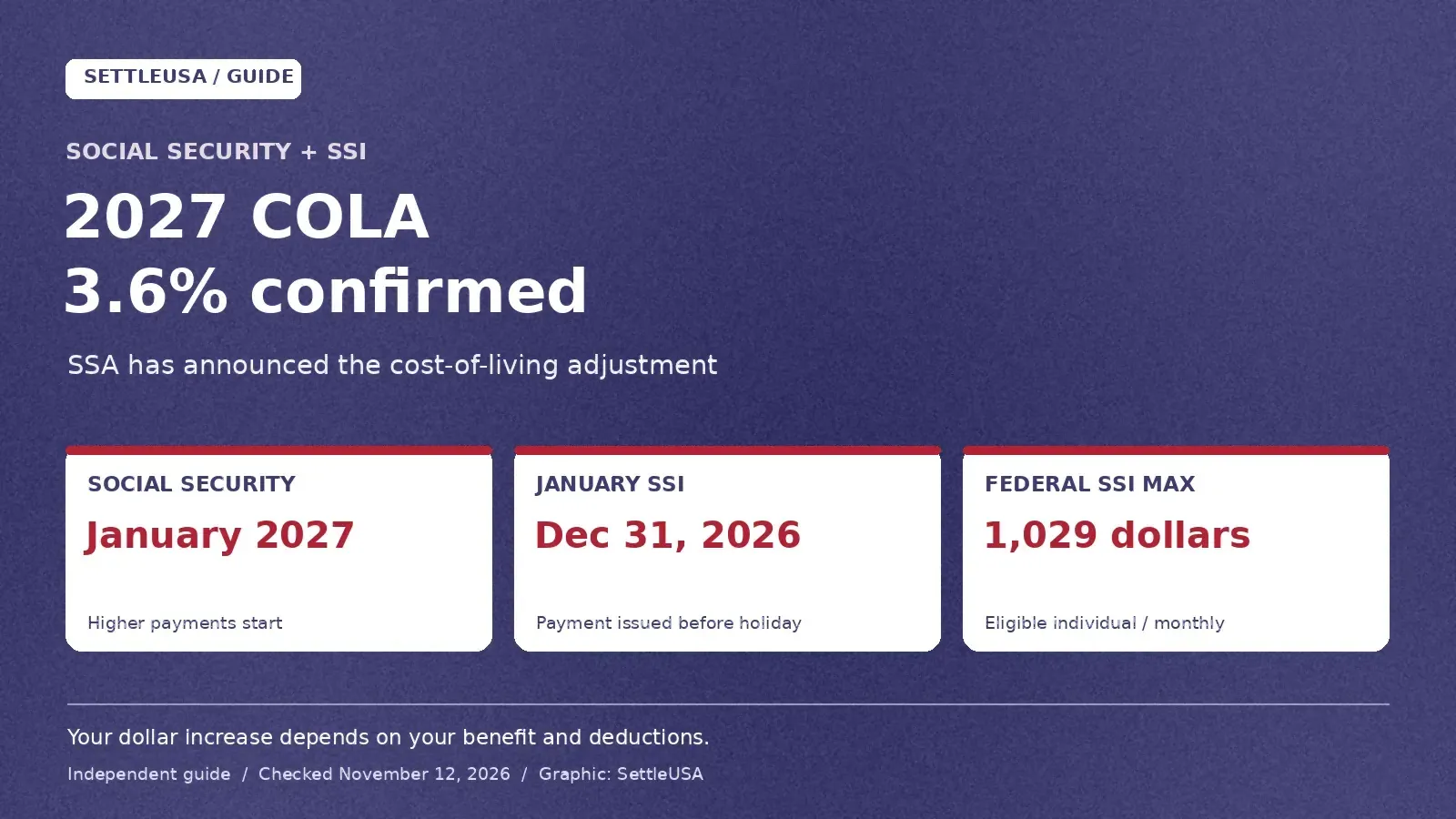
The Social Security COLA for 2027 is 3.6%, confirmed by SSA. Higher Social Security payments start in January 2027, while the higher January SSI payment arrives December 31, 2026. Your dollar increase depends on your benefit; Medicare premiums and other deductions can change the amount deposited.
Published · Updated
At a glance
- COLA
- 3.6%
- Social Security
- Higher payments January 2027
- SSI
- January payment December 31, 2026
- Part B premium
- Final 2027 figure not verified
As of November 12, 2026, the 2027 increase is confirmed. Use the figures below to understand your notice, separate gross benefits from take-home payments and identify limits that apply if you keep working.
In this guide
- Social Security increase 2027: what is confirmed?
- When does the 2027 COLA start for Social Security and SSI?
- How much does a 3.6% increase add?
- SSI COLA 2027: federal maximum payment amounts
- What is the Social Security taxable maximum for 2027?
- Working while receiving benefits: 2027 earnings limits
- How does CPI-W set the COLA?
- Social Security COLA history: 2016–2027
- Medicare Part B premium 2027: what is verified?
- Where is my Social Security COLA notice?
- Does the COLA affect VA, CSRS and FERS?
- Frequently asked questions
- Official sources
Social Security increase 2027: what is confirmed?
The Social Security COLA for 2027 is 3.6%, according to SSA’s announcement. This is the announced adjustment, not a forecast. It applies to Social Security benefits and federal Supplemental Security Income payment levels.
A percentage increase is different from a fixed dollar bonus. The dollars depend on the benefit being adjusted. For household planning, find your own benefit notice first, then compare the new gross amount and the amount expected in your bank account.
Keep three questions separate: how much the benefit increases, when the payment arrives and what is deducted. A correct COLA percentage does not by itself answer the other two. This guide explains each part using official pages checked November 12, 2026.
When does the 2027 COLA start for Social Security and SSI?
SSA says the higher Social Security payments begin in January 2027. The increase is effective for December 2026 benefits, which are paid the following month. The higher SSI payment for January arrives December 31, 2026, because January 1 is a holiday. See SSA’s payment-start announcement.
| Benefit | Benefit period | First higher payment |
|---|---|---|
| Social Security | December 2026 | January 2027 on your assigned date |
| Federal SSI | January 2027 | December 31, 2026 |
That early SSI deposit belongs to January. Label it that way in your budget so the late-December bank activity does not look like extra spending money. Follow the Social Security 2027 schedule for the payment date that applies to your situation.
If you receive more than one benefit, check each notice separately. Do not assume every payment in your household will move on the same day. Keep the benefit month next to the deposit date when writing down the new amounts.
How much does a 3.6% increase add?
SSA’s 2027 fact sheet estimates the average retired-worker monthly benefit at $2,095 before the COLA and $2,170 afterward. That is a $75 increase in the published rounded averages. It is not an amount promised to every retired worker.
| Category | Before COLA | After COLA |
|---|---|---|
| All retired workers | $2,095 | $2,170 |
| Aged couple, both receiving benefits | $3,238 | $3,355 |
| All disabled workers | $1,642 | $1,701 |
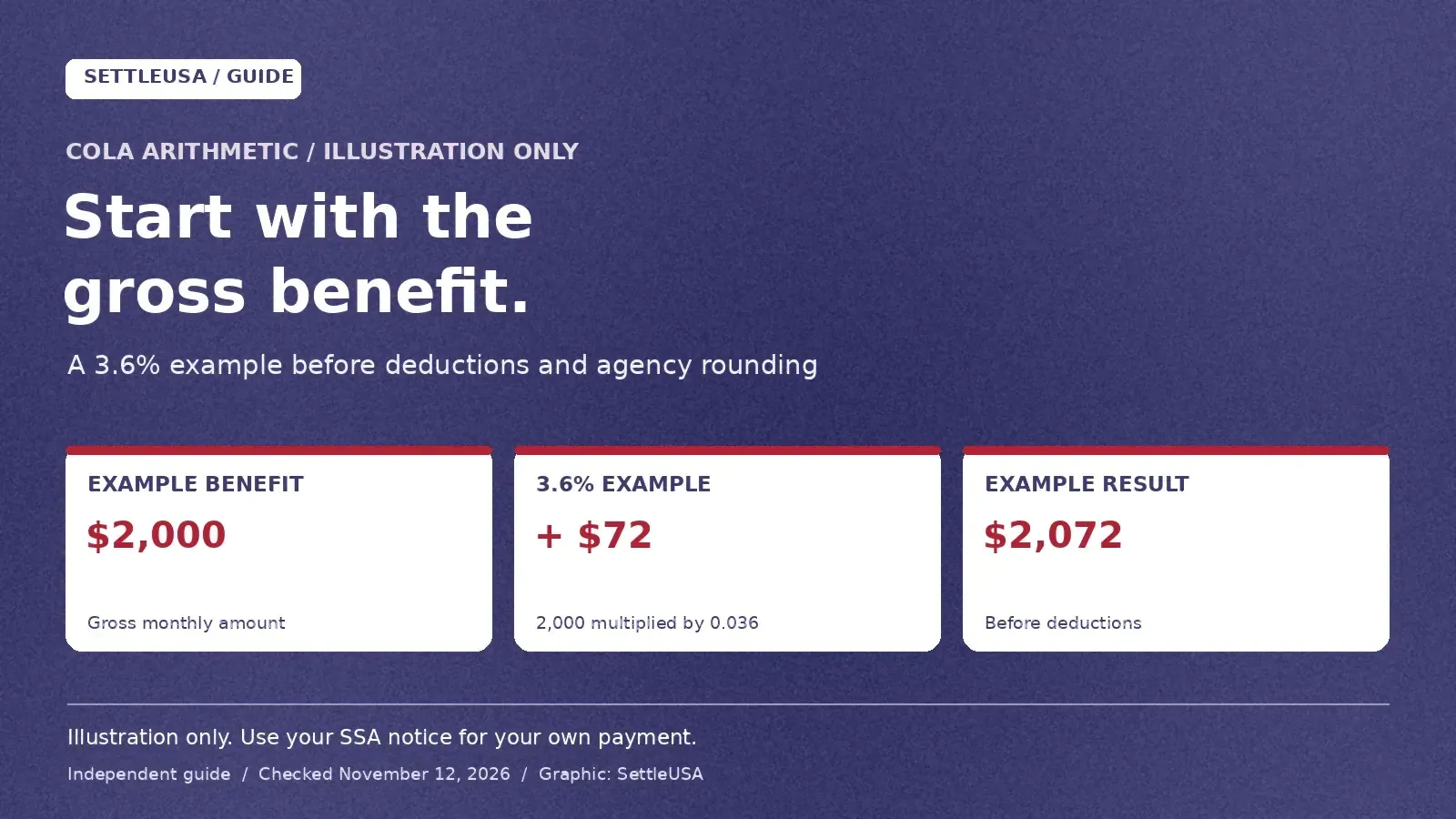
For an illustration only, a $2,000 gross monthly benefit multiplied by 0.036 gives a $72 increase. Adding that to $2,000 gives $2,072 before any deductions or agency rounding. This is arithmetic to explain the percentage, not an individual benefit quote.
Use the gross benefit from your notice for a rough comparison. Multiplying only the deposit in your bank statement can give a misleading result if that deposit already has deductions removed. The notice is the useful document to keep alongside your budget.
SSI COLA 2027: federal maximum payment amounts
The SSA federal SSI amounts page lists a monthly maximum of $1,029 for an eligible individual and $1,544 for an eligible couple in 2027. These are federal payment standards; they do not mean every recipient receives that amount.
| Recipient | 2026 | 2027 |
|---|---|---|
| Eligible individual | $994 | $1,029 |
| Eligible couple | $1,491 | $1,544 |
SSA explains that countable income reduces the monthly payment and that some states supplement SSI. It calculates the new standard from unrounded annual amounts, then rounds the monthly result down to whole dollars. Simply multiplying last year’s published rounded maximum may not reproduce the table exactly.
Check the notice for the person or eligible couple concerned. If you receive both Social Security and SSI, do not add the federal maximum to the Social Security increase and assume that is your new combined income. Ask SSA to explain how the benefits interact in your case.
What is the Social Security taxable maximum for 2027?
The 2027 SSA fact sheet sets maximum earnings subject to Social Security tax at $192,300, up from $184,500 in 2026. The Medicare taxable earnings column remains “No Limit.” These are payroll-tax figures, separate from the size of a retirement deposit.
The wage base is also different from the retirement earnings test below. One tells you how much earnings are subject to Social Security payroll tax; the other can affect benefits when someone works before full retirement age.
When reading a headline about a higher “Social Security limit,” look for the complete label. Write “taxable maximum” or “earnings test” next to the figure you save. The two numbers answer different questions and should not be substituted for each other.
Working while receiving benefits: 2027 earnings limits
SSA’s 2027 fact sheet gives an annual earnings limit of $25,560 for people under full retirement age all year. Above that limit, SSA withholds $1 of benefits for every $2 of excess earnings.
For someone reaching full retirement age during 2027, the higher limit is $67,920. SSA withholds $1 for every $3 above that limit, counting earnings only before the month full retirement age is reached. Beginning with that month, the earnings test no longer applies.
SSA’s working while receiving benefits guide explains the distinction between being under full retirement age all year and reaching that age during the year. Its general examples still use 2026 limits; use the new fact sheet for 2027 dollar thresholds.
Before accepting extra hours or changing your work pattern, ask SSA how your expected earnings affect your own benefit. Have your expected annual wages, the month you reach full retirement age and any change in employment ready. Do not treat a general annual threshold as a personal benefit calculation.
How does CPI-W set the COLA?
The COLA uses the Consumer Price Index for Urban Wage Earners and Clerical Workers, or CPI-W. SSA compares the third-quarter average with the corresponding average in the last year a COLA took effect. The third quarter covers July, August and September. See SSA’s calculation.
SSA reports third-quarter averages of 317.265 for 2025 and 328.746 for 2026. The percentage change, rounded to the nearest tenth of one percent, produces 3.6%. If the comparison produces no increase, there is no COLA under the formula.
This is a national index calculation. It is not worked out from your household’s receipts or your particular rent increase. You may find your own costs rise faster or slower, so use actual bills when deciding what the new payment can cover.
For a practical budget review, compare food, housing, utilities and transport separately. The purpose is to see whether your own spending plan balances, rather than expecting a national percentage to match each bill. Keep any uncertain costs provisional until you receive the new bill.
Social Security COLA history: 2016–2027
The following table labels the year in which Social Security recipients receive the higher payments. SSA’s actuarial series instead labels the preceding December effective year. Keeping those labels distinct avoids an apparent one-year mismatch.
| Payment year | COLA |
|---|---|
| 2016 | 0.0% |
| 2017 | 0.3% |
| 2018 | 2.0% |
| 2019 | 2.8% |
| 2020 | 1.6% |
| 2021 | 1.3% |
| 2022 | 5.9% |
| 2023 | 8.7% |
| 2024 | 3.2% |
| 2025 | 2.5% |
| 2026 | 2.8% |
| 2027 | 3.6% |
Use this history to understand past changes, not to predict the next adjustment. Each year’s result depends on the specified CPI-W comparison. An earlier unusually large increase does not establish what a future year must pay.
Medicare Part B premium 2027: what is verified?
As of November 12, 2026, we did not locate a finalized 2027 standard Part B premium announcement in the CMS newsroom. No projected premium is included here. Check CMS or your own new benefit notice before calculating a final take-home increase.
SSA explains that Medicare premiums may be taken out of monthly Social Security benefits; otherwise, Medicare bills you directly. See SSA’s Medicare management page. This is why the gross COLA increase and the change in your bank deposit can differ.
For a provisional budget, keep a separate blank for the new Medicare deduction rather than filling it with an unofficial forecast. Once the notice arrives, compare the old and new gross benefits, the premium line and the resulting payment.
An announcement about Medicare Advantage, prescription drug plans or physician payment rates is not necessarily an announcement of the standard Part B premium. Check the benefit name and year on the source before transferring a figure into your budget.
Where is my Social Security COLA notice?
SSA says 2027 COLA notices will be available to most beneficiaries in the Message Center of my Social Security in late November 2026. Its COLA page identifies November 18, 2026 as the account-creation cutoff for online access to this notice.
Open SSA.gov directly, sign in and look for the notice when it becomes available. Save it somewhere private so you can compare your benefit and deductions with the first higher payment. If a notice is unclear, ask SSA about the specific line you do not understand.
SSA says its services are free and warns against requests for personal information or advance fees by gift card or wire transfer. You should not need to pay someone to “activate” the COLA. Verify an unexpected message through SSA.gov before following its instructions.
Does the COLA affect VA, CSRS and FERS?
VA says its compensation adjustment percentage matches Social Security’s. Its 2027 COLA update identifies 3.6%. However, the VA compensation rate table still listed 2026 amounts when checked, so exact 2027 VA monthly figures should be checked again when published.
OPM confirms 3.6% for CSRS and 2.6% for FERS in 2027. Its retiree COLA guidance says the change is made in December and reflected in January payments. Recent retirees can receive a prorated adjustment.
OPM also says FERS annuitants under 62 generally do not receive COLAs unless an exception applies. A Social Security COLA headline therefore should not be used as an automatic percentage for every federal pension.
If your household receives several benefits, make a separate budget line for each program and use the agency’s own notice. Keep the rate, effective month and deposit date together. That makes it easier to spot a missing notice or an estimate that still needs replacing.
Frequently asked questions
Is Social Security COLA 2027 officially 3.6%?
Yes. SSA confirms 3.6% for 2027. It is the announced adjustment, not a projection.
When does the Social Security COLA 2027 increase reach my account?
The higher Social Security benefits are payable in January 2027 on the payment date assigned to you. The January SSI payment is issued December 31, 2026 because January 1 is a holiday.
Does every retiree get $75 more?
No. The $75 difference is between SSA’s rounded retired-worker averages of $2,095 and $2,170. Your increase depends on your benefit and deductions.
What is the SSI COLA 2027 maximum?
The federal monthly maximum is $1,029 for an eligible individual and $1,544 for an eligible couple. Countable income and any state supplement affect an actual payment.
Is the Medicare Part B premium for 2027 included?
No finalized CMS announcement was located during this check. Confirm the premium with CMS or your benefit notice before calculating the net increase.
Does FERS receive the same COLA as Social Security?
OPM lists 2.6% for FERS and 3.6% for CSRS in 2027. Eligibility exceptions and proration can affect an individual annuity.
Do I have to apply for the COLA?
The COLA is an automatic adjustment under SSA’s formula. Check your notice through SSA.gov; do not pay an unsolicited caller to activate an increase.
Official sources
- Social Security Administration — 2027 COLA announcementChecked
- Social Security Administration — 2027 COLA fact sheetChecked
- Social Security Administration — Latest COLA calculationChecked
- Social Security Administration — Federal SSI amounts for 2027Checked
- Social Security Administration — Historical COLA seriesChecked
- Social Security Administration — Receiving benefits while workingChecked
- Social Security Administration — Manage Medicare benefitsChecked
- Centers for Medicare & Medicaid Services — Newsroom checked for Part B announcementChecked
- Veterans Affairs — VA compensation rates and matching COLA ruleChecked
- Veterans Affairs — 2027 COLA updateChecked
- Office of Personnel Management — Retirement COLA questionsChecked
Source review: complete. Last checked .
Independent guide, not affiliated with SSA, VA, USDA or any government agency. Not financial or legal advice. Confirm your circumstances with the responsible agency or service.