
REAL ID requirements: documents you need
What documents do you need for a REAL ID?
As of November 12, 2026, prepare proof of identity, legal name, date of birth, lawful status, Social Security information, and two address proofs. Your state DMV determines the accepted documents. Airport enforcement began May 7, 2025; another TSA-accepted ID, such as a passport, can replace a REAL ID for screening.
Published · Updated
At a glance
- Airport enforcement
- Began May 7, 2025
- Where to apply
- Your state licensing agency
- Airport alternative
- Another TSA-accepted ID
- ConfirmID
- Optional $45 verification process; no guarantee
- Checked
- November 12, 2026
Use your state’s checklist before booking a REAL ID visit. This guide explains the national requirements, differences in California, New York, and Oregon, and what TSA currently offers if you reach the airport without acceptable identification.
In this guide
- REAL ID requirements: start with your state checklist
- The REAL ID deadline has passed: what applies now?
- Which identity and lawful-status documents do newcomers need?
- What if you do not have a Social Security card?
- Two address proofs and legal-name changes
- How California, New York, and Oregon differ
- How do you recognize the REAL ID star marking?
- Can you fly without a REAL ID?
- No acceptable ID? TSA ConfirmID costs $45
- What to do before your REAL ID appointment
- Frequently asked questions
- Official sources
REAL ID requirements: start with your state checklist
REAL ID is a federal standard for state-issued driver’s licenses and identification cards. States issue the cards and decide which evidence satisfies their application procedures. Use the DHS public FAQs for the national framework, then your state licensing agency for the documents to bring.
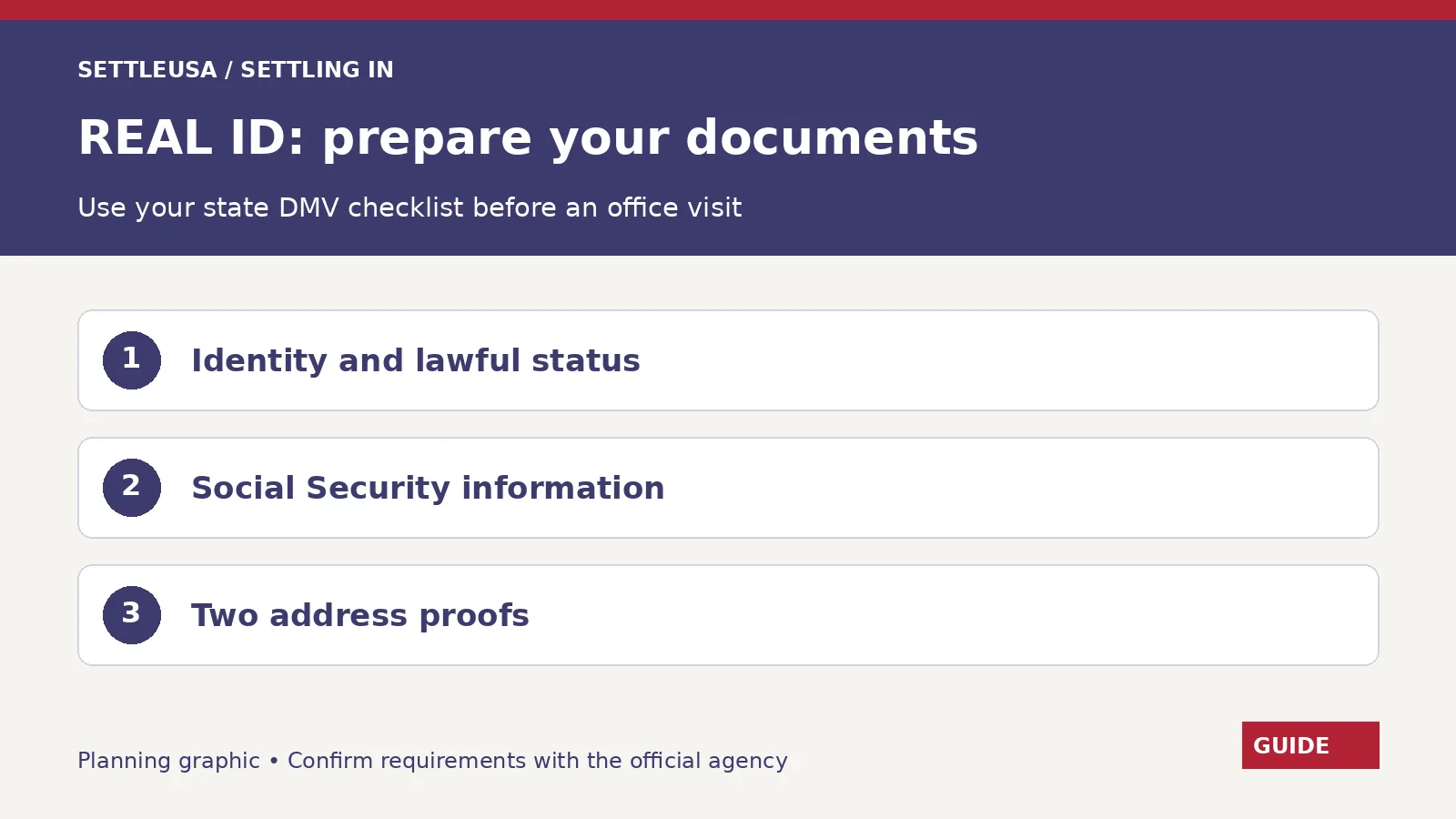
- Proof of your full legal name and date of birth.
- Accepted evidence of identity and lawful status.
- Social Security information, or the state’s documented procedure if you are not eligible for an SSN.
- Two proofs of your principal residence address.
- Name-change records where needed to connect your documents.
This is a preparation list, not a promise that any particular passport, visa, or bill will be accepted. Check the exact combinations, document dates, and original-copy rules in your state. The federal guidance expressly allows additional state requirements.
SettleUSA is an independent guide, not a law firm or government agency. This is general information, not individualized legal or financial advice. Do not send us your SSN or document images. Use your state licensing agency for applications and TSA for airport identification questions.
The REAL ID deadline has passed: what applies now?
REAL ID enforcement began on May 7, 2025. As of November 12, 2026, a noncompliant state license is not accepted as airport identification. You can instead present another TSA-accepted ID, such as a passport. Check TSA’s current identification rules before travel.
The deadline does not mean every resident must buy a REAL ID card. A compliant state card is one way to satisfy the airport identity requirement; another accepted document may serve that purpose. New York explicitly describes REAL ID as optional in its license comparison.
Separate three questions when planning: Is your state license valid for driving? Is your chosen document accepted at airport security? What documents are needed for international travel? A REAL ID upgrade answers the second question; it does not automatically settle the others. Compare the document types.
Which identity and lawful-status documents do newcomers need?
Noncitizens can qualify for REAL ID, but the accepted evidence and card term depend on their status and state process. Oregon lists eligible permanent and temporary categories in its REAL ID FAQs. Ask your licensing agency about your actual documents rather than assuming only US citizens qualify.
California’s checklist includes a valid permanent resident card, a valid employment authorization document, and certain foreign-passport, visa, and I-94 combinations. Those are examples from California, not a national rule that every foreign passport is sufficient. Read California’s identity-document list.
For example, California lists a foreign passport with a valid US visa and approved I-94, with a separate provision for certain freely associated states. Check the exact wording that matches your category. A passport used alone for airport screening is a different question from DMV evidence. California document checklist.
For evidence of identity, date of birth, and lawful status, Oregon requires originals or certified copies rather than electronic images or ordinary photocopies. California also requires you to bring the originals after uploading documents. Oregon evidence rules and California application steps explain their procedures.
If a document is expiring or your immigration paperwork has been extended, ask the DMV which accompanying notices it accepts before making the visit. Do not assume the expiration date printed on one document tells the whole story, and do not alter or annotate an original yourself.
What if you do not have a Social Security card?
The federal guidance lists Social Security information among the requirements and describes alternative evidence, including certain tax forms and pay stubs showing the SSN. Your state’s process controls what you must present. Read the DHS Social Security documentation FAQ.
Oregon says you may provide your SSN verbally and do not need the physical card. It verifies the number and legal name with SSA. Oregon also describes providing proof of SSN ineligibility when applicable. Confirm the equivalent requirement in your own state. Oregon Social Security rules.
Do not enter an ITIN where an agency asks for an SSN or invent a number to complete an online form. If you are not eligible for an SSN, ask the licensing agency how to document that situation. If eligibility is unclear, use our Social Security number guide and contact SSA.
If your documents show different names, resolve the evidence question before visiting. Ask whether a name-change record, an SSA update, or both are needed for your case. This avoids assuming that a marriage document automatically fixes every agency record.
For the separate question of how to get a Social Security number, start with SSA eligibility and the application route for your status. A DMV checklist does not replace that process, and obtaining a state card does not determine SSN eligibility.
Our ITIN number guide explains the IRS tax identifier. For an SSN for immigrants, SSA applies separate eligibility rules. Keep those processes distinct when asking the DMV how to handle an SSN requirement or document ineligibility.
Two address proofs and legal-name changes
Prepare two accepted proofs of your principal residence. Examples may include a lease, utility bill, bank record, or other listed evidence, but the specific rules vary. Use your state’s document list rather than a generic internet checklist. DHS explains the two-proof requirement.
California asks for two different printed documents showing your name and matching mailing address. Its checklist also explains relationship documents when residency evidence is in another person’s name. Newcomers staying with relatives should check those options before assuming they must first obtain two household bills. California residency checklist.
New York requires two residency proofs, does not accept P.O. Box addresses for this purpose, and says residency documents older than one year are not accepted. It also requires evidence connecting legal-name changes. Read New York’s tips to avoid mistakes.
Lay out the identity document, address documents, and name-change evidence together before the appointment. Look for spelling differences, missing apartment numbers, old addresses, or a previous surname. If something does not line up, ask the DMV what evidence bridges the difference. Do not assume staff can overlook it.
How California, New York, and Oregon differ
These examples show why the national checklist is only a starting point. They are not substitute application instructions for residents of other states. Open the relevant state page before booking a visit, especially if your documents involve an address change or limited immigration-document validity.
| State | Useful distinction | Official checklist |
|---|---|---|
| California | Online application and document upload, followed by an office visit with originals; two different printed residency proofs. | California DMV; document checklist |
| New York | Two residency proofs; name-change connections; no additional REAL ID upgrade fee, although normal transaction fees apply. | New York DMV |
| Oregon | SSN can be provided verbally; original REAL ID requires an office visit; $30 REAL ID charge is added to standard fees. | Oregon DMV FAQs |
The fees above illustrate a state difference, not a national price. In Oregon, the additional REAL ID charge applies to original, renewal, and replacement transactions. Check the full fee for your transaction and the type of license or ID you need. Oregon fee explanation.
Before leaving home, confirm the appointment location, accepted payment methods, and whether the office offers the service you need. Keep the official checklist accessible during preparation so you can check items off without depending on a saved social media summary.
How do you recognize the REAL ID star marking?
DHS shows compliant markings in the upper portion of a REAL ID card. The exact design varies: California describes a golden bear and star, while Oregon uses a star inside a black circle. DHS marking examples, California identification guidance, and Oregon card description show the differences.
An Enhanced Driver’s License is an accepted alternative even when it does not have a REAL ID star. DHS explains this exception; New York distinguishes its star-marked REAL ID from its flag-marked Enhanced document. If unsure, ask your state DMV to identify your card type. DHS enhanced-license FAQ.
Do not rely on a state’s general compliance status as proof that your own card is compliant. States can issue standard and REAL ID documents. Check the card you intend to carry, then compare it with the official examples and TSA list.
Can you fly without a REAL ID?
Yes, if you bring another acceptable document. TSA lists US passports and passport cards, foreign government-issued passports, permanent resident cards, employment authorization cards, and other specified IDs. Choose the document that applies to you and review the full TSA accepted-ID list before departure.
A temporary driver’s license is not accepted airport identification. Do not plan to use a DMV paper receipt while waiting for the physical card; bring another accepted ID instead. TSA states the temporary-license rule.
TSA says children under 18 do not need ID for domestic travel, with a specific exception for unaccompanied minors seeking TSA PreCheck screening. Airlines can have their own requirements. Check TSA’s children guidance and the airline before travel.
Keep international travel separate. REAL ID does not replace the documents needed to cross an international border. New York’s comparison distinguishes domestic-flight use from border-crossing use, and Oregon says REAL ID is not a passport. New York comparison and Oregon travel guidance.
No acceptable ID? TSA ConfirmID costs $45
As of November 12, 2026, TSA says travelers without an acceptable ID can pay $45 to use TSA ConfirmID. The program began February 1, 2026. It is an alternative identity-verification process, and payment does not guarantee successful verification or access through security. TSA identification rules.
The fee covers ten days beginning on the travel start date entered for the receipt. It is not a REAL ID card, a state application fee, or a guarantee you can board. Review TSA’s ConfirmID instructions before relying on this option.
- Open the official TSA ConfirmID page and follow its Pay.gov payment link.
- Check the traveler’s legal name and travel start date carefully.
- Keep the payment confirmation email and a printed or electronic receipt.
- Present the receipt at the checkpoint and allow time for identity verification and screening.
TSA says each adult 18 or older without acceptable ID must complete the process separately. If you do not have acceptable ID and choose not to use ConfirmID, you may not be allowed through security. Read the current ConfirmID conditions.
If you have a valid accepted passport with you, you do not need to pay the ConfirmID fee. TSA recommends paying ahead when the service is needed, and says travelers without proof of payment must leave the line to pay and rejoin at the end. TSA ConfirmID FAQs.
What to do before your REAL ID appointment
Choose your state’s official checklist, confirm the exact identity and lawful-status combination, gather two acceptable address proofs, and resolve any name differences. Then follow the state’s application and appointment process. Use the state links above rather than sending documents to a guide website.
If a flight is approaching, check which accepted ID you already have before relying on a new card arriving. Ask the DMV about processing for your transaction and use TSA’s current accepted-ID page for airport planning. A completed DMV application is not itself accepted airport identification. Check TSA’s list.
Keep your appointment confirmation and a document checklist, but avoid putting full SSNs or document images in shared notes. If your case is unusual, take a specific question to the DMV: which evidence is missing, what alternative is allowed, and whether you need to return after an agency record update.
Frequently asked questions
What are the main REAL ID requirements?
Prepare proof of legal name, date of birth, identity and lawful status, Social Security information or the applicable ineligibility procedure, and two address proofs. Your state’s checklist determines the accepted documents and combinations.
What is the REAL ID deadline?
Enforcement began May 7, 2025. A noncompliant state license is no longer accepted as airport identification, but another TSA-accepted document can be used.
Can I fly with a foreign passport instead of REAL ID?
TSA lists foreign government-issued passports as acceptable identification. Check its current list and your airline’s requirements before traveling; international journeys have separate document requirements.
What if I have no REAL ID or other acceptable ID?
TSA offers ConfirmID for a $45 fee, valid for ten days from the travel start date on the receipt. TSA attempts to verify identity, but payment does not guarantee access through security.
Do I need a physical Social Security card for REAL ID?
It depends on your state. Oregon allows the number to be provided verbally and verifies it with SSA; other states have their own proof procedures. Check your state’s current checklist.
Does every accepted state ID need a star?
REAL ID cards have compliant markings, but an Enhanced Driver’s License is an accepted alternative and may not have a star. Ask your DMV if you cannot identify the card type.
Can I use my temporary paper license at TSA?
No. TSA does not accept a temporary driver’s license as identification. Bring another document on its accepted-ID list while waiting for your physical card.
Can a noncitizen get REAL ID?
Eligible noncitizens can qualify, with documents and card terms depending on their status and state process. Ask your licensing agency which evidence it needs for your category.
Official sources
- Department of Homeland Security — REAL ID public FAQsChecked
- Transportation Security Administration — Acceptable identification at the TSA checkpointChecked
- Transportation Security Administration — TSA ConfirmIDChecked
- Transportation Security Administration — TSA ConfirmID FAQsChecked
- California Department of Motor Vehicles — Apply for REAL IDChecked
- California Department of Motor Vehicles — REAL ID checklistChecked
- New York Department of Motor Vehicles — Enhanced or REAL IDChecked
- Oregon Driver and Motor Vehicle Services — Oregon REAL ID FAQsChecked
Source review: complete. Last checked .
Independent guide, not affiliated with SSA, VA, USDA or any government agency. Not financial or legal advice. Confirm your circumstances with the responsible agency or service.