
How to get rid of a mattress: 8 legal options
What is the best way to get rid of an old mattress?
Check city bulk collection and mattress recycling first, then ask your retailer about take-back if you are buying a replacement. For a usable mattress, confirm a donation or direct handoff. Book an accepted route before moving it outside, and check local fees, wrapping requirements and collection instructions.
Published · Updated
As of November 12, 2026, mattress disposal depends on your location, collection provider and the mattress’s condition. Use these eight options to find an accepted route, then confirm the local details before moving it. SettleUSA is an independent guide.
In this guide
- How to get rid of a mattress: choose your route
- 1. Check city bulk pickup for mattress disposal
- 2. Use a state mattress recycling program
- 3. Ask about a mattress recycler outside those programs
- 4. Arrange retailer haul-away when buying new
- 5. Check whether a charity accepts used mattresses
- 6. Arrange a direct handoff for a usable mattress
- 7. Compare private junk removal services
- 8. Confirm landfill or transfer station acceptance
- Bagging, bed bugs and illegal dumping penalties
- Frequently asked questions
- Official sources
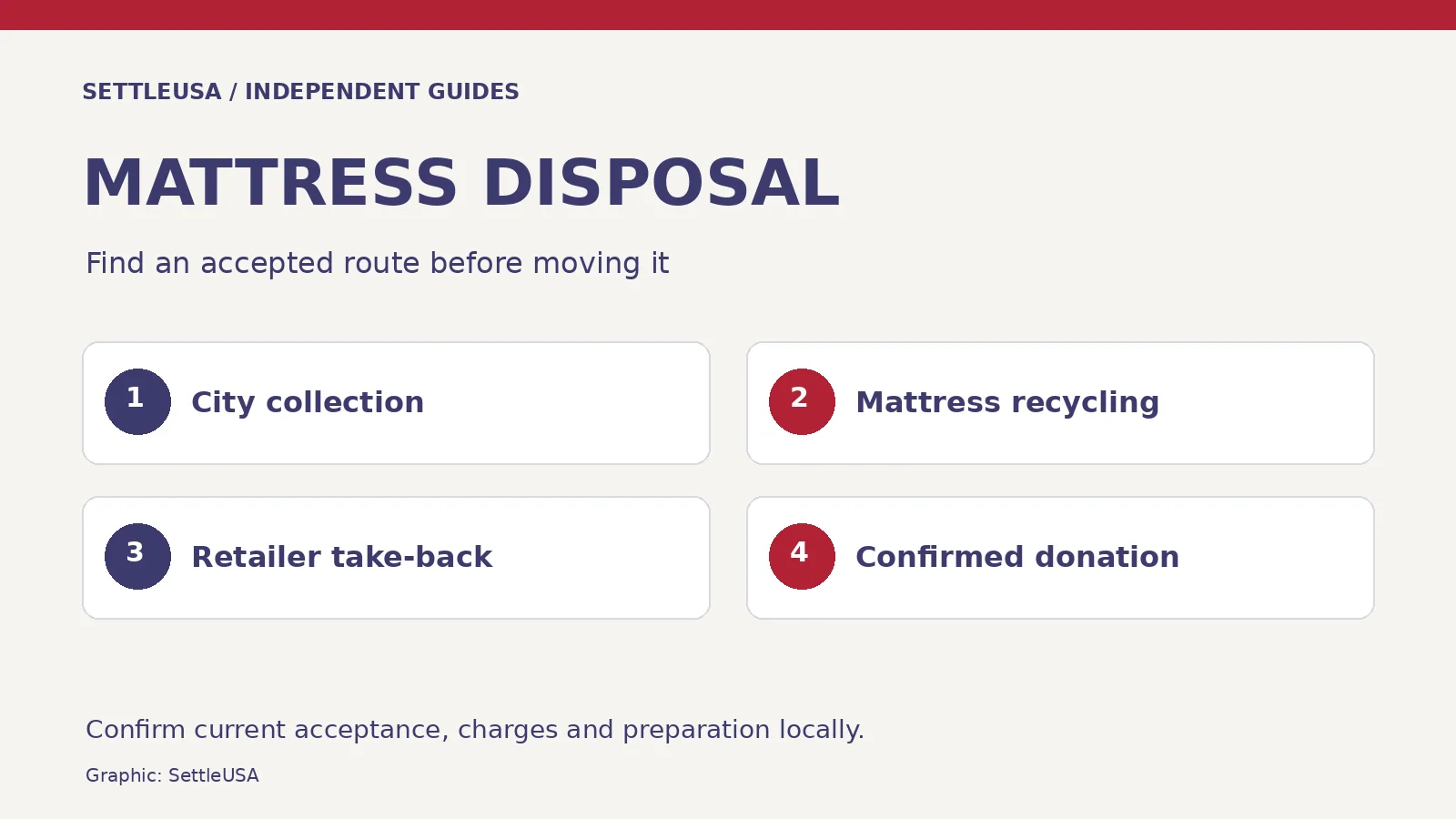
How to get rid of a mattress: choose your route
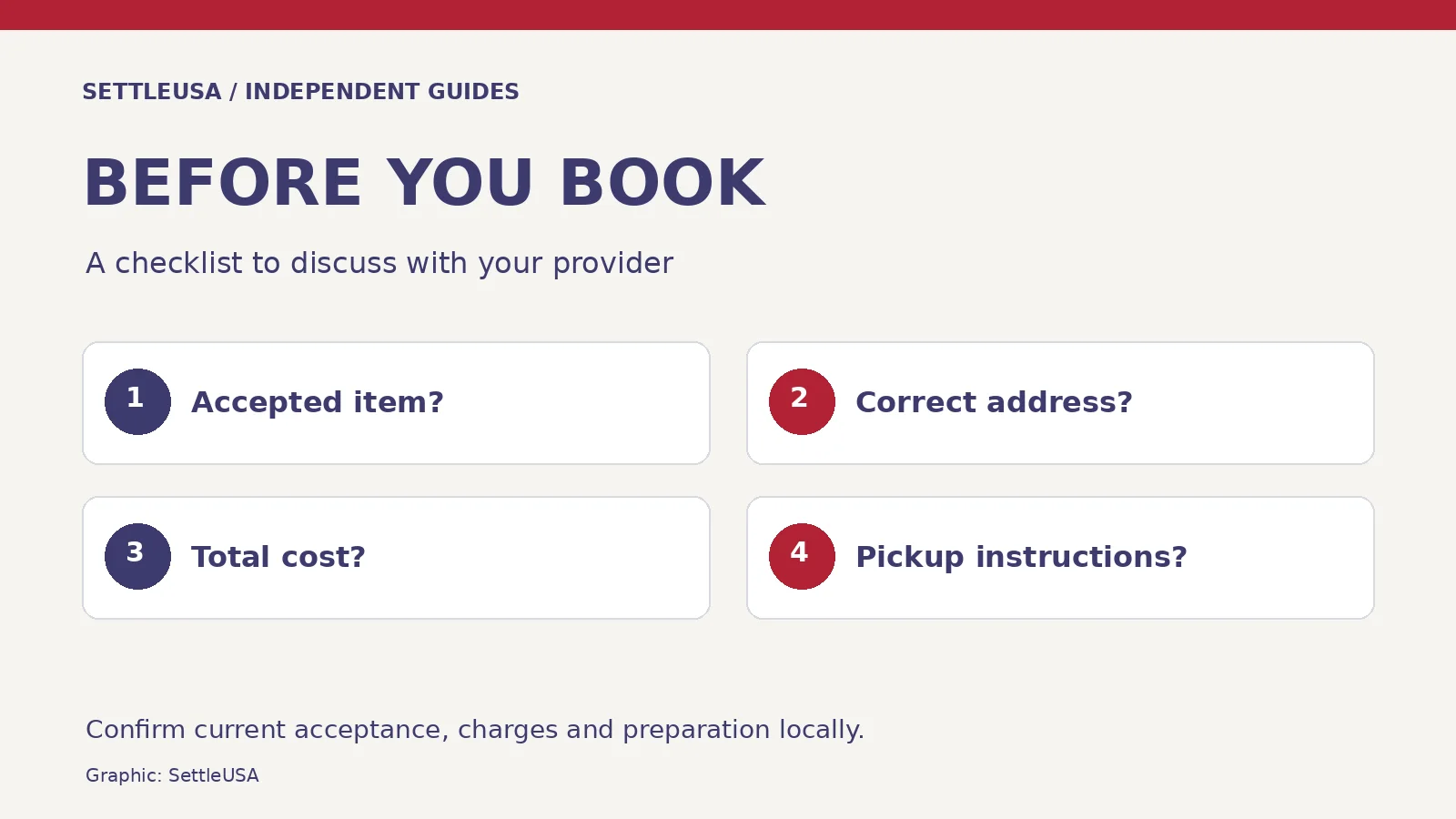
Before moving the mattress, write down its size, condition and location. Include the box spring and bed frame if those also need to go. Ask each provider how it counts those pieces, whether it accepts your address and whether you must carry everything outside.
This guide offers eight routes to check, rather than eight services available everywhere. A recycling location, charity or collector must agree to accept your mattress. Keep it on your property until you have confirmed the handoff and any local set-out instructions.
If your mattress is still usable, consider an agreed reuse arrangement. If it is damaged, ask about recycling before disposal. EPA’s waste reduction guidance encourages donation of usable goods; it does not guarantee that an organization will accept bedding.
For a move-out, start with the date the mattress must leave. Work backward to a confirmed appointment, then keep a backup option. Do not book a new delivery on the assumption that the delivery team will automatically remove your old bed.
1. Check city bulk pickup for mattress disposal
Look up your address through the bulk trash guides. Read the accepted-items list, service eligibility, booking process and set-out rules. A mattress listed as accepted does not tell you whether the service includes your building, what it costs or when to put it out.
For example, Los Angeles Sanitation’s bulky pickup page lists mattresses and box springs and requires advance notice. Our Los Angeles guide helps you find the local process. Confirm that LASAN is the provider for your property before using its service.
Compare the Phoenix, Dallas and Washington, DC guides if you live there. Use the official city instructions linked in your guide. A nearby city’s rules are not permission to place a mattress at your curb.
If you rent an apartment, ask the manager who handles bulky waste and where to keep the mattress before removal. Ask whether they book collection or expect you to arrange it. Get a specific answer before using a communal trash room or moving the mattress into a hallway.
2. Use a state mattress recycling program
As of November 12, 2026, Bye Bye Mattress covers California, Connecticut, Oregon and Rhode Island. It is operated by the nonprofit Mattress Recycling Council, under state mattress stewardship laws. Start with its location directory and confirm the receiving site’s current instructions.
California’s CalRecycle mattress program page confirms state oversight and MRC’s role. For local options, use California’s Bye Bye Mattress page. Participating drop-off locations accept eligible mattresses at no additional cost; check acceptance before transporting yours.
Connecticut’s DEEP mattress recycling page explains the stewardship law and links the locator. It warns that some towns may not participate. Use Connecticut’s program page and contact your local recycling coordinator if you cannot find a suitable location.
Rhode Island’s mattress stewardship law provides for a statewide plan and funding structure. Use Rhode Island’s Bye Bye Mattress page for consumer options. Oregon DEQ confirms that Oregon’s program began January 1, 2025, so the program is no longer limited to the original three states.
A program collection site is different from a truck coming to your home. Ask whether the site accepts residents from your area, your mattress type and your item’s condition. Confirm hours, any booking requirement and whether a box spring must be listed separately.
3. Ask about a mattress recycler outside those programs
If you are outside a Bye Bye Mattress state, ask your city or county recycling office for a mattress-specific facility. Do not assume that a recycling center taking cardboard or metal will accept a whole mattress. Describe whether yours is foam, spring, hybrid or another type.
Connecticut DEEP’s recycling explanation distinguishes reuse from material recovery: recycling separates components such as steel, foam and wood. Ask the receiving facility whether it dismantles mattresses or sends them to another processor. That question helps clarify what its recycling service actually includes.
Before paying, request the drop-off address, acceptance conditions and total charge. If pickup is offered, ask whether the price includes moving the mattress out of the home. Keep the facility’s confirmation with your travel or collection plan, especially if you have arranged a borrowed truck.
4. Arrange retailer haul-away when buying new
Ask about removal before placing your new mattress order. Tell the retailer whether there is a box spring, stairs or a long carry. Check whether the service includes removal from the bedroom, collection at the door or curbside only. Put the agreed scope on the order.
California has a specific rule: Bye Bye Mattress’s California guidance says a retailer delivering a mattress must offer old-mattress take-back at no additional cost. Delivery or setup charges may still apply, and the retailer may refuse an item that presents a health or safety risk.
The same guidance allows the retailer up to 30 days for take-back. Confirm the actual removal date instead of assuming it will be delivery day. Outside California, check the retailer’s current terms; this guide does not establish a nationwide right to free haul-away.
If the old mattress has a condition issue, disclose it before delivery. Ask what happens if the crew refuses it and whether any removal charge is refundable. Have that conversation while you can still arrange another route, rather than while the new bed is blocking the room.
5. Check whether a charity accepts used mattresses
Ask the specific charity or reuse organization before offering a mattress. Do not assume that furniture acceptance includes bedding: used mattresses may be refused. Send clear photos and describe age, stains, damage and any pest concern. Ask about the box spring separately.
The Connecticut DEEP page says donated mattresses should be clean and in good condition, and describes licensing requirements for reuse businesses there. Those rules are a reminder to check local acceptance, not a promise that a charity elsewhere can accept your bed.
If an organization agrees to take it, confirm whether it collects or requires delivery, where the handoff happens and what inspection is required. Keep an alternative plan if final acceptance depends on seeing the mattress. Do not leave bedding outside a closed donation center.
6. Arrange a direct handoff for a usable mattress
For an item suitable for reuse, consider asking someone you know whether they want it. EPA lists selling and donating unwanted goods as waste reduction options. For mattresses, ask your local consumer protection or recycling office about any applicable reuse restrictions before arranging a public sale.
Be clear about condition and dimensions. Agree who supplies transport, who carries it and when ownership changes hands. A person expressing interest is not a confirmed collection. Keep the mattress indoors or otherwise protected while you settle the details.
Do not offer an infested mattress as usable furniture. EPA’s bed bug guidance says to discard furniture responsibly when pests cannot safely be eliminated and prevent someone else from taking it home. Ask your collector how to prepare and identify an affected item.
7. Compare private junk removal services
Private removal is an option to investigate if you need help carrying the mattress or cannot match a city collection date. Ask each company to quote for the exact items and access. Do not treat an online starting price as your confirmed bill.
Ask whether stairs, long carries, box springs, bed frames, disposal and recycling charges are included. Explain any infestation before booking and ask whether the company can accept the job. Request a written total or a clear explanation of how the final price will be calculated.
Ask where the mattress will go and whether you can receive a receipt. A promise to remove it from your home does not by itself explain its destination. If a company cannot describe an accepted disposal or recycling route, keep looking before handing over the item.
8. Confirm landfill or transfer station acceptance
Call the receiving facility before loading your mattress. Ask whether it accepts mattresses from your address, whether recycling is available and what condition it will accept. Ask for the current fee and payment methods; this guide does not quote a national landfill price.
Check with the facility about local disposal restrictions too. Ask whether mattresses must be separated from other waste and whether a box spring attracts a separate charge. If you are using a rental or commercial vehicle, confirm any documentation requirements before traveling.
Write down the destination and instructions for the person driving. Plan unloading assistance and secure transport appropriate to the vehicle. Do not cut apart the mattress just to make it fit: first ask the receiving site whether it needs the item intact for its process.
Bagging, bed bugs and illegal dumping penalties
Bagging rules are local. Washington, DC DPW requires plastic wrapping for mattresses and box springs. New York City Sanitation requires sealed plastic bags to limit bed bug spread and warns that incorrect mattress or box spring disposal can bring a fine of up to $300.
That NYC amount is a local preparation penalty, not a national dumping fine. Dallas Sanitation warns that early or noncompliant bulky set-outs can lead to citations as well as collection charges. Confirm your city’s rules instead of assuming a “free” sign makes a curbside mattress legal.
For suspected bed bugs, tell the collector before moving the item. Follow its wrapping instructions and EPA’s responsible-discarding advice. Keep a pest-related collection separate from any donation inquiry. Do not hide the condition from a recycler or removal crew.
Before set-out, save the booking details, photograph the prepared item and check the collection point. If it is missed, contact the provider with the request reference. Ask whether to bring it back onto your property while the problem is resolved; do not leave it indefinitely in public space.
Frequently asked questions
Is mattress disposal free everywhere?
No. Check your city, retailer or receiving facility for current eligibility and charges. No-cost recycling drop-off at a participating program site does not necessarily include transport from your home.
Where should I look for mattress recycling?
Start with Bye Bye Mattress in California, Connecticut, Oregon and Rhode Island. Elsewhere, ask your city or county recycling office for mattress-specific options and confirm acceptance before traveling.
Can I put a mattress out with regular trash?
Check your local rules first. A mattress may require a bulky-item booking, a particular collection day and plastic wrapping. Do not assume that your normal trash pickup covers it.
Does a charity have to accept my used mattress?
No. Check the individual organization’s bedding policy and condition requirements before arranging collection or delivery. Do not leave an unaccepted mattress at a donation center.
How do I get rid of furniture and a mattress together?
Give the collector an itemized list, including the bed frame and box spring. Ask how each piece is counted and whether different preparation or collection routes apply.
Can junk removal services collect a mattress with bed bugs?
Check with the specific service and disclose the infestation before booking. Ask about acceptance, wrapping, identification and any extra charge; do not offer the mattress for reuse.
Is Dallas bulk trash pickup an option for mattresses?
Dallas lists mattresses among accepted bulky household items. Check the city’s current schedule and set-out instructions for your address; early or noncompliant placement can lead to charges or citations.
Official sources
- EPA — What You Can DoChecked
- Connecticut DEEP — Mattress Recycling and stewardship lawChecked
- CalRecycle — Mattress Product ManagementChecked
- Rhode Island General Assembly — R.I. Gen. Laws § 23-90-5: Mattress stewardship planChecked
- Oregon DEQ — Mattress Stewardship ProgramChecked
- Mattress Recycling Council — Bye Bye Mattress program statesChecked
- Mattress Recycling Council — Mattress Disposal in CaliforniaChecked
- Mattress Recycling Council — Mattress Disposal in ConnecticutChecked
- Mattress Recycling Council — Mattress Disposal in Rhode IslandChecked
- NYC Department of Sanitation — Furniture, Mattresses, and RugsChecked
- DC DPW — Bulk Trash CollectionChecked
- Dallas Sanitation Services — Brush and Bulky Item CollectionChecked
- Los Angeles Sanitation and Environment — Schedule a Bulky Item PickupChecked
- EPA — Do-it-yourself Bed Bug ControlChecked
Source review: complete. Last checked .
Independent guide, not affiliated with SSA, VA, USDA or any government agency. Not financial or legal advice. Confirm your circumstances with the responsible agency or service.