
Miami, FL bulky trash pickup: schedule, booking and rules
How does City of Miami bulky trash pickup work?
The City of Miami publishes weekly residential bulky trash collection, with the day found through its official address search. Set non-vegetative bulky items out the evening before, no later than 6 a.m. on service day. Confirm city service first: Miami-Dade County’s booked bulky waste program has different eligibility and rules.
Published · Updated
At a glance
- Schedule
- Weekly residential bulky route; use the city’s address lookup.
- Limits
- Clean vegetation: 100 cubic feet maximum; ask about oversized household items.
- Fees
- No separate city bulk-pickup price verified; confirm charges for special arrangements.
- How to book
- Regular route uses an address lookup; call 311 or Solid Waste at 305-960-2801 for help.
- Last verified
- November 12, 2026
- Source
- Department of Solid Waste (city website)
As of November 12, 2026, this independent guide explains City of Miami bulky trash service. It separates the city’s weekly route from Miami-Dade County bookings and shows where to check preparation, Mini Dump access and household chemical disposal.
In this guide
- City of Miami or Miami-Dade County: which rules apply?
- Miami bulk pickup schedule: find your weekly day
- What City of Miami bulky trash accepts and excludes
- Set-out times: bulky items and clean yard trash differ
- City bulky trash limits, fees and enforcement
- How to arrange Miami bulk pickup step by step
- Missed bulky pickup and illegal dumping reports
- Mini Dump access and recycling Miami alternatives
- Hazardous waste disposal Miami: use chemical collection
- Frequently asked questions
- Official sources
SettleUSA does not take bookings or payments.
City of Miami or Miami-Dade County: which rules apply?
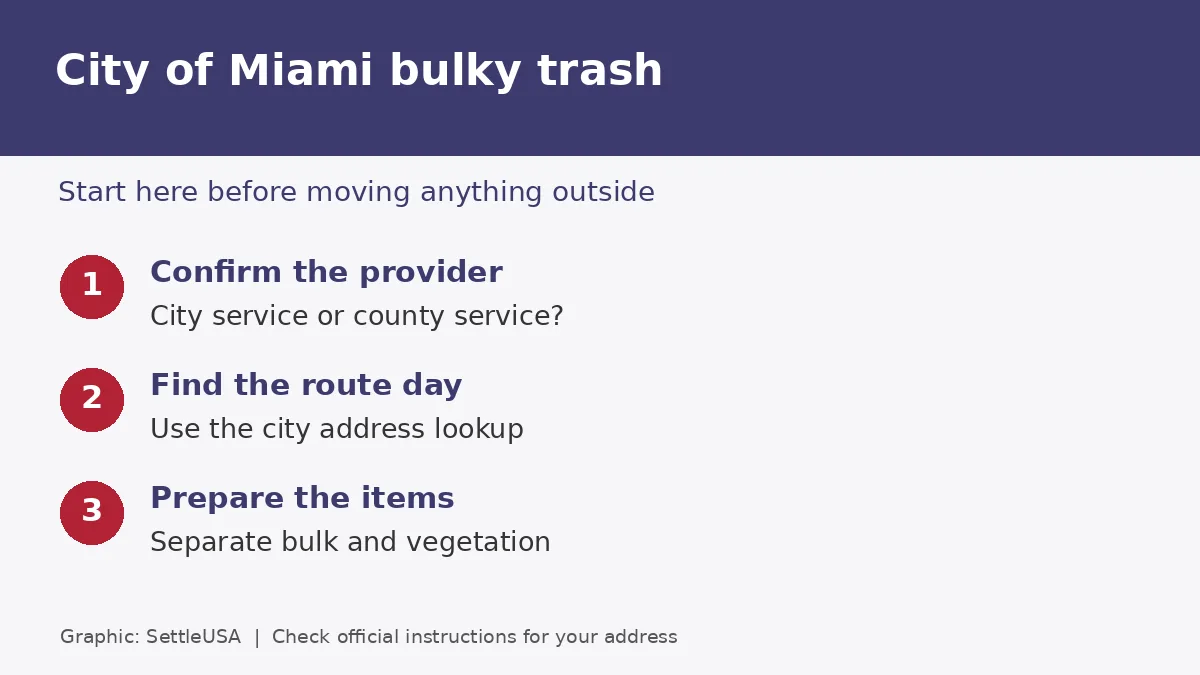
Start with the City of Miami address lookup and your property’s waste arrangements. The City of Miami Department of Solid Waste runs the service described here. Do not select a program solely because an address includes “Miami” or because a search result mentions the county.
The city department page directs businesses and properties with four or more units to city-approved commercial haulers. If you live in an apartment, condominium or HOA with shared service, ask the manager who handles bulky removal. Confirm whether the property receives the city residential route before setting furniture out.
Searching for bulk trash pickup Miami-Dade leads to a separate county appointment service. That page gives eligible county waste households two annual pickups of up to 25 cubic yards each. Those county allowances and booking instructions are not the City of Miami weekly bulky rules.
If your address does not appear in the city search, contact Solid Waste rather than choosing the nearest street. For an address served by another municipality or private hauler, obtain that provider’s schedule and item requirements. This guide does not infer service from a neighborhood name.
Miami bulk pickup schedule: find your weekly day
The official schedule page states that City of Miami residential bulky trash is collected once a week. Enter the full address and select the matching suggestion. Look specifically for the bulky result; garbage and recycling schedules are separate services.
The city describes an established route rather than a county-style appointment for every standard bulky pile. Use the confirmed address result to plan. If a load is unusual or you need a special arrangement, ask the department before treating it as part of normal service.
The schedule page says bulky service falling on Christmas Day or Martin Luther King Jr. Day moves to the next scheduled pickup day in that area. It does not promise next-day collection. Check the city’s current alerts, particularly when planning around a holiday or disruption.
Keep a screenshot or written record of the address result and review it again before a major cleanout. A neighbor’s usual day is useful as a prompt to check, but it is not confirmation of the service assigned to your own property.
What City of Miami bulky trash accepts and excludes
The city’s bulky trash do’s and don’ts list furniture, household electronics, white goods and clean yard trash as accepted categories. Their examples and exclusions are more useful than treating every object too large for a cart as automatically eligible.
| Item | Collection rule |
|---|---|
| Household furniture and mattresses | Accepted examples include bed frames, dressers, tables, chairs, sofas and mattresses. |
| Household electronics | Accepted examples include TVs, computer equipment and small kitchen appliances. |
| White goods and appliances | Refrigerators, stoves, microwaves and dishwashers are listed; confirm preparation for refrigerant equipment. |
| Clean yard trash | Tree cuttings and trimmings accepted subject to preparation and volume rules; keep separate from garbage and recyclables. |
| Food and household garbage | Not bulky trash; use the appropriate regular garbage service. |
| Construction and remodeling debris | Not accepted, including drywall, roofing, tiles, carpeting, toilets and kitchen cabinets. |
| Hazardous waste and paint-related material | Not accepted, including chemicals, gas cylinders, batteries, paint containers and painting equipment. |
| Automobile parts and tires | Not accepted; the city also excludes auto glass, vehicle batteries, oil and other vehicle parts. |
The exclusions matter during a move or renovation. A dresser and a removed kitchen cabinet may look similar at the curb but appear in different city categories. Separate the load before asking for collection rather than assuming a furniture label covers building fixtures.
Set-out times: bulky items and clean yard trash differ
The department’s residential guidelines allow non-vegetative bulky trash out from the evening before collection, with a deadline of 6 a.m. on service day. Clean vegetative waste may be placed out up to two days before service. Do not apply that longer vegetation window to a sofa.
The schedule page says to place material in front of the resident’s property and keep yard trash separate from garbage and recyclables. It also publishes a bundle rule of no more than 3 feet in length and 50 pounds in weight.
That page uses broad wording about bundling “all items,” while the accepted list explicitly includes full-sized furniture and appliances. Confirm preparation for an oversized object with Solid Waste; do not interpret the wording as permission to cut up refrigerant equipment or as a complete ban on the listed furniture.
Ask where the pile should sit if trees, parked cars, overhead equipment or a shared frontage make access difficult. Keep the item list and address ready. A rule written for cart placement should not be assumed to establish the clearance for mechanical bulky collection.
City bulky trash limits, fees and enforcement
The city department page limits clean vegetation to 100 cubic feet, approximately a pile 5 feet by 5 feet by 4 feet. It says vegetation from trimming or cutting trees above that volume must not be left in the public right-of-way.
The reviewed city pages did not establish a universal annual pickup allowance or a separate price for an ordinary residential bulky stop. They also did not give a clear total household-furniture pile limit. Ask Solid Waste about an unusually large cleanout or any special charge before making arrangements.
Do not transfer the county’s two-pickup, 25-cubic-yard allowance to a city-serviced home. Conversely, do not assume a county-serviced address has the city’s weekly entitlement. Confirm the account and provider before comparing disposal options.
The city warns that illegal dumping can lead to fines or possible jail time. This guide does not assert a specific fine amount. Use the department’s disposal guidance and contact the city about a questionable load instead of leaving excluded material at the curb.
How to arrange Miami bulk pickup step by step
- Open the city collection schedule page and enter your full service address.
- Select the matching address suggestion and note the bulky trash collection day.
- Check the accepted-item list, separate vegetation and exclude chemicals, auto parts and renovation debris.
- For an oversized appliance, unclear limit or shared property, call Solid Waste at 305-960-2801 or 311 before setting anything out.
- Prepare the load as confirmed. Place non-vegetative bulk out the evening before, by 6 a.m. on service day; follow the separate clean-vegetation window if applicable.
- Review service alerts and retain the address result and any instructions received.
This is a route-checking process for ordinary city service. If you are actually a county waste customer, use the Miami-Dade appointment system instead and obtain a confirmed booking before setting a county pile out. Ask which agency handles the address if you are unsure.
Missed bulky pickup and illegal dumping reports
For a city bulky collection problem, contact Solid Waste at 305-960-2801 or 311, the contacts published on the schedule page. Give the service address, expected date and a description of the material. Ask whether the stop was missed, delayed or rejected.
Photograph the load and keep any instructions received. Ask whether it should remain out and what action to take next. A specific bulk missed-report cutoff or guaranteed return time was not confirmed, so do not assume the procedure for a garbage-cart miss covers every bulky case.
The city also takes illegal-dumping reports through 311 and its online report link. Distinguish material dumped by another person from your own scheduled pile. Describe the location accurately and avoid moving unidentified containers while trying to make the area presentable.
Mini Dump access and recycling Miami alternatives
The City of Miami Mini Dump at 1290 NW 20th Street accepts residents’ bulky items and yard trash. Published hours are Monday–Friday, 8 a.m.–4 p.m., and Saturday, 8 a.m.–noon. It closes Sundays, Martin Luther King Jr. Day and Christmas Day.
Bring one proof of City of Miami residency, such as a Florida license or ID, qualifying utility statements, rental agreement or tax bill. The city allows one trip per day, no larger than a pickup-truck load. Verify unusual materials before loading the vehicle.
The facility excludes commercial-marked vehicles, dump-type and panel-type trucks, commercial trucks or vans, and contractor material. These restrictions still matter when a resident is doing the driving. Call 311 about vehicle eligibility rather than assuming a rented or borrowed commercial vehicle will qualify.
Consider an arranged donation for usable household items before disposal. Send photographs, describe condition and confirm transport with the recipient. The city also recommends donating usable paint to neighbors or community groups; keep paint out of the bulky pile and use chemical disposal if it cannot be reused.
Hazardous waste disposal Miami: use chemical collection
The city’s chemical disposal page directs non-commercial residents to Miami-Dade Home Chemical Collection Centers for oil-based paint, pesticides, solvents, pool chemicals and liquid latex paint. This city referral is separate from the county’s curbside bulky waste eligibility.
Call 305-468-5900 for the closest center’s hours and location. Pack containers upright in sturdy boxes, secure the lids and label the contents. The city says to place a leaking container in a larger container with absorbent material. Never combine products to reduce the number of containers.
Commercial waste is not accepted through that household chemical route. Check uncertain materials before traveling, including anything without an identifiable label. For a mixed cleanout, keep the chemical boxes separate while you decide what goes to donation, bulky collection or an approved drop-off facility.
Frequently asked questions
Is Miami bulky trash pickup weekly?
The City of Miami’s schedule page publishes weekly residential bulky service. Use its address search for the actual day and check current service alerts.
Do I need to book City of Miami bulky trash?
The city describes regular weekly route service. Use the address lookup and contact Solid Waste for special or unclear loads. Miami-Dade County customers use a separate appointment program.
When should I set out a sofa?
For city service, non-vegetative bulky items may go out the evening before collection and must be out by 6 a.m. on service day. The longer clean-vegetation window does not apply to a sofa.
Does bulk trash pickup Miami-Dade use the same allowance?
No. The county publishes a separate booked service for its eligible waste households, with two annual pickups of up to 25 cubic yards each. Do not apply that allowance to City of Miami weekly routes.
Can I put a TV or refrigerator in City of Miami bulk?
The city lists household electronics and white goods, including TVs and refrigerators, as accepted categories. Confirm preparation for a large or refrigerant-containing appliance before set-out.
Can I leave tires or remodeling debris in the pile?
No. The city’s bulky list excludes auto parts and tires, construction and demolition debris, paint-related material and hazardous waste. Arrange an approved alternative.
What do I need for the Miami Mini Dump?
Bring proof of City of Miami residency and use an eligible vehicle. The published limit is one pickup-truck-sized load per day; commercial vehicles and contractor material are excluded.
Where can I take household paint and chemicals?
The city refers non-commercial residents to Miami-Dade Home Chemical Collection Centers. Call 305-468-5900 to confirm the receiving location, hours and acceptance before traveling.
Official sources
- City of Miami Department of Solid Waste — Solid Waste — service eligibility and residential guidelinesChecked
- City of Miami Department of Solid Waste — View Garbage Pickup, Recycling, and Bulky Trash SchedulesChecked
- City of Miami Department of Solid Waste — About Mini Dump and Bulky TrashChecked
- City of Miami Department of Solid Waste — Dispose of Hazardous Materials & ChemicalsChecked
- Miami-Dade County Department of Solid Waste Management — Bulky Waste Pickup — separate county serviceChecked
Source review: complete. Last checked .
Independent guide, not affiliated with SSA, VA, USDA or any government agency. Not financial or legal advice. Confirm your circumstances with the responsible agency or service.