
SSI payment schedule 2027
When will SSI payments arrive in 2027?
SSI normally arrives on the first, moving to the preceding business day for weekends and federal holidays. January 2027 is scheduled for December 31, 2026; May for April 30; and August for July 30. January 2028 SSI is scheduled for December 30, 2027, because December 31 is the observed New Year’s holiday.
Published · Updated
At a glance
- Federal individual maximum
- $1,029 monthly in 2027
- Federal eligible-couple maximum
- $1,544 combined monthly in 2027
- COLA
- 3.6% for 2027
- Two-deposit months
- April, July and December
- January 2028 deposit
- December 30, 2027
As of November 12, 2026, SSA has published its 2027 payment calendar and federal SSI amounts. Use the benefit-month table below to identify early deposits and avoid counting them as extra money. SettleUSA is an independent guide, not SSA.
In this guide
- SSI payment schedule 2027: all 12 benefit months
- Why do some SSI payments arrive in the previous month?
- January 2028 SSI: December 30, not December 31
- Which months have two SSI payments or no deposit?
- SSI COLA 2027: exact federal monthly payment amounts
- State supplements can change your total SSI payment
- SSI and Social Security payments: the first and the third
- How to report income and changes while receiving SSI
- Direct Express and direct deposit for SSI payment 2027
- What if an SSI payment does not arrive?
- Keep your payment plan and personal details safe
- Frequently asked questions
- Official sources
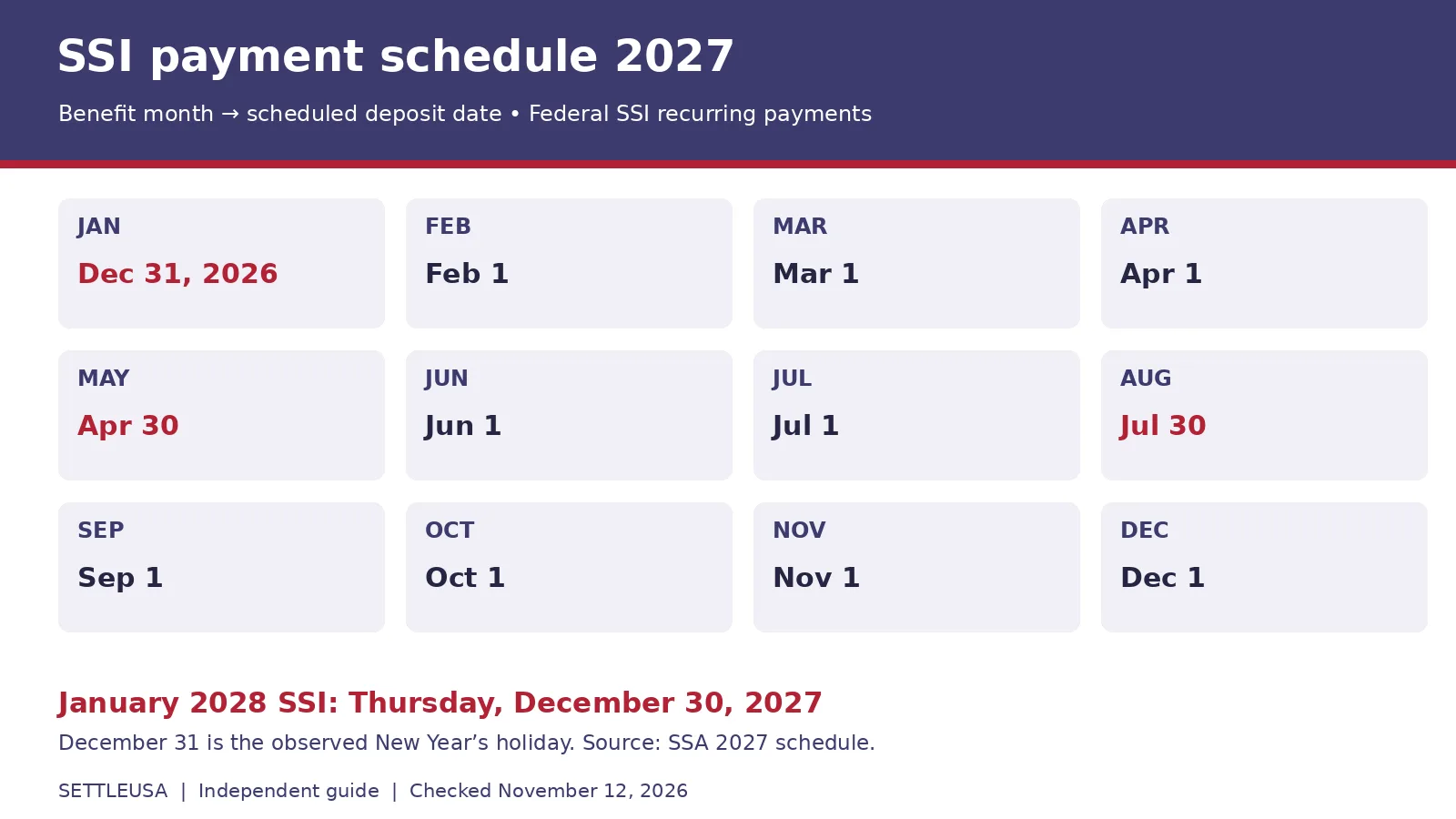
SSI payment schedule 2027: all 12 benefit months
These are the regular federal SSI payment dates for each 2027 benefit month, checked November 12, 2026. The January payment falls in 2026; the remaining rows identify the deposit belonging to each month. Source: SSA’s 2027 schedule and the year-end entry in its 2026 schedule.
| Benefit month | Scheduled payment date | Reason for any shift |
|---|---|---|
| January | Thursday, December 31, 2026 | January 1 is New Year’s Day |
| February | Monday, February 1, 2027 | No shift |
| March | Monday, March 1, 2027 | No shift |
| April | Thursday, April 1, 2027 | No shift |
| May | Friday, April 30, 2027 | May 1 is Saturday |
| June | Tuesday, June 1, 2027 | No shift |
| July | Thursday, July 1, 2027 | No shift |
| August | Friday, July 30, 2027 | August 1 is Sunday |
| September | Wednesday, September 1, 2027 | No shift |
| October | Friday, October 1, 2027 | No shift |
| November | Monday, November 1, 2027 | No shift |
| December | Wednesday, December 1, 2027 | No shift |
Choose the benefit month first, then read across to the deposit date. If you are looking at a bank statement instead, start with the date and label the month it covers. This prevents an early installment from being mistaken for a new award, a bonus or a missing payment later.
This table describes recurring federal SSI. It does not establish your eligibility, approval date or a first payment after a new application. For an individual case, compare the table with your SSA award notice and ask SSA to explain anything that does not match.
Why do some SSI payments arrive in the previous month?
SSI normally pays on the first day of the benefit month. If that day is a weekend or federal holiday, SSA pays on the last business day beforehand. SSA explains the early-payment rule and says the second payment is not a duplicate.
The first of May 2027 is Saturday, so May’s payment is scheduled in April. The first of August is Sunday, putting August’s payment in July. January’s shift crosses the calendar year. These changes come from the payment rule, rather than an extra entitlement for recipients.
When you plan bills, write “for May” or “for August” beside an early deposit. Keep that money connected to the coming month’s expenses in your own worksheet. A bank statement is organized by transaction date; your spending plan can also show the month the benefit is intended to cover.
An early SSI installment changes when you receive a benefit. It does not create another month of benefits. If the scheduled payment arrives at the end of the preceding month, do not expect the same regular installment again on the first.
January 2028 SSI: December 30, not December 31
The SSA 2027 calendar places the SSI payment for January 2028 on Thursday, December 30, 2027. This is separate from the December 2027 benefit, which is scheduled for December 1.
January 1, 2028 is Saturday. OPM’s 2028 holiday schedule lists Friday, December 31 as the observed New Year’s holiday. The preceding business day is therefore Thursday, December 30. Stopping at “the Friday before” would miss the observed holiday.
For year-end planning, label the December 30 entry “January 2028 SSI.” Do not attach a 2028 benefit amount to it using a 2027 rate table. This guide verifies the scheduled date; it does not forecast a 2028 COLA or federal SSI maximum.
This distinction matters if you save a copy of the calendar for later. The date belongs in your December transaction list, while the benefit belongs in your January plan. Re-check SSA’s schedule and your own notice before making year-end arrangements.
Which months have two SSI payments or no deposit?
Counting the regular scheduled deposits that fall within each calendar month gives the pattern below. The count is derived from SSA’s dates, not from the number of benefit months you are entitled to. An individual adjustment or retroactive payment could appear separately.
| Calendar month | Regular SSI deposits | What the count means |
|---|---|---|
| January | Zero | January benefit is scheduled December 31, 2026 |
| April | Two: April 1 and April 30 | April benefit, then May benefit |
| May | Zero | May benefit is scheduled April 30 |
| July | Two: July 1 and July 30 | July benefit, then August benefit |
| August | Zero | August benefit is scheduled July 30 |
| December | Two: December 1 and December 30 | December benefit, then January 2028 benefit |
| February, March, June, September, October, November | One each | Regular first-of-month benefit |
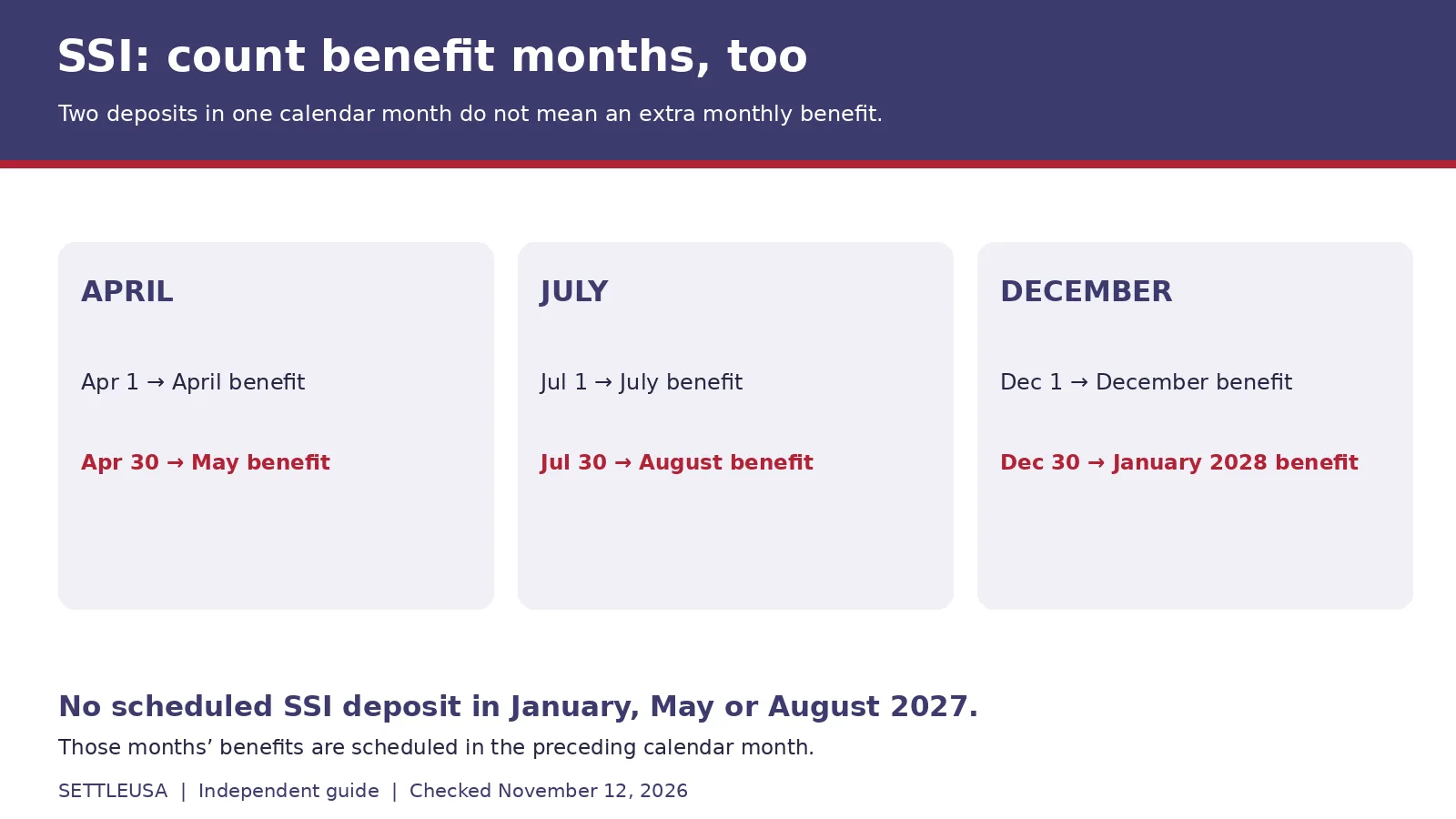
For a payment that follows this schedule, a month with no deposit is not itself evidence that SSI has stopped. Check whether its benefit was paid early. If the expected early deposit is missing too, follow the missing-payment steps below rather than assuming the calendar explains the problem.
SSI COLA 2027: exact federal monthly payment amounts
SSA’s 2027 COLA fact sheet confirms a 3.6% increase. Its SSI federal payment amounts page lists these monthly maximums effective January 2027. They are the published rates, rather than estimates calculated from rounded prior-year monthly figures.
| Recipient category | Monthly federal maximum |
|---|---|
| Eligible individual | $1,029 |
| Eligible individual with an eligible spouse | $1,544 combined |
The eligible-couple figure is a combined maximum, not an amount for each spouse. SSA calculates annual unrounded amounts, divides by twelve and rounds down to the next dollar. Use the agency’s exact figures if you are comparing an award notice with a rate chart.
Your actual federal SSI can be lower because SSA subtracts countable income. A maximum-rate table cannot tell you how much you personally qualify for. Check the benefit calculation in your notice and ask SSA about the income or living-arrangement information used in it.
If you see a change in the bank deposit, compare it with your own notice instead of applying 3.6% to every payment you received previously. Keep payment-date questions separate from amount questions. The Social Security COLA 2027 guide covers the wider adjustment.
State supplements can change your total SSI payment
Some states add money to federal SSI. SSA’s state-supplement guidance explains that administration varies: SSA handles some supplements, states handle others, and some categories have dual administration. Amounts also depend on factors such as income and living arrangements.
Do not treat the federal maximum as a guaranteed total including every state payment. If you receive a separate state supplement, ask the administering state agency about that payment’s amount and schedule. The federal calendar here does not independently verify a state’s separate deposit date.
For your records, keep the federal SSI notice and any state notice together. If the combined total changes, identify which part changed before contacting an office. This makes it easier to ask the right agency about the specific payment you are checking.
SSI and Social Security payments: the first and the third
If you receive both SSI and Social Security, SSA’s schedule legend puts Social Security on the third and SSI on the first, subject to payment-date adjustments. Receiving both does not put the Social Security payment into a birthday-based Wednesday row.
The programs also use different benefit-month timing. SSA’s beneficiary booklet explains that Social Security is generally paid in the following month. For instance, a regular Social Security deposit in February covers January, while February SSI is the payment for February.
Keep separate lines for SSI and Social Security even if both arrive in the same account. Use the Social Security payment schedule 2027 for that program’s dates, and compare the monthly guides when you need both programs on one page.
A practical household record can include recipient, program, benefit month, due date and amount received. This is especially useful when one person gets both benefits or when different people share a bank account. Avoid counting one deposit twice while adding up the household’s income.
How to report income and changes while receiving SSI
Use SSA’s monthly wage and income reporting instructions rather than waiting for your next SSI deposit. Monthly wages generally need to be reported by the sixth day of the month after you are paid. SSA describes online, mobile-app and instructed automated-phone reporting options.
SSA also describes Payroll Information Exchange arrangements. If you authorize automatic reporting, you may not need to report wages it receives that way. You must still report wages not covered by that arrangement and notify SSA when you change jobs or stop working.
Changes in self-employment and other income generally need reporting by the tenth day of the following month. SSA’s situation-change instructions also cover household, marital-status, resource and address changes. Report those promptly and no later than the tenth day of the month after they occur.
- Gather the pay records or documents that show the change.
- Use the reporting method SSA says applies to your situation.
- Keep the confirmation or a note of when and how you reported.
- Compare the next notice with your records and ask SSA about anything unclear.
The sixth-day wage reminder and the tenth-day change-reporting reminder are different tasks. Put the one that applies to you on your own calendar. A weekend-adjusted SSI payment is not a substitute for reporting income, and your bank cannot report household changes to SSA on your behalf.
Direct Express and direct deposit for SSI payment 2027
SSA lists two electronic payment methods: deposit into a bank account or onto a Direct Express debit card. Read the official direct deposit page for the available routes. Your receiving method does not create another monthly SSI entitlement.
If you use Direct Express, check the card account when checking for a deposit. If you use a bank account, check the account SSA has on file. Keep your payment records accessible so you can identify the correct program and scheduled date if you need help.
If your SSI direct-deposit account changes, SSA says to call to update it. Follow its current instructions and retain your confirmation. This guide does not promise early access or a particular posting time; verify the balance actually available before arranging a withdrawal.
What if an SSI payment does not arrive?
For an electronic payment missing on the scheduled date, SSA says to contact your bank or financial institution first. If you still need help, call SSA at 1-800-772-1213, TTY 1-800-325-0778, or contact your local Social Security office.
- Confirm the benefit month and whether its payment was scheduled in the preceding month.
- Check the receiving account or card rather than relying on a notification alone.
- Ask the financial institution about the expected transaction.
- Explain to SSA whether the issue is a missing deposit, an incorrect amount or an account-detail change.
The printed SSA payment calendar mentions three additional mailing days. For an electronic payment, use the separate bank-first guidance linked above. Have the expected date and your recent notice ready, and keep a short record of whom you contacted.
Keep your payment plan and personal details safe
SSA warns about requests for money or personal information to activate a COLA, threats to suspend a Social Security number and payment demands involving gift cards or cryptocurrency. Read SSA’s scam guidance if an unexpected message claims there is a problem with your benefit.
Open the official SSA website independently when you need to check a message. A payment-date guide cannot verify your identity or resolve an account block. Do not put bank details or a Social Security number into a reply to an unexpected payment alert.
Before saving this calendar, mark the early-payment rows, copy your own reporting reminders and keep your SSA notice nearby. Re-check official information before the year-end transition. SettleUSA is independent and does not administer SSI, accept applications or collect a fee to release a government payment.
Frequently asked questions
What is the SSI payment schedule 2027?
SSI is normally due on the first, with weekend and federal-holiday payments shifted to the preceding business day. The table lists all twelve 2027 benefit months, including January paid December 31, 2026.
Which months have two SSI payments in 2027?
April, July and December each have two regular scheduled SSI deposits. The later payment in each month belongs to the following benefit month; it is not an extra monthly benefit.
Why is there no SSI deposit in January, May or August 2027?
Those benefit months are scheduled early: December 31, 2026, April 30, 2027, and July 30, 2027, respectively. If the early payment itself is missing, check with your financial institution and SSA.
Is January 2028 SSI paid December 31, 2027?
No. SSA’s 2027 schedule shows December 30, 2027. December 31 is the observed New Year’s holiday, so the payment moves to the preceding business day.
How much is the SSI COLA 2027?
SSA confirms a 3.6% COLA. The federal monthly maximum is $1,029 for an eligible individual and $1,544 combined for an eligible couple; your actual payment can differ.
Does Direct Express change my SSI payment date?
Direct Express is an electronic way to receive the benefit. Use the same regular SSI schedule and check your own card account for the deposit.
When do SSI and Social Security payments arrive if I get both?
The usual schedule puts SSI on the first and Social Security on the third, with applicable date adjustments. Use the separate Social Security calendar when checking that benefit.
When should I report wages to SSA?
SSA says to report monthly wages by the sixth day of the following month unless an applicable automatic-reporting arrangement covers them. Other income and situation changes have separate instructions, generally by the tenth day after the change month.
Official sources
- Social Security Administration — Schedule of Social Security Benefit Payments 2027Checked
- Social Security Administration — Schedule of Social Security Benefit Payments 2026Checked
- Social Security Administration — Getting Two SSI Payments in One MonthChecked
- Office of Personnel Management — Federal Holidays: 2027 and 2028 schedulesChecked
- Social Security Administration — 2027 Cost-of-Living Adjustment Fact SheetChecked
- Social Security Administration — SSI Federal Payment Amounts for 2027Checked
- Social Security Administration — Understanding SSI: SSI Benefits and state supplementsChecked
- Social Security Administration — What You Need to Know When You Get Retirement or Survivors BenefitsChecked
- Social Security Administration — Report monthly wages and other incomeChecked
- Social Security Administration — Report changes to your situationChecked
- Social Security Administration — Social Security Direct DepositChecked
- Social Security Administration — How do I report a missing payment?Checked
- Social Security Administration — Protect Yourself from Social Security ScamsChecked
Source review: complete. Last checked .
Independent guide, not affiliated with SSA, VA, USDA or any government agency. Not financial or legal advice. Confirm your circumstances with the responsible agency or service.