
How to open a bank account without an SSN
Can I open a bank account without a Social Security number?
You may be able to open a bank account without an SSN if the bank accepts another identification number and can verify your identity. Federal rules allow alternatives for non-US persons, but each institution sets its application requirements. Ask about your documents and the specific account before applying.
Published · Updated
At a glance
- Start here
- Ask the bank about the exact account and accepted documents
- Possible ID routes
- ITIN, passport details, or other qualifying government identification
- Approval
- Subject to the bank’s verification and account requirements
- Last checked
- November 12, 2026
As of November 12, 2026, an SSN is not the only identification number listed in the federal customer identification rule for non-US persons. This guide helps you prepare questions and compare accounts without assuming that every bank accepts the same documents.
In this guide
- What does the rule allow without an SSN?
- I don’t have a bank account: where should I start?
- What documents should you prepare?
- Does an ITIN number replace an SSN for banking?
- How should you compare fees and account features?
- What are Bank On certified accounts?
- What happens when you apply?
- How can you avoid overdraft surprises?
- What if the bank declines your application?
- Frequently asked questions
- Official sources
What does the rule allow without an SSN?
General information only. SettleUSA is an independent guide, not a law firm or government agency. This page is not individualized legal, tax, or financial advice. Confirm your situation with the responsible agency or institution. Never send SettleUSA your SSN, passport, immigration documents, or account details.
The customer identification rule, 31 CFR 1020.220(a)(2)(i)(A)(4), distinguishes between US and non-US persons. For a non-US person, it lists a taxpayer identification number, passport number and issuing country, alien identification card number, or details of another qualifying government-issued document.
The other government document must evidence nationality or residence and have a photograph or similar safeguard. Banks also need identifying information such as your name, birth date, and address. They must use procedures that let them reasonably establish who their customer is.
This is a federal identification framework, not an instruction that a bank must open a particular account for everyone with a passport. Ask the bank which category and requirements apply to you. Do not try to determine the regulatory definition of a US person from citizenship alone.
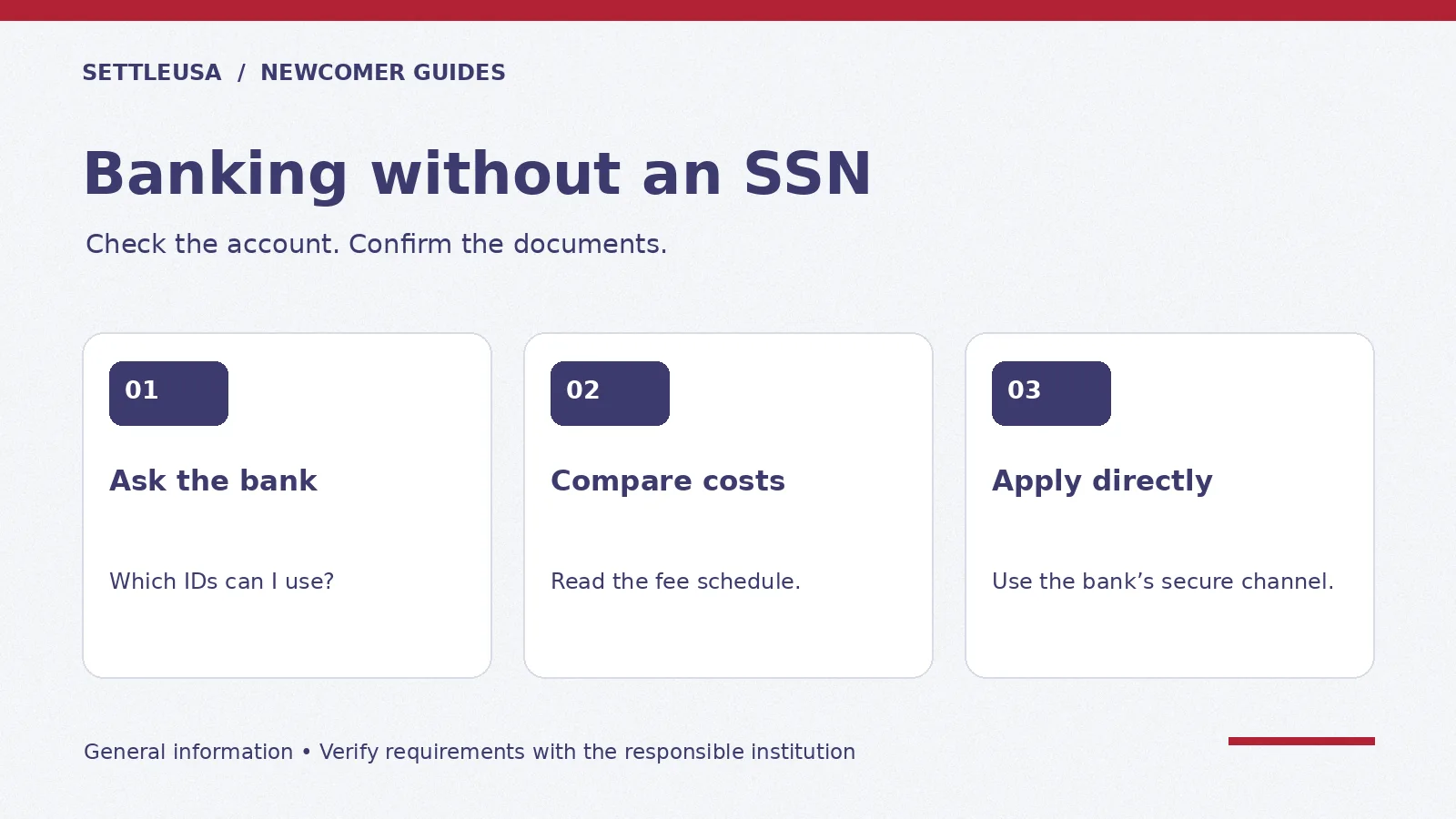
A useful opening question is: “I do not have an SSN. For this checking account, which identification numbers and documents can you accept?” Ask about the actual product you want, rather than whether the bank generally serves international customers.
I don’t have a bank account: where should I start?
Begin with your daily needs: receiving pay, paying rent, withdrawing cash, or keeping savings separate. Then ask an institution about document acceptance before arranging a visit. The FDIC’s GetBanked guide provides an account comparison checklist and explains opening and managing an account.
- If you have an ITIN, ask whether the account accepts it and which separate photo identification is required.
- If you have a foreign passport but no SSN or ITIN, ask whether the bank offers an account using passport details and what tax paperwork it requires.
- If your documents are unfamiliar to the representative, ask for the bank’s account-opening team or a written document checklist.
- If the online application requires an SSN, ask whether an in-person application has a different verification process. See the FDIC account-opening flyer.
Keep brief notes: institution name, exact account name, accepted documents, application route, and the date of the conversation. Do not put your actual identification numbers into a comparison spreadsheet or an email asking general eligibility questions.
What documents should you prepare?
The CFPB’s newcomer account checklist says institutions have their own policies on foreign identification. Some accept foreign passports or consular identification. A second document, such as an address-bearing bill or birth certificate, may also be requested.
| Item | What to confirm |
|---|---|
| Photo identification | Is my passport, consular ID, or other government ID accepted for this account? |
| Identification number | Can I use my ITIN or qualifying foreign identification details? |
| Address | Which documents establish my address, and what can I use if I recently arrived? |
| Name differences | What supporting document or translation does the bank require? |
| Opening funds | How much is required, and which deposit methods are accepted? |
Treat this table as a preparation tool, not a universal list of acceptable evidence. If you live with family and have no bill in your name, describe that situation to the bank before visiting. Ask it to explain any alternative proof it accepts.
Bring only the documents the institution requests, using its secure process. Never alter an ID or use someone else’s number to get around an application field. If a staff member’s answer is unclear, ask for clarification before handing over sensitive information.
Does an ITIN number replace an SSN for banking?
An ITIN is issued for federal tax purposes to someone who needs a taxpayer identification number but is not eligible for an SSN. The IRS ITIN page says it does not authorize work, change immigration status, or serve as identification outside the federal tax system.
A bank accepting an ITIN as a taxpayer number can still require separate identity documents. It also does not follow that having an ITIN makes you eligible for every bank product. Ask about the checking or savings account separately from any credit card application.
The CFPB checklist says an SSN or ITIN is needed for an interest-bearing account and notes that a no-interest account may be an option without one. Ask the bank which tax-number and certification requirements apply to your circumstances; do not assume all passport-based accounts work alike.
For how to apply for an ITIN, start with IRS instructions. The usual application uses Form W-7 with a federal tax return, although exceptions exist, including some third-party reporting situations. A bank’s request for an ITIN does not itself establish that you meet an exception.
Our ITIN guide can help you find the official application route. If you may qualify for an SSN, use the Social Security number guide to reach SSA rather than treating an ITIN as a substitute for an SSN you are eligible to receive.
How should you compare fees and account features?
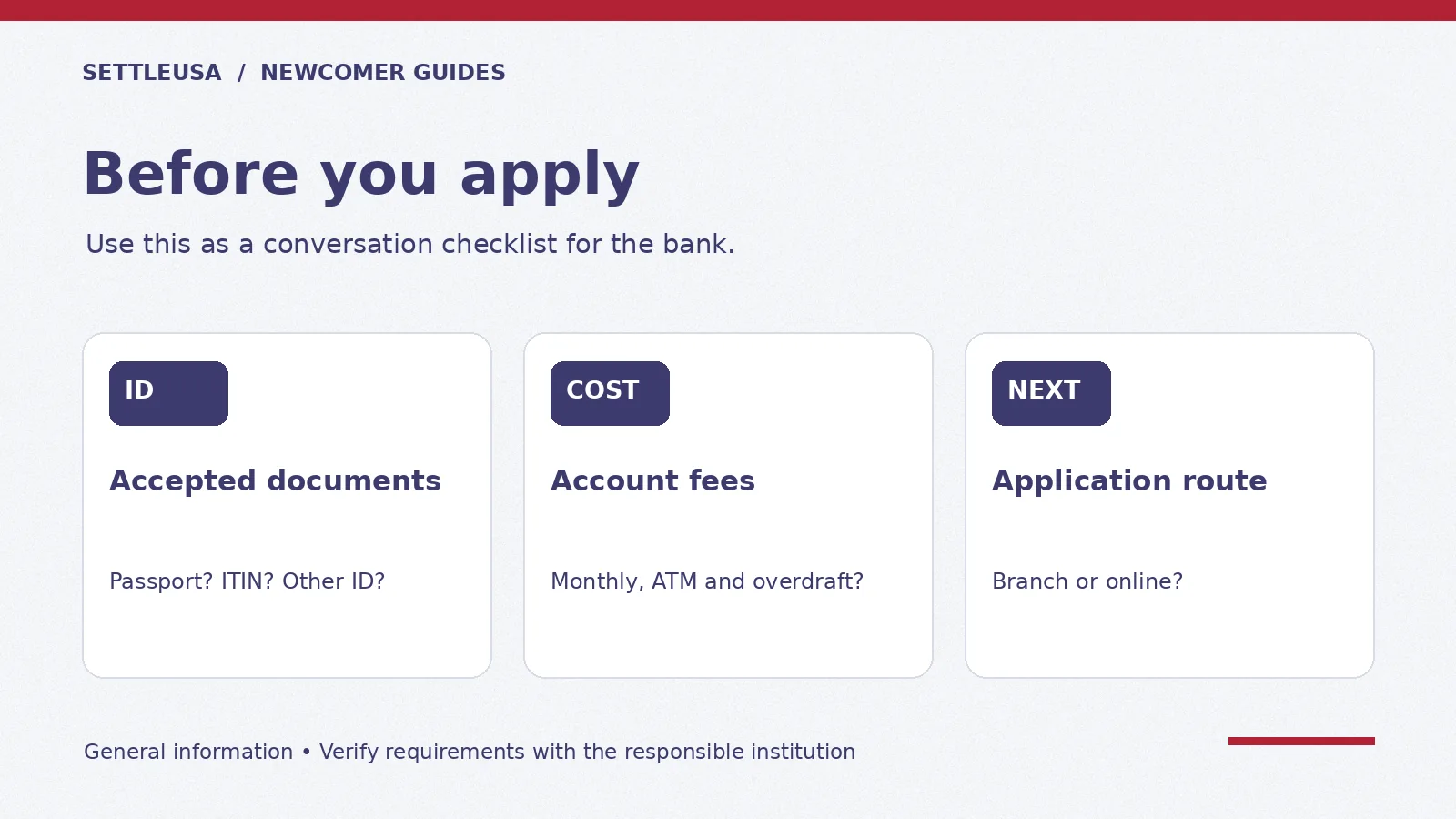
Ask for the fee schedule before signing. The amount needed to open an account and the balance needed to avoid a monthly fee are different questions. Choose an account around the money you expect to keep available, rather than a balance you hope to maintain later.
- Monthly service fee: what exact condition removes it, and can you meet that condition regularly?
- ATM access: where can you withdraw cash, and what charges apply outside the network?
- Cash deposits: where can you deposit cash, and are there restrictions or fees?
- Transfers and bill payments: does the account support the payments you need?
- Access and support: can you use the app, visit a branch, or get help in your preferred language?
The CFPB explains that a “free” account can still have certain fees, including ATM, overdraft, or check-related charges. Read beyond the headline. If a fee waiver depends on direct deposit, ask whether the deposits you expect will meet the bank’s definition.
What are Bank On certified accounts?
The Bank On certified account directory lists products meeting the Cities for Financial Empowerment Fund’s National Account Standards. It is a comparison starting point operated by the program itself, not a government benefit or an endorsement of a specific bank by SettleUSA.
Use the directory to identify accounts to investigate, then read the institution’s current disclosures. Certification does not tell you whether that institution will accept your passport, ITIN, residency circumstances, or application method. Confirm those details directly before submitting an application.
Compare a listed account with other suitable accounts using the same questions. An account that works well for receiving electronic payments may be less convenient if you regularly need a teller or cash deposits. Your document route and everyday banking needs both matter.
What happens when you apply?
The FDIC account-opening flyer describes an opening process that includes applying, making an initial deposit, signing documents, and setting up account tools. Before funding the account, ask the institution to explain its verification status and how you will know that the account is ready to use.
- Review the account name and fee disclosures against the product you discussed.
- Complete the bank’s application accurately through its official website, app, or branch.
- Ask how and when you can use deposited funds and whether any initial restrictions apply.
- Keep copies of the account agreement and deposit receipt securely.
- Activate access tools through the bank’s instructions, then check that your name and contact details are correct.
Do not arrange your essential payments around an account until the bank confirms what is available. If you are offered additional products during the appointment, ask for their terms separately. You can take time to understand a credit offer before deciding whether it fits your needs.
How can you avoid overdraft surprises?
For ATM withdrawals and one-time debit card transactions, the CFPB says banks cannot charge an overdraft fee unless you opt in. Checks and recurring electronic payments can still generate overdraft fees without that opt-in. Declining one type of coverage does not eliminate every possible charge.
Ask the representative to show you which overdraft choices apply to the account. Request examples using a recurring rent payment and an ordinary debit purchase. Ask what happens when a payment is declined and whether a returned-payment charge can come from the merchant.
As a practical routine, review upcoming automatic payments before moving money out of the account. Set a low-balance reminder if available, and keep the bank’s reporting instructions accessible. These habits support budgeting; they are not a guarantee that you will never incur a fee.
What if the bank declines your application?
First ask whether the issue is identity verification, the account’s eligibility requirements, or a consumer report. Those answers point to different next steps. A missing document calls for an accepted alternative; an inaccurate report calls for a dispute.
If a checking-account report caused the refusal, the CFPB says the bank must provide an adverse action notice identifying the reporting company. Request your free report from that company, review it, and dispute errors. Checking-account history is a separate issue from not having an SSN.
A second-chance account is generally designed for people with problems in their banking history. It is not a universal workaround for identification requirements. Ask whether a lower-risk account is available and still confirm its accepted documents and fees.
For unresolved account-opening questions, return to the bank’s official support channel. For a consumer financial complaint, follow the complaint link on the relevant CFPB page. Do not pay a third party promising guaranteed approval or confidential access to a bank’s verification system.
Frequently asked questions
Can I open a bank account without SSN or ITIN?
Possibly. The federal identification rule lists alternatives for non-US persons, including passport details, but the bank must accept your documents and verify your identity. Ask whether a no-interest account is available and what tax paperwork is required.
Is an ITIN number enough to open an account?
Not by itself. A bank may accept it as a taxpayer identification number while requiring separate photo identification, address evidence, and other account-opening information.
How do I apply for ITIN just to open a bank account?
Check IRS eligibility and Form W-7 instructions first. ITINs are for federal tax purposes; some reporting exceptions allow an application without a tax return, but a wish to open an account does not automatically establish eligibility.
Can I apply online without an SSN?
Ask the institution about its specific application system. If online verification does not support your documents, the FDIC advises that a branch visit or phone contact may be needed; acceptance is still subject to the institution’s rules.
Does Bank On certification guarantee approval?
No. The directory identifies accounts meeting the program’s standards. You must still meet the institution’s identification and account requirements.
Where can I find guidance on an SSN for immigrants?
Use SSA’s official guidance through our Social Security number guide. Check SSN eligibility before applying for an ITIN; the IRS issues ITINs to people who need a federal tax number and are not eligible for an SSN.
Official sources
- Board of Governors of the Federal Reserve System — 31 CFR 1020.220: Customer Identification Program Requirements for BanksChecked
- Consumer Financial Protection Bureau — Checklist for opening a bank or credit union accountChecked
- Federal Deposit Insurance Corporation — GetBanked: choose and open an accountChecked
- Cities for Financial Empowerment Fund / Bank On — Certified accounts directoryChecked
- Internal Revenue Service — Individual taxpayer identification number (ITIN)Checked
- IRS Taxpayer Advocate Service — Getting an ITINChecked
- Consumer Financial Protection Bureau — Fees on a free checking accountChecked
- Consumer Financial Protection Bureau — What can I do if my bank charged me an overdraft fee?Checked
- Consumer Financial Protection Bureau — Why was I denied a checking account?Checked
- Consumer Financial Protection Bureau — What is a second-chance bank account?Checked
- Federal Deposit Insurance Corporation — How to Open a Checking or Savings Account at an FDIC-Insured BankChecked
Source review: complete. Last checked .
Independent guide, not affiliated with SSA, VA, USDA or any government agency. Not financial or legal advice. Confirm your circumstances with the responsible agency or service.