
How to build credit as an immigrant in the US
How can a newcomer start building US credit?
Start by checking whether you have a US credit report, then compare an affordable product that reports payments to credit bureaus. A secured credit card or credit builder loan may help if you qualify. Confirm identification requirements with the lender, pay on time, and avoid promises of instant credit scores.
Published · Updated
At a glance
- First check
- Your credit reports and lender identification requirements
- Possible tools
- Secured credit cards and credit builder loans, if eligible
- Free reports
- Weekly reports from each nationwide bureau through AnnualCreditReport.com
- No guarantee
- Approval, timing and score changes depend on your circumstances
As of November 12, 2026, the official consumer guidance below supports a gradual approach: understand your file, check product costs, and build a payment record you can maintain. This guide explains the questions to ask; it does not recommend a lender or promise approval.
In this guide
- What does having no credit mean?
- How do you check your free credit reports?
- Can you build credit with an ITIN number?
- How does a secured credit card work?
- What is a credit builder loan?
- What about authorized users, rent, and debit cards?
- What repayment habits help build a record?
- What if the report is wrong or an application is denied?
- How can newcomers avoid credit-repair scams?
- Frequently asked questions
- Official sources
What does having no credit mean?
General information only. SettleUSA is not a law firm or government agency and does not provide individualized financial, legal, or tax advice. Use official agency and lender channels. Never send us an SSN, ITIN, account statement, passport, or immigration document.
A credit report records information about credit accounts and repayment. A credit score uses information in a credit report to estimate repayment risk. The FTC’s guide to credit reports explains that the nationwide bureaus are Equifax, Experian, and TransUnion, and that not all creditors report information.
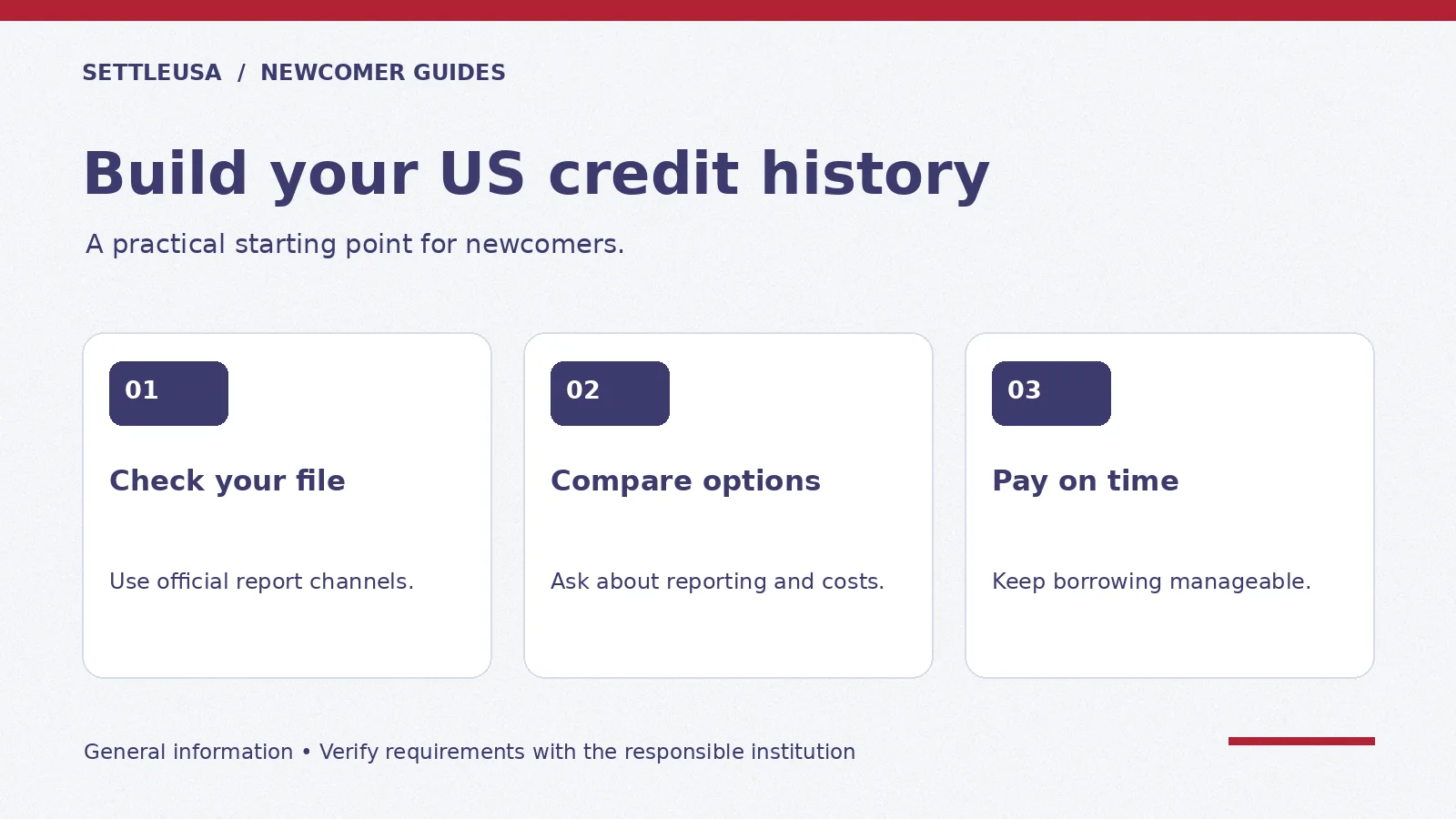
If you are new to US borrowing, begin by asking what is already on your file rather than assuming that you have a particular score. A lender’s inability to find enough information is a reason to ask about its requirements, not a reason to buy a promised “new credit identity.”
Keep three goals separate: everyday access to money, establishing a reported payment history, and preparing for a future borrowing application. You may need a checking account immediately while taking more time to choose a credit product. A rushed borrowing decision can make the first months of settlement harder.
Write down the purpose of borrowing before comparing offers. For example: “I want a manageable account that reports payments, and I can repay ordinary purchases from money already budgeted.” This gives you a clearer basis for comparing fees than a headline promising a fast score increase.
How do you check your free credit reports?
The FTC confirms free weekly reports from each of the three nationwide bureaus through AnnualCreditReport.com. This weekly program is separate from the statutory entitlement to a free annual report. Use the exact website address; be cautious of lookalike pages asking you to buy a subscription.
The request process verifies identity. If you have no SSN, cannot pass online verification, or cannot locate your file, contact the official service or bureau for its current identification procedure. Do not type an ITIN into a field labeled SSN unless the official service explicitly instructs you to do so.
- Check names, addresses, and identifying details for obvious mistakes.
- Review the accounts: do you recognize each lender and account?
- Check reported payment history and balances against your own records.
- Save a secure copy or note the date checked, without putting identification numbers into an unsecured planning document.
A report you cannot retrieve online is not proof that you have no credit history. Ask the bureau how to resolve identity verification or file access. Avoid repeatedly guessing answers to identity questions or giving personal documents to a third party offering to unlock your report.
Can you build credit with an ITIN number?
Start by asking the lender whether it accepts an ITIN for the specific product and what other identification it needs. Do this before submitting an application. This guide does not verify any lender’s current ITIN acceptance policy, and an ITIN does not guarantee approval.
The federal customer identification rule permits a taxpayer identification number among the identification-number alternatives for non-US persons. It also includes other routes, such as passport details. Those identification provisions do not require a lender to approve a card, loan, or any particular applicant.
The IRS explains that ITINs are for federal tax purposes for people who are not eligible for an SSN. An ITIN does not provide immigration status or work authorization. If you are researching an SSN for immigrants, use our SSN guide to reach SSA’s official information.
Ask the lender how it matches your reported account to your credit file and what to do if your identification details change. Keep your name and contact details accurate across applications. Follow the lender’s secure instructions rather than sending identification documents with an initial general inquiry.
How does a secured credit card work?
A secured credit card typically requires a cash deposit against the credit line. It is a borrowing product, so purchases create a bill you must repay. The CFPB includes secured cards among credit-building options and distinguishes them from prepaid cards, which use money you have already loaded.
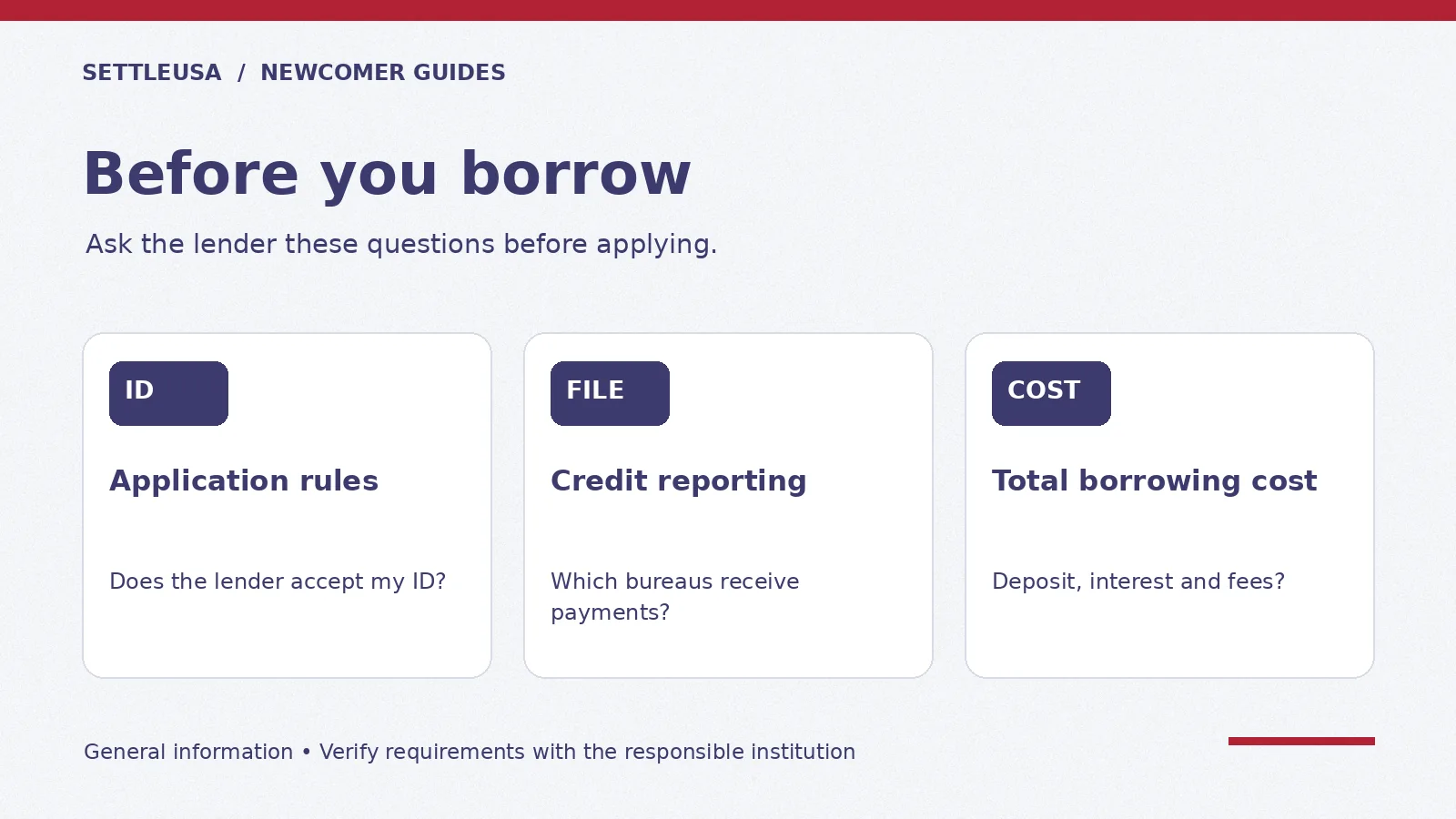
Before applying, ask how much cash is tied up, what you must repay each month, and when the deposit can be returned. Do not use money needed for rent or essentials simply to obtain a larger credit limit. Ask whether the account reports to each nationwide credit bureau.
- What are the application, annual, monthly, or other fees?
- What interest rate applies, and what purchase grace-period conditions must I meet?
- Which bureaus receive payment information, and whose name is reported?
- What happens to the deposit if I close the account with a balance?
- Is there a review for a different account later, and what conditions apply?
A deposit is not a substitute for understanding the repayment terms. Request the written disclosures and read them before sending money. Compare the total cost with another product that accepts your documents, rather than assuming every “secured” offer is affordable.
What is a credit builder loan?
With a credit builder loan, the money is typically held in a locked savings account while you make payments. The CFPB’s Building credit from scratch checklist describes this structure. It is designed around building a payment record, rather than supplying cash immediately for a purchase.
Ask for the full repayment schedule and total cost in writing. Confirm what amount you receive at completion, whether interest or fees reduce that amount, and what happens if you cannot continue. The product name alone does not answer these questions.
Compare the payment against your actual monthly surplus after necessities. If income varies, work through a difficult month as well as an ordinary month. Ask how late payments are reported and whether the lender has a hardship process before entering the agreement.
Do not take out a loan solely because a salesperson predicts a specific score increase. The useful comparison is whether the account’s reporting, cost, and payment schedule fit your situation. You can pause your search if you cannot yet make the repayments comfortably.
What about authorized users, rent, and debit cards?
The CFPB’s Your Money, Your Goals credit booklet discusses authorized-user arrangements, co-signers, and reporting less-traditional payment data. These routes have different obligations and reporting practices. Ask exactly whose information will appear in the file, and do not assume a family arrangement will work without checking the issuer’s terms.
Before becoming an authorized user, discuss permitted spending, bill payment, and what happens if either person wants to end the arrangement. If you are considering co-signing, read the repayment obligations carefully and seek qualified help if you do not understand them.
For rent or utility reporting, ask whether there is a charge, which bureaus receive the data, and whether late payments are reported. Do not assume that paying rent automatically creates the same credit record as a reported loan or card.
The CFPB says debit cards, cash, and prepaid cards generally do not build a borrowing history. If your first priority is paying bills, a bank account without an SSN may still be useful; just keep its purpose separate from establishing credit.
What repayment habits help build a record?
The CFPB’s repayment guidance emphasizes paying on time, avoiding balances close to the credit limit, and avoiding many applications in a short period. It also explains that carrying a balance is not necessary to build credit; paying the card balance in full can avoid finance charges.
- Choose a small, planned use for the account rather than treating the limit as extra income.
- Put the statement date and due date in your calendar, and read the actual bill each month.
- If you use automatic payments, check that the linked account has enough money and confirm that the payment completed.
- Review new fees, disputed purchases, and changes to terms before the next payment is due.
- Contact the lender promptly if a payment looks unaffordable; ask about available options.
A low balance is a budgeting choice, not a promise of a particular score result. You do not need to spend heavily to demonstrate repayment. Revisit the plan when your income, rent, or family expenses change so the account remains manageable.
Keep a simple record of when you applied, the account you opened, its fees, and the reporting information the lender gave you. Review that record before another application. It helps you avoid taking several overlapping products while still learning how the first one works.
What if the report is wrong or an application is denied?
The FTC’s dispute guide says to contact both the credit bureau showing the error and the business that supplied the information. Explain what is wrong and include supporting copies using the official dispute instructions. Keep the originals and a record of what you submitted.
Be specific: identify the account or entry, explain the error, and state the correction requested. For example, distinguish a payment date error from an account you never opened. Check the response and the revised report instead of assuming that submitting a dispute finishes the problem.
If a lender declines you, read the explanation before applying elsewhere. Ask whether the issue concerns identification, affordability, product eligibility, or report information. This guide cannot determine whether you qualify, but those questions help you find the appropriate next step.
The CFPB explains that national-origin discrimination is prohibited, while lenders may consider immigration or residency information relevant to repayment and legal obligations. The law does not guarantee approval. If you believe discrimination occurred, follow the official CFPB complaint route linked on that page.
How can newcomers avoid credit-repair scams?
The FTC warns that credit-repair companies cannot remove accurate, current negative information. Be cautious of anyone guaranteeing instant results, demanding advance payment for credit repair, or telling you to dispute information you know is true.
Do not buy a replacement credit identity or use someone else’s number on an application. The FTC identifies promises of a new identity and instructions to lie as scam signs. A legitimate question about ITIN acceptance is different from inventing a new identity to hide a record.
If you suspect identity theft, use IdentityTheft.gov through the FTC’s official guidance. For a credit-repair scam, use the reporting route on the FTC page. Keep advertisements and payment records securely, but do not send them to SettleUSA.
Your next step: Check your report access, list the identification you can provide, and ask one lender for written product terms and reporting details. Compare them with your budget before applying. If the terms are unclear or unaffordable, ask for clarification or wait.
Frequently asked questions
How do I build credit as an immigrant with no credit history?
Check your report access, confirm lender identification requirements, and compare an affordable account that reports payments. A secured card or credit builder loan may be an option if you qualify. Pay on time and review the reported information.
Can I use an ITIN number instead of an SSN for credit?
Ask the lender about the particular product before applying. Federal identification rules include taxpayer-number alternatives for non-US persons, but this guide has not verified any lender’s ITIN policy or guaranteed eligibility.
Does a bank account without SSN build credit?
Opening a deposit account and using a debit card do not by themselves establish a borrowing repayment history. Ask separately about any credit product, its costs, and reporting practices.
Are credit reports free every week?
Yes. As checked November 12, 2026, the FTC confirms that each nationwide bureau offers free weekly reports through AnnualCreditReport.com. If online identity verification does not work, ask the official service or bureau how to request access.
Do I need to pay interest to build credit?
No. CFPB guidance says paying a credit card balance in full each month can build credit while avoiding finance charges. Read the account’s grace-period and payment terms.
How quickly will I get a good credit score?
There is no guaranteed timetable or score increase in this guide. Credit building takes time, and results depend on the information reported and the scoring system used.
Where should I start if I need an SSN for immigrants?
Use SSA’s official eligibility information through our Social Security number guide. The IRS says an ITIN is for people who need a federal tax identification number and are not eligible for an SSN.
Official sources
- Consumer Financial Protection Bureau — Ways to start or rebuild a good credit historyChecked
- Consumer Financial Protection Bureau — How to rebuild your creditChecked
- Consumer Financial Protection Bureau — Building credit from scratchChecked
- Consumer Financial Protection Bureau — Permitted factors in credit-card decisionsChecked
- Internal Revenue Service — Individual taxpayer identification numberChecked
- Board of Governors of the Federal Reserve System — 31 CFR 1020.220: Customer Identification Program Requirements for BanksChecked
- Federal Trade Commission — Free Credit ReportsChecked
- AnnualCreditReport.com — Official credit report request websiteChecked
- Federal Trade Commission — Disputing Errors on Your Credit ReportsChecked
- Federal Trade Commission — Fixing Your Credit FAQs (FTC publication, January 2026)Checked
- Consumer Financial Protection Bureau — Your Money, Your Goals: Credit booklet (Action Plan)Checked
Source review: complete. Last checked .
Independent guide, not affiliated with SSA, VA, USDA or any government agency. Not financial or legal advice. Confirm your circumstances with the responsible agency or service.