
Getting a US driver's license as a newcomer
How do immigrants get a US driver’s license?
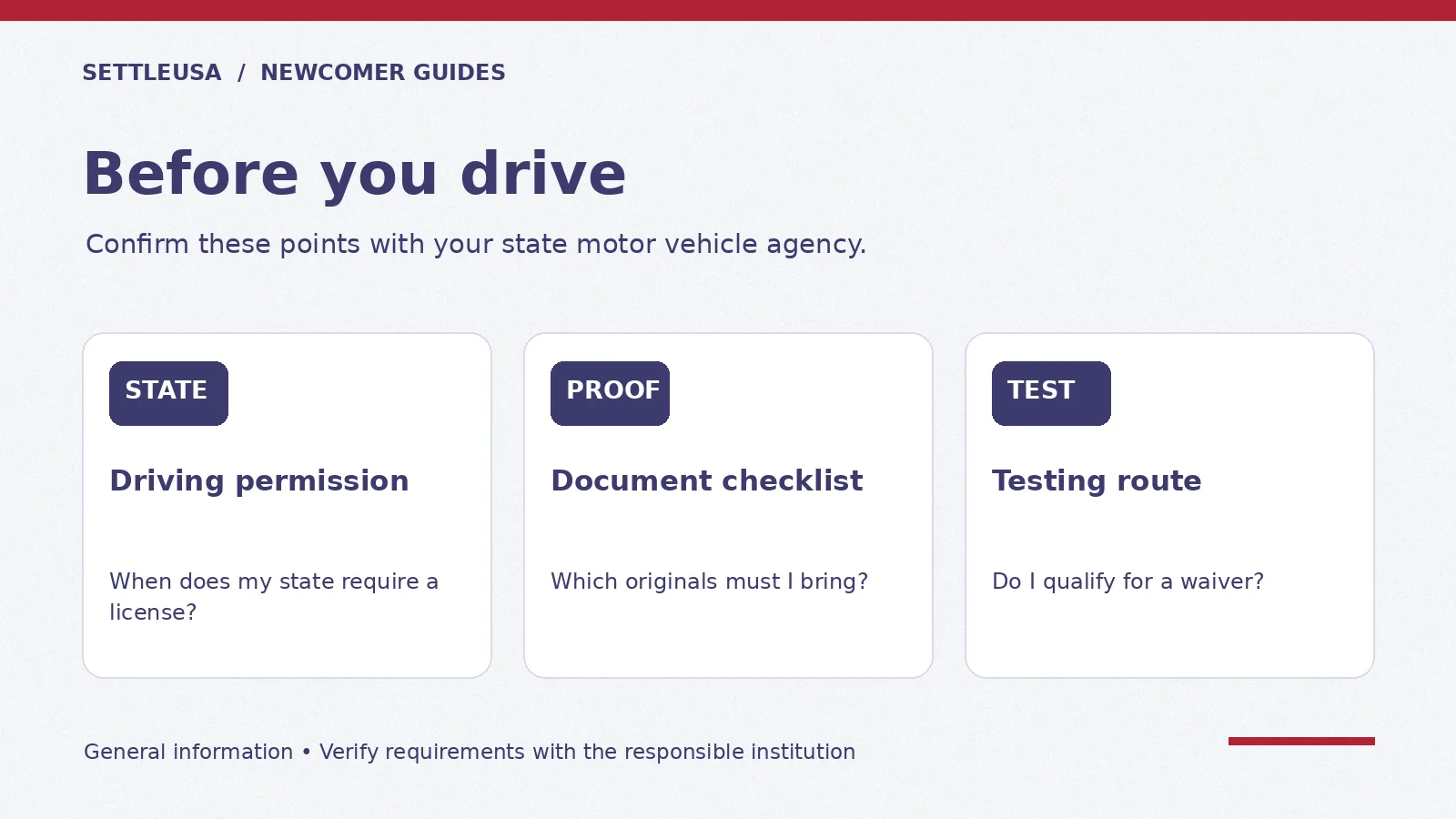
Apply through the motor vehicle agency in the state where you live. Documents, lawful-presence requirements, deadlines, and test waivers vary by state. Some states offer standard licenses without proof of lawful status. Check whether your foreign license remains valid after you become a resident, and choose the correct application route.
Published · Updated
At a glance
- Responsible agency
- Your state DMV, DPS, or equivalent licensing agency
- Foreign license
- Check visitor permission and new-resident rules separately
- License type
- Standard driving license and REAL ID have different purposes
- Scope
- Ordinary noncommercial newcomer applications; checked November 12, 2026
As of November 12, 2026, there is no single nationwide newcomer application checklist. Start with your state, your residency circumstances, and whether you already hold a valid foreign license. The examples below cover ordinary noncommercial licenses; they do not decide your eligibility.
In this guide
- Which state’s rules apply to a newcomer?
- Can you drive with a foreign license or an IDP?
- How do new-resident rules differ across states?
- California: what is the AB 60 route?
- Texas: lawful presence, documents, and test waivers
- New York: standard licenses under the Green Light Law
- Florida: use the correct immigration document category
- What if you have no driver’s license or missing documents?
- REAL ID requirements: do you need a different license?
- How should you prepare for the appointment and tests?
- Frequently asked questions
- Official sources
Which state’s rules apply to a newcomer?
General information only. SettleUSA is not a law firm or government agency. This guide is not individualized immigration or legal advice. Confirm eligibility and permission to drive with the responsible state agency. Never send SettleUSA an SSN, passport, A-number, or immigration document.
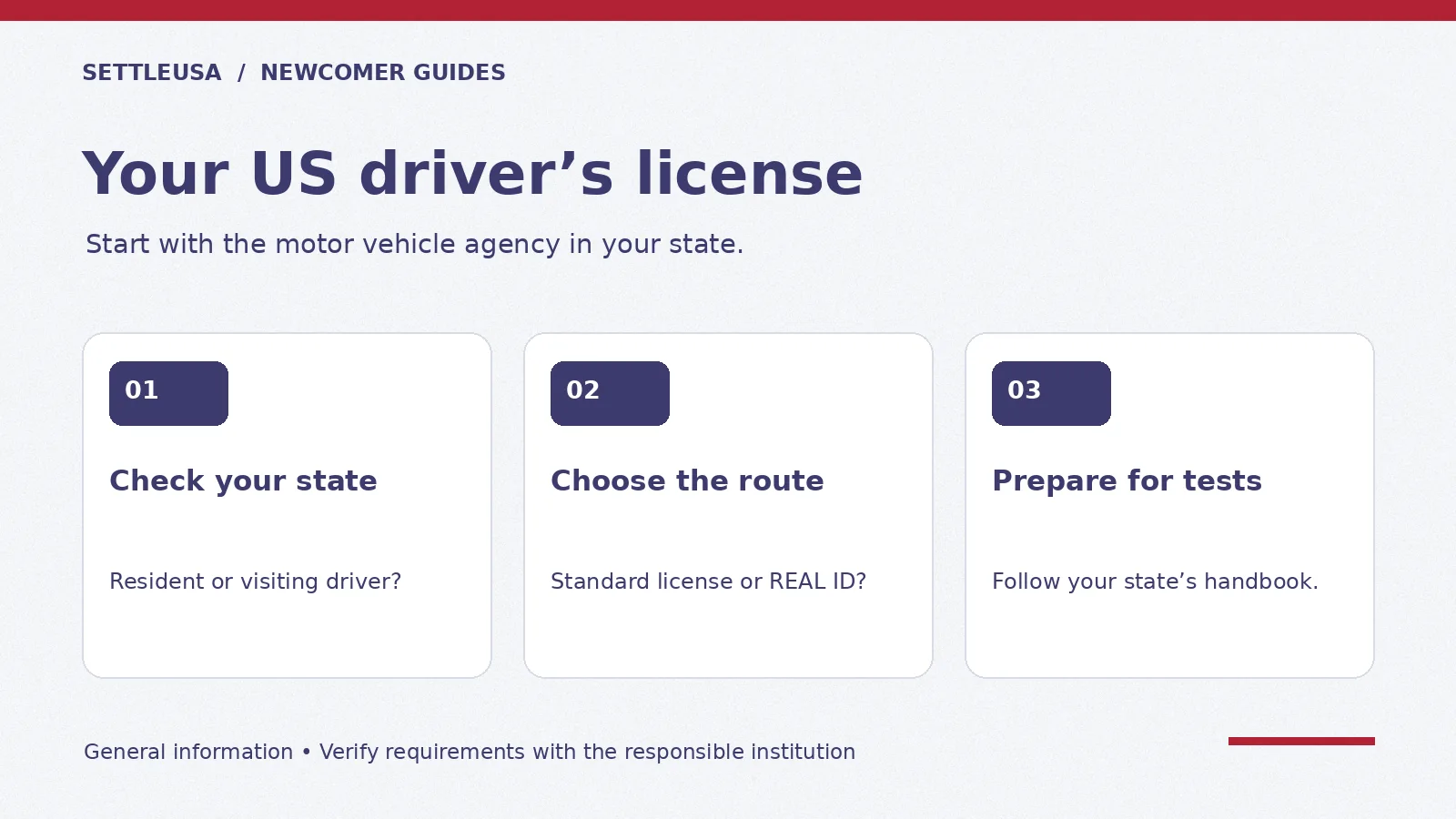
Your application starts with the state where you live. USAGov explains that residency and identification requirements differ by state and links to motor vehicle agencies. A rule you read for a friend in another state may not apply to you, even if your immigration documents look similar.
Before booking, establish whether the agency treats you as a visitor or a new resident. Ask when its resident licensing requirement starts. Do not assume that the date you entered the United States, the date you moved into an apartment, and the date you became a state resident are interchangeable.
- Find the official agency page for ordinary passenger-vehicle licenses.
- Choose the instructions for a first license, foreign-license holder, or qualifying transfer.
- Read the document list for your status and chosen license type.
- Check appointment, testing, translation, and fee instructions before attending.
Commercial driving, motorcycles, and applicants under 18 can have additional requirements. This guide does not cover those routes. If your circumstances fall outside the standard adult application, ask the agency to identify the correct instructions rather than adapting the checklist yourself.
Can you drive with a foreign license or an IDP?
Check every state where you plan to drive. USAGov says some states require an International Driving Permit (IDP) as well as your home-country license. Foreign visitors must obtain the IDP before travel through the issuing country; the United States does not issue IDPs to foreign visitors.
An IDP does not remove the need to check your underlying license or the state’s new-resident rules. Ask about the requirements for your age, license class, and length of stay. If renting a car, also confirm the rental company’s document requirements in advance.
For example, New York’s driver manual allows a nonresident with a valid license from another state or country to drive there. A new resident licensed outside Canada must follow the applicable testing route, including vision, written and road tests and the safe-driving course; a foreign license is not an automatic exchange.
Do not purchase a document advertised as an “international license” on the assumption that it grants permission to drive everywhere. Start with the state agency and your home-country licensing authority. If you cannot confirm that you may drive, arrange another way to travel while you resolve the question.
How do new-resident rules differ across states?
The following examples show why you need a state-specific answer. They summarize official pages checked November 12, 2026. Read the linked instructions before relying on a deadline, and ask the agency how its definition of residency applies to you.
| State | Official starting point | Newcomer issue to check |
|---|---|---|
| California | New resident portal | Residents who intend to drive must apply for a California license. Ask DMV when your application is due. |
| Texas | Moving to Texas | Up to 90 days of initial driving privileges with a valid license from a listed jurisdiction or qualifying country; check whether your country qualifies. |
| New York | Moving to New York | Get a New York license within 30 days of becoming a resident; check the foreign-license testing route. |
| Florida | Florida driver handbook | Check FLHSMV’s licensing deadline for your circumstances before driving. |
The Texas allowance is not a blanket promise for every overseas license. Likewise, a new-resident deadline does not mean that a person without valid driving permission may drive while waiting for an appointment. Ask the agency about your existing license and any permit restrictions.
California’s portal also treats vehicle registration as a separate task. If bringing or buying a car, work through the vehicle requirements alongside the license application. Do not assume receiving a license completes those tasks.
California: what is the AB 60 route?
California’s AB 60 license page is for people unable to provide proof of legal presence who otherwise meet DMV requirements and can prove identity and California residency. It describes an application route, not an automatic entitlement based on living in the state.
The published steps include a knowledge test, document review, and a behind-the-wheel test. If acceptable identity or residency documents are unavailable, a secondary review may be necessary. Complete that review interview before the driving test when required.
- Use DMV’s AB 60 checklist to check acceptable identity and residence evidence.
- Study the official handbook and check the available knowledge-test languages.
- Ask DMV whether a document needs translation or additional review.
- Confirm which appointments you need and what to bring to each one.
Use the California new-resident portal to reach the appropriate license route if AB 60 is not the route for your circumstances. Do not use an AB 60 checklist as a substitute for a REAL ID checklist or assume a foreign license removes testing requirements.
Texas: lawful presence, documents, and test waivers
The Texas DPS application page lists citizenship or lawful-presence evidence, Texas residency, identity, and an SSN among its documentation requirements. It also lists vehicle insurance or a statement that you do not own a vehicle, plus other requirements that depend on the application.
DPS describes vision, knowledge, and practical driving tests. Some applicants also need driver education or an Impact Texas Driver certificate. Use the official checklist for your age and transfer situation instead of assuming all adult applicants have the same course requirements.
The Texas newcomer guidance lists reciprocity with France, Germany, South Korea, the United Arab Emirates, and Taiwan. For valid licenses from these countries, knowledge and skills tests may be waived; keeping the foreign license affects the stated waiver route. Ask DPS to confirm your eligibility.
That page says foreign licenses not in English or Spanish need translation by a translation service or consulate before arrival. If you lack an SSN or have unusual immigration paperwork, ask DPS about the applicable procedure before booking. This guide does not establish an exemption for you.
New York: standard licenses under the Green Light Law
The New York DMV Green Light Law page says residents age 16 and older may apply for a standard noncommercial license or learner permit regardless of citizenship or lawful status. It is a standard license route, not the same document standard as REAL ID.
Applicants must show a combination of documents proving name, birth date, and New York residency. People never issued an SSN must sign the specified affidavit when applying for a standard license. Do not sign that statement if an SSN has in fact been issued to you.
The page describes a written test for a learner permit and a road test for a license. Use its document tool before attending. The Green Light Law does not cover commercial licenses or non-driver ID cards.
For new residents, the New York moving guide sets a 30-day licensing requirement. The driver manual’s nonresident and new-resident section explains how a foreign-license application differs from a qualifying US or Canadian transfer. Check those instructions before surrendering your existing license or scheduling a road test.
Florida: use the correct immigration document category
The Florida driver handbook lists primary evidence for immigrants, including a permanent resident card or qualifying I-551 stamp. It also lists Social Security number evidence and two documents showing a Florida residential address. Check the current checklist matching your actual status before attending.
The immigrant route is not a universal checklist for every foreign national. The Hillsborough County Tax Collector’s document page links separate FLHSMV checklists for immigrants, nonimmigrants, and Canadians. Choose the right category before preparing documents; ask FLHSMV if you are unsure which category applies.
For applicants living with someone else and lacking address documents in their own name, that county page describes a Certification of Address process with supporting evidence and signature requirements. Confirm the current process with your issuing office rather than assuming that a letter from a relative will be accepted.
The handbook describes a vision exam and written or driving-test waivers for qualifying license holders. Ask FLHSMV which tests and appointments your existing license requires. If you have no SSN, ask which evidence or procedure applies to your category before attending.
What if you have no driver’s license or missing documents?
If you have no driver’s license, ask about the first-time applicant route rather than a transfer. If you have a foreign license, explain the issuing country, license class, validity, and language. Those details help the agency direct you to the correct tests and document instructions.
- Identity: confirm the exact passport, birth, or government-issued documents accepted for your route.
- Residence: ask which documents must carry your current address and what alternatives exist if you live with family.
- Lawful presence: check whether your chosen route requires it and which evidence applies to your category.
- SSN: ask about requirements, ineligibility procedures, or affidavits; these vary by route and state.
- Names and translations: ask about original documents, certified copies, name changes, and translated records.
For an SSN for immigrants, start with SSA’s eligibility guidance. Do not substitute an ITIN for an SSN on a license application unless the state agency specifically instructs you to do so. Keep tax-number questions separate from proof of identity and immigration status.
REAL ID requirements: do you need a different license?
REAL ID concerns federal identification uses; your state still determines driving privileges. The DHS REAL ID FAQ explains federal purposes and confirms that enforcement began May 7, 2025. A search for the REAL ID deadline should not be treated as your deadline to obtain a state driving license.
As checked November 12, 2026, TSA lists acceptable identification at airport checkpoints, including foreign government-issued passports and permanent resident cards. Standard state licenses that are not REAL ID compliant are no longer accepted as checkpoint identification. Check TSA’s current list before flying.
You may therefore have separate plans for driving and air-travel identification. If applying for REAL ID, use the state’s REAL ID document checklist. A standard-license route that does not require proof of lawful status does not automatically qualify you for REAL ID.
Read our REAL ID guide alongside the state instructions. If you already hold an acceptable travel document, check the official alternatives before assuming you must change your license specifically for an upcoming flight.
How should you prepare for the appointment and tests?
Keep a private checklist with the official page address, chosen route, documents, tests, and questions still unanswered. Save the appointment instructions and recheck them before leaving home. Ask about interpreter arrangements or accessible testing if needed, using the state agency’s official contact channel.
- Study the state handbook rather than relying only on practice apps.
- Confirm whether your appointment is for documents, a knowledge test, a permit, or a road test.
- Ask what vehicle, insurance evidence, and accompanying licensed driver are required for the road test.
- Ask about current fees and acceptable payment methods directly; this guide does not quote a nationwide fee.
- After issuance, check your name, restrictions, expiration date, and any temporary-document instructions.
Do not drive yourself to a test unless the agency confirms your existing permission allows it. If a test or document review is delayed, ask what you may do while waiting. A booking confirmation is not evidence of driving permission.
Your next step: Open your state’s official newcomer or first-license page, choose the right license category, and confirm your document and test route. Resolve uncertainty about permission to drive before using a car.
Frequently asked questions
Can immigrants get a driver’s license without lawful status?
Some states offer qualifying standard licenses. California’s AB 60 and New York’s Green Light Law are examples; documents and tests still apply. Texas’s application page requires lawful-presence evidence for noncitizens. Check your state’s current route.
Can I drive on my foreign license after moving to the US?
Possibly, but visitor and new-resident rules differ. Check the state agency for your license’s issuing country, validity, your age, and the date residency begins. A foreign license is not automatically exchangeable for a state license.
Do I need an International Driving Permit?
Some states require an IDP alongside a valid foreign license. USAGov says foreign visitors must obtain it before travel through the issuing country; the US does not issue IDPs to foreign visitors. Check rental-company requirements too.
What if I have no driver’s license at all?
Use the state’s first-time driver route and ask about a permit, required education, tests, and practice restrictions. A foreign-license transfer route is not suitable if you have never held a license.
Are REAL ID requirements the same as standard license requirements?
No. A standard license route and REAL ID can have different document requirements and federal uses. Confirm the checklist for the document you want; standard-license eligibility does not itself establish REAL ID eligibility.
Has the REAL ID deadline already passed?
REAL ID enforcement began May 7, 2025. As checked November 12, 2026, TSA lists acceptable alternatives, including foreign government-issued passports. The REAL ID enforcement date is separate from a state’s new-resident licensing deadline.
Can I get a driver’s license without an SSN?
It depends on the state and route. New York’s standard-license route allows an affidavit for applicants never issued an SSN. Do not assume another state accepts that affidavit or that an ITIN can replace an SSN.
Official sources
- USAGov — Driving in the U.S. if you are not a citizenChecked
- California Department of Motor Vehicles — AB 60 Driver’s LicensesChecked
- California Department of Motor Vehicles — New California Resident PortalChecked
- Texas Department of Public Safety — Apply for a Texas Driver LicenseChecked
- Texas Department of Public Safety — Moving to Texas: driver licenses and IDsChecked
- New York Department of Motor Vehicles — Driver Licenses and the Green Light LawChecked
- New York Department of Motor Vehicles — Moving to or from New York StateChecked
- New York Department of Motor Vehicles — Driver’s Manual Chapter 1: Driver LicensesChecked
- Florida Highway Safety and Motor Vehicles — Official Florida Driver License Handbook: identification and reciprocityChecked
- Hillsborough County Tax Collector — Driver License and ID Card Document RequirementsChecked
- Department of Homeland Security / TSA — REAL ID Frequently Asked QuestionsChecked
- Transportation Security Administration — Acceptable Identification at the TSA CheckpointChecked
Source review: complete. Last checked .
Independent guide, not affiliated with SSA, VA, USDA or any government agency. Not financial or legal advice. Confirm your circumstances with the responsible agency or service.