
N-400 fee: citizenship application cost and fee waivers
How much is the N-400 citizenship application fee?
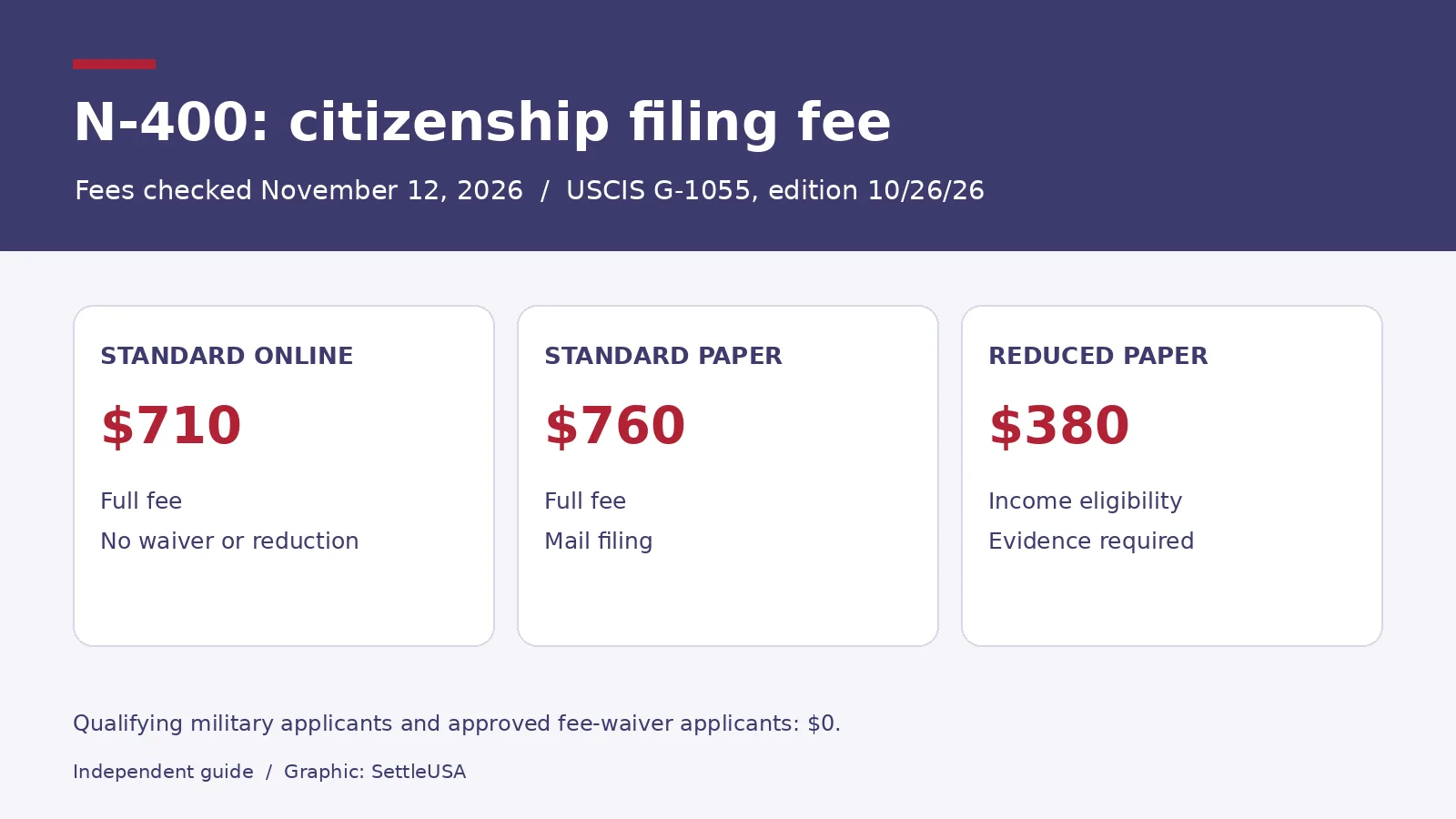
As of November 12, 2026, the standard N-400 fee is $710 online or $760 on paper. Eligible applicants can request a $380 reduced paper fee or a full fee waiver. Qualifying military applicants pay $0. Reduced-fee and waiver requests require paper filing; there is no separate N-400 biometrics fee.
Published · Updated
Check fee help before choosing how to file. This guide explains the standard citizenship application cost, the reduced-fee income rule, I-912 waivers, military exemptions and current payment instructions.
In this guide
- What is the current N-400 fee?
- Online, paper, reduced fee or no fee?
- Who qualifies for the $380 reduced N-400 fee?
- How does an N-400 fee waiver with I-912 work?
- Who receives the military fee exemption?
- Does the N-400 fee include biometrics?
- How do you pay the citizenship application fee?
- What should you check before sending N-400?
- Is the N-400 fee refundable?
- After paying: track the application and use official resources
- Frequently asked questions
- Official sources
What is the current N-400 fee?
SettleUSA is an independent guide, not a law firm or government agency. This is general information, not individualized legal or financial advice. Submit personal information and evidence only through the official agency process. Do not send SettleUSA Social Security numbers, immigration documents, or payment details.
As of November 12, 2026, the general N-400 fee is $710 online or $760 on paper. These amounts were checked against G-1055 edition 10/26/26. That schedule also lists a reduced paper fee and $0 categories, so check assistance options before paying the full amount. See the N-400 rows on pages 30–31.
N-400 is the application for naturalization for people who meet the eligibility requirements. Paying the fee does not establish eligibility or guarantee citizenship. If you need help deciding whether you qualify, use the official eligibility information or get advice from a qualified immigration attorney. Read the purpose and eligibility links.
USCIS published the current fee schedule edition on October 28, 2026. That publication date is not a statement that every fee changed then. Check the current schedule and the N-400 webpage again immediately before filing. Check the latest edition notice.
Online, paper, reduced fee or no fee?
The amount depends on the filing route and any assistance or exemption for which you qualify. The reduced fee and fee waiver require paper filing. Check these options before submitting a full-fee online application. Read the filing-route instructions.
| Option | Fee | Main condition |
|---|---|---|
| Standard online | $710 | Official online application route. |
| Standard paper | $760 | Paper application with the correct payment. |
| Reduced paper fee | $380 | Documented annual household income no more than 400% of guidelines. |
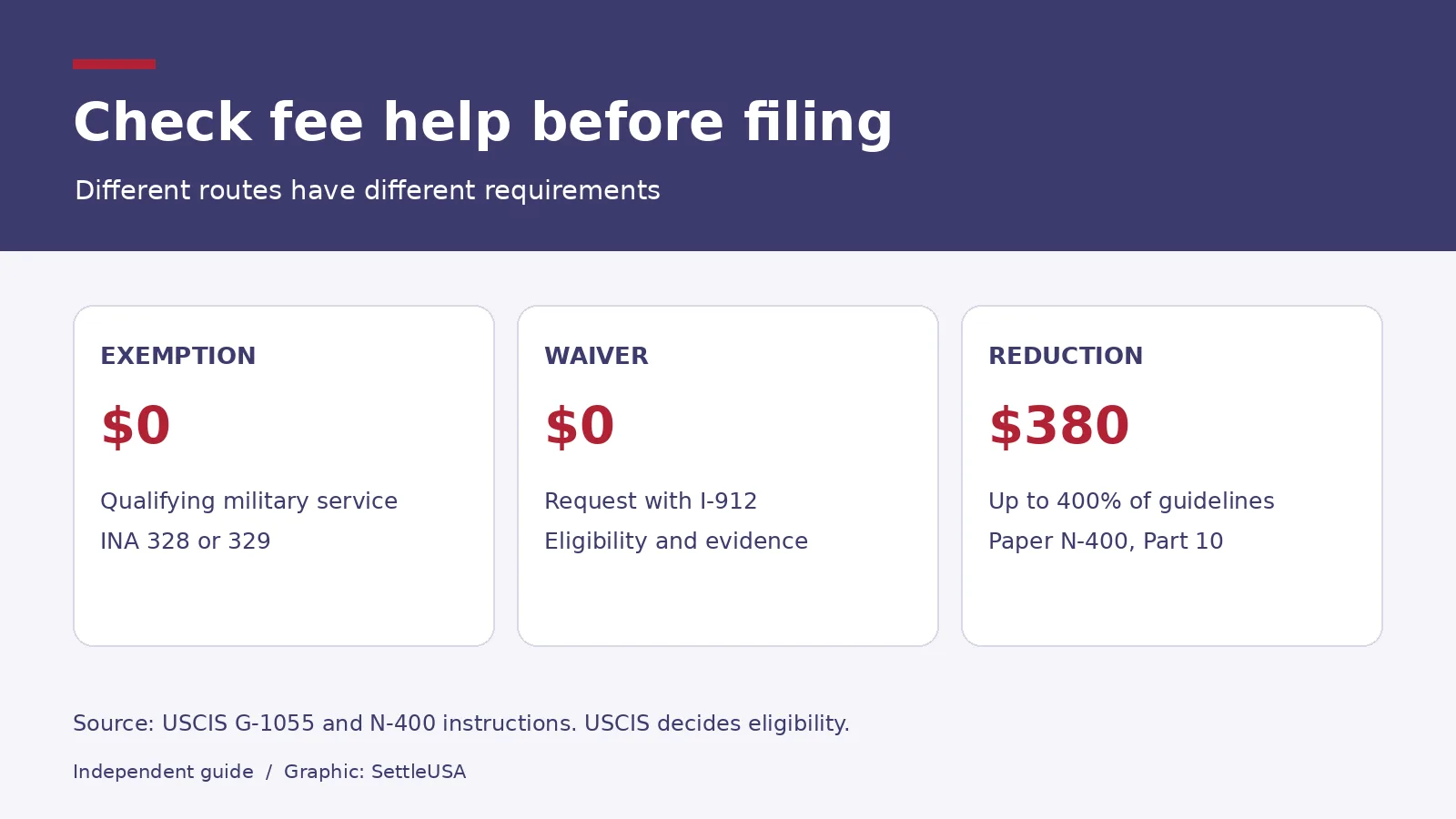
| Approved fee waiver | $0 | Qualify and submit the waiver request and evidence with paper N-400. |
| Military exemption | $0 | Meet INA section 328 or 329 requirements based on military service. |
The standard online amount is $50 less than the standard paper amount. That comparison does not replace the assistance rules: a qualifying reduced paper filing costs less than either full-fee route. Check the right category first, then choose the submission method it requires. Verify all fee options.
Who qualifies for the $380 reduced N-400 fee?
The schedule says applicants whose documented annual household income is not more than 400% of the Federal Poverty Guidelines may use the $380 paper fee. The N-400 instructions say eligibility depends on household size and income at the time of filing. Check the reduced-fee row; read Part 10 instructions.
“Not more than” includes the threshold itself. Use the current guidelines for your household rather than an old dollar amount from a saved article. This guide does not publish household dollar limits because applicants should check the applicable current table before submitting financial evidence. Follow the guideline link in the instructions.
Complete Part 10 of N-400, Request for a Fee Reduction, and provide the required information and evidence. A reduction is requested through N-400 itself. It is different from the I-912 fee-waiver request explained below. Read the reduction instructions.
The instructions describe evidence such as household members’ recent federal tax returns. If a return was not filed or does not reflect current income, they describe alternatives such as pay statements, wage records or employer statements. Use the evidence rules that fit your situation. Check Required Evidence — Reduced Fee.
How does an N-400 fee waiver with I-912 work?
A fee waiver is a request to pay no filing fee because you cannot afford it. N-400 is among the eligible forms, but USCIS must review the qualifying basis and evidence. The reduced-fee income threshold does not automatically produce a full waiver. Check eligible forms and filing instructions.
- A qualifying means-tested benefit can support a request.
- Household income at or below 150% of the Federal Poverty Guidelines can support a request.
- Extreme financial hardship that prevents payment can support a request.
- The applicable conditions and supporting documentation still matter.
These are the main bases described in USCIS fee-waiver guidance. Read the household and benefit rules carefully, especially if relying on another household member’s benefit or financial support. A benefit card alone may not contain the information USCIS requires.
Submit I-912 or a qualifying written request, evidence, and the paper N-400 together. USCIS says not to send I-912 by itself or after the application has already been received. N-400 waiver applicants cannot file online. Read how to submit the request; check the paper-only rule.
Who receives the military fee exemption?
G-1055 lists $0 for N-400 applicants who meet the requirements of INA section 328 or 329 with respect to military service. This is a specific legal category. Check the eligibility requirements rather than assuming any connection to military service establishes the exemption. Read the military exemption row.
The N-400 page identifies evidence for military-service applicants, including service certification or separation records as applicable. Read that checklist and the instructions for the basis under which you apply. Do not assume a family relationship alone establishes the exemption. See the Military Service evidence checklist.
An exemption is different from a waiver. USCIS says a fee-exempt filing category does not require I-912 just to claim that exemption. You must still meet the requirements of the application and provide the relevant evidence. Read about exemptions and waivers.
Does the N-400 fee include biometrics?
There is no separate N-400 biometrics fee to add to the current filing amount. USCIS’s fee-rule guidance explains that biometric-service costs were incorporated into the main benefit fees in most cases. The N-400 fee rows list the filing amount without a separate biometrics charge. Read the fee explanation; check N-400 fees.
USCIS says N-400 applicants generally must submit biometrics unless the requirement is waived. If you need to attend an application support center, USCIS sends an appointment notice. The absence of a separate charge does not remove the appointment requirement. Read the current Biometrics section.
Follow the instructions USCIS sends for your case. The application instructions explain that biometrics can include fingerprints, a photograph and a signature for identity and security checks. Keep the appointment notice with your case records so you can find the time, location and instructions easily. Read Biometric Services Appointment.
How do you pay the citizenship application fee?
For a standard online filing, use the payment process reached through the official N-400 page and USCIS account. USCIS lists credit, debit, prepaid cards and ACH debit among online payment methods. SettleUSA does not take payments or provide application accounts. Check payment methods; open the official filing route.
For mailed applications, current guidance uses G-1450 for card authorization or G-1650 for ACH transactions. USCIS generally no longer accepts personal checks, business checks, money orders or cashier’s checks for paper-filed forms unless a qualifying exemption applies. Read the current payment alert.
If you qualify for an exemption from electronic fee payment, check G-1651 and the payment instructions. Filing a paper N-400 does not itself establish a paper-payment exemption. Reduced-fee applicants still need an accepted way to pay the reduced amount. Read the paper-payment exception guidance.
USCIS recommends paying each separate benefit request separately. If several family members apply, read the payment guidance for each request so one defective application does not put another complete application at risk of rejection. Read the separate-payment recommendation.
What should you check before sending N-400?
Use the current accepted form edition and keep all paper pages from that edition. USCIS warns that missing pages or mixed editions can lead to rejection. For a reduced fee, confirm Part 10 and the required evidence; for a waiver, check the complete I-912 package. Check edition and filing instructions.
- Confirm the naturalization basis and eligibility information.
- Check exemption, waiver and reduction options before paying.
- Use the filing method required for the option you choose.
- Review the evidence and signature instructions.
- Check the current filing address or official online route.
- Save copies and read every notice sent by USCIS.
The official N-400 page offers an initial-evidence checklist, but says it does not replace the form instructions or legal requirements. Treat a checklist as a preparation aid. If your situation involves a complicated immigration history, get qualified advice before filing. Read the official evidence checklist.
Is the N-400 fee refundable?
USCIS’s published policy says filing and biometric service fees are final and nonrefundable regardless of its action on the request or a withdrawal. Paying buys the application service; it does not guarantee the result. Review eligibility and fee help before submitting. Read the USCIS refund policy.
If a payment or filing problem occurs, read the specific USCIS notice and contact the agency through its official channels. This guide cannot determine whether an individual payment issue will qualify for correction. Start with the instructions attached to your own application or notice. Check official payment guidance.
Keep the payment confirmation, application copy and agency correspondence together. They help you explain the problem accurately if you need agency assistance. Send payment authorizations and identity evidence only through the official process, and keep your personal copies secure.
After paying: track the application and use official resources
USCIS online accounts can provide case updates, payment access, evidence-response tools and contact-information management. Paper applicants receive instructions for account access, and USCIS says it processes an application even if the applicant does not create an online account. Read what happens after filing.
The US citizenship test and interview preparation are separate practical steps from selecting a fee category. Start with the naturalization links on the official N-400 page. This fee guide does not assign a test version or predict when an individual interview will take place. Use official naturalization resources.
For comparisons with card renewal, see our green card renewal guide. For other application charges, see the USCIS fee schedule guide. Each form has its own purpose, eligibility requirements and fee rules.
Before submitting, return to the official N-400 page and current G-1055 schedule. Confirm the filing route, fee category, evidence and payment instructions. If an agency notice or instruction differs from this guide, resolve it directly with USCIS.
Frequently asked questions
What is the N-400 fee in November 2026?
The general fee checked November 12, 2026, is $710 online or $760 on paper. Qualifying paper applicants may pay $380, while approved fee-waiver and specified military categories pay $0.
Who qualifies for the $380 citizenship application fee?
USCIS lists applicants whose documented annual household income is no more than 400% of the Federal Poverty Guidelines. Complete Part 10 of the paper N-400 and include the required evidence.
Can I request an N-400 fee waiver online?
No. USCIS requires a paper N-400 for fee-waiver and reduced-fee requests. Submit the waiver request and evidence with the application.
Is I-912 the form for a reduced N-400 fee?
I-912 requests a full waiver of an eligible fee. The N-400 reduced fee is requested through Part 10 of N-400, with the supporting information required in its instructions.
Does military service make the N-400 fee zero?
G-1055 lists a $0 fee for applicants meeting INA section 328 or 329 military-service requirements. Check the specific eligibility and evidence rules before filing.
Do I pay another N-400 biometrics fee?
There is no separate biometrics charge to add to the current N-400 filing fee. USCIS may still require a biometrics appointment and will notify you if attendance is necessary.
Will USCIS refund the citizenship application fee if I withdraw?
The published USCIS policy says filing and biometric service fees are final and nonrefundable, including when a request is withdrawn. Read the official policy before paying.
Is the N-400 fee the same as green card renewal?
No. N-400 is a naturalization application; I-90 renews or replaces a permanent resident card. They are different processes with separate fees.
Official sources
- U.S. Citizenship and Immigration Services — G-1055 current edition noticeChecked
- U.S. Citizenship and Immigration Services — G-1055 Fee Schedule, edition 10/26/26Checked
- U.S. Citizenship and Immigration Services — N-400, Application for NaturalizationChecked
- U.S. Citizenship and Immigration Services — Form N-400 instructionsChecked
- U.S. Citizenship and Immigration Services — I-912, Request for Fee WaiverChecked
- U.S. Citizenship and Immigration Services — Additional Information on Filing a Fee WaiverChecked
- U.S. Citizenship and Immigration Services — Filing Fees and refund policyChecked
- U.S. Citizenship and Immigration Services — Calculate Your FeesChecked
- U.S. Citizenship and Immigration Services — Frequently Asked Questions on the USCIS Fee RuleChecked
Source review: complete. Last checked .
Independent guide, not affiliated with SSA, VA, USDA or any government agency. Not financial or legal advice. Confirm your circumstances with the responsible agency or service.