
USCIS fee schedule: common form fees
What are the current USCIS filing fees?
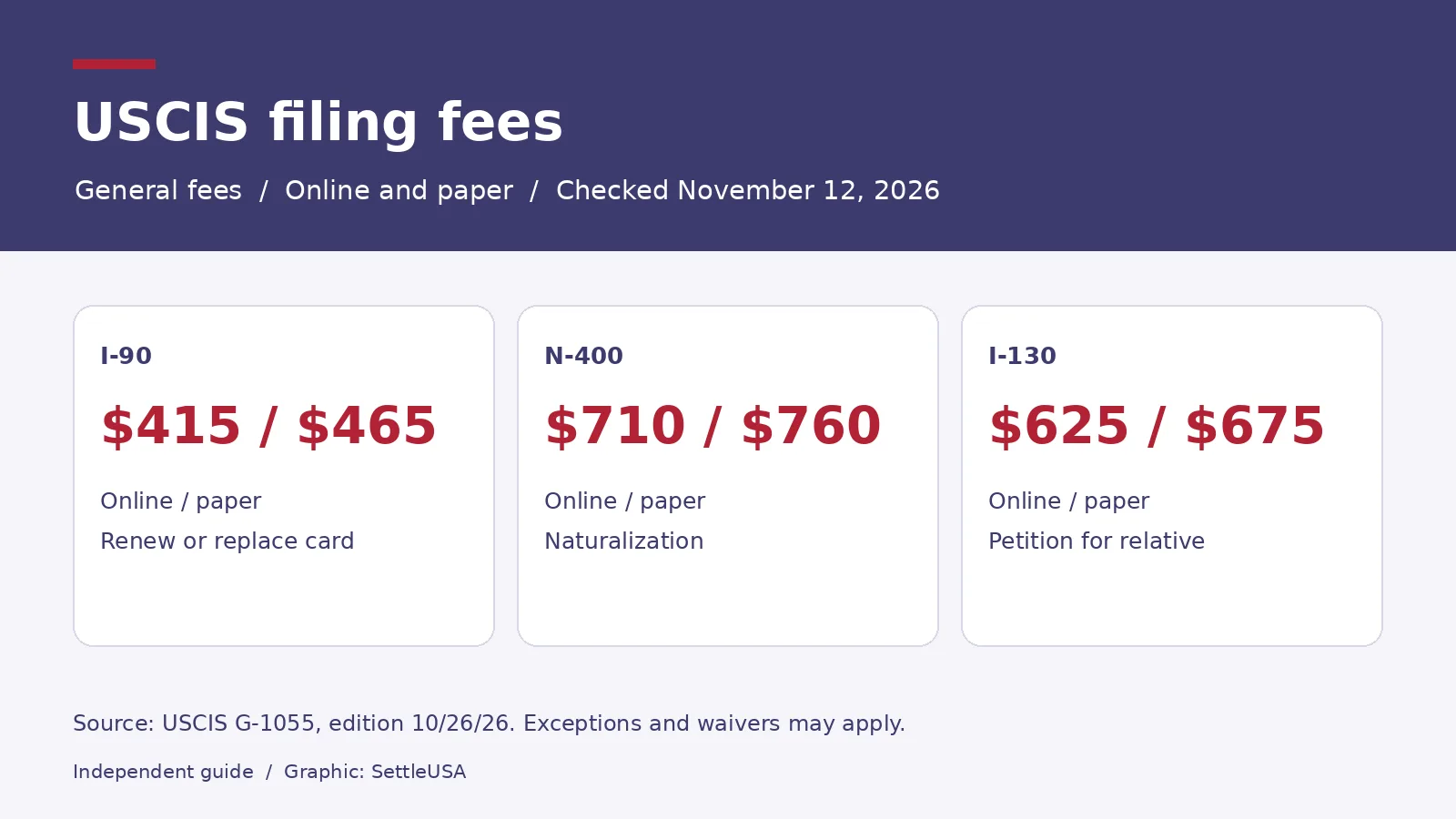
As of November 12, 2026, USCIS lists general online/paper fees of $415/$465 for I-90, $710/$760 for N-400, and $625/$675 for I-130. Fees depend on the form, category and filing route. Check G-1055 edition 10/26/26 and the official calculator before paying; exemptions and additional fees may apply.
Published · Updated
Use this table as a starting point, then check your exact category with USCIS. The amount, filing route and payment instructions all matter when preparing an application.
In this guide
- Which USCIS fee schedule is current?
- Common USCIS filing fees: online versus paper
- How to use the official USCIS fee calculator
- Why I-485, I-765 and I-131 need extra care
- Green card renewal, N-400 fee and N-600 costs
- Which USCIS fees can be waived with I-912?
- Reduced fees and exemptions are different
- Additional statutory fees and annual adjustments
- How do you pay USCIS filing fees now?
- Final fee checks, rejections and refunds
- Frequently asked questions
- Official sources
Which USCIS fee schedule is current?
SettleUSA is an independent guide, not a law firm or government agency. This is general information, not individualized legal or financial advice. Submit personal information and evidence only through the official agency process. Do not send SettleUSA Social Security numbers, immigration documents, or payment details.
As of November 12, 2026, the USCIS G-1055 page identifies edition 10/26/26 as the current fee schedule. USCIS says it published that edition on October 28, 2026. The PDF describes its amounts as currently in effect. Open the current G-1055 page.
The newest edition date is not the effective date of every individual fee. USCIS says this edition added an I-290B exemption for specified class members. It does not say every amount changed on that date. Use the current table and the alerts relevant to your form. Read the edition notice.
This guide covers common forms and selected filing categories. It cannot list every exemption, reduced fee, or additional charge. Before filing, match your exact category in G-1055 and check the form webpage. A familiar form number alone may not identify the amount you owe. Read the full fee schedule.
Common USCIS filing fees: online versus paper
These amounts come directly from G-1055 edition 10/26/26, checked November 12, 2026. “General” means the schedule’s general row, not a price that applies to everyone. The I-131 row deliberately identifies one specific travel-document category because that form has no single universal fee. Verify each row in the official PDF.
| Form | Category shown | Online | Paper | Important exception or limit |
|---|---|---|---|---|
| I-90 | Regular card renewal or replacement | $415 | $465 | Specific $0 categories and fee waivers exist. |
| N-400 | General naturalization filing | $710 | $760 | Reduced paper fee $380; eligible waiver or military exemption $0. |
| I-130 | General family petition | $625 | $675 | This petition fee is not the complete cost of immigration. |
| I-485 | General filing category | $1,390 | $1,440 | Age, category and online eligibility matter. |
| I-765 | General EAD filing | $470 | $520 | Many category-specific rates; see Appendix C. |
| I-131 | Advance parole: pending I-485, Part 1, item 5.A | $580 | $630 | Selected category only; see Appendix B. |
| I-751 | General removal of conditions | $700 | $750 | Specific exemptions and fee waivers exist. |
| I-129F | General fiancé(e) petition | Not listed | $675 | K-3 petition based on a filed I-130 is listed at $0. |
| N-600 | General certificate of citizenship application | $1,335 | $1,385 | Specific exemptions and fee waivers exist. |
An online fee in G-1055 does not establish that every applicant can file online. The form page determines who can use that route. I-485, for example, is available online for certain applicants and representatives. Check eligibility before budgeting for the lower amount. Read the I-485 online-filing alert.
For I-129F, the general row lists a fee without a separate online amount. This table therefore leaves the online price unlisted. Do not assume every paper form has an online equivalent or subtract an online discount yourself. Check the filing category and method.
How to use the official USCIS fee calculator
The official calculator presents G-1055 information by form. USCIS developed it to reduce rejections caused by incorrect fees. Select your form, then read the categories and exceptions rather than stopping at the first amount you see. Open Calculate Your Fees.
- Identify the exact form and your reason for filing it.
- Check whether you are using online or paper filing.
- Read the category-specific fee, exemptions and notes.
- Check whether an additional statutory fee applies.
- Review the official form instructions and payment guidance.
- Repeat the check for each separate application in your package.
Keep a record of the date you checked and the category you used. That is especially helpful if you prepare several forms over different weeks. Recheck before submission so you do not use a saved amount after an official update. The calculator is a useful cross-check, not an eligibility decision. Use the current calculator.
Why I-485, I-765 and I-131 need extra care
The general I-485 row is $1,440 on paper or $1,390 online. The schedule separately lists a child under 14 filing concurrently with a parent at $950 on paper or $900 online. It also lists specific $0 categories. Do not apply the general row to every family member. See the I-485 rows on pages 15–16.
For I-765, the general row is $520 paper or $470 online. A separate row lists $260 for paper or online filing if you filed I-485 with a fee on or after April 1, 2024, and it remains pending. Other categories have other rates. See Appendix C for I-765.
The I-131 row above is for advance parole with a pending I-485, not reentry permits, refugee travel documents, or every parole request. Those purposes have their own rows. Check Appendix B using the purpose and item number from the application. Read Appendix B for I-131.
USCIS fee-rule guidance explains that I-485, I-765 and I-131 generally have separate filing fees, including when filed together. Check for category-specific and filing-date exceptions before adding them up. A single package does not necessarily mean a single fee. Read the separate-fee explanation.
Green card renewal, N-400 fee and N-600 costs
Green card renewal usually points readers to I-90. Naturalization uses N-400 for eligible applicants. N-600 is an application for a Certificate of Citizenship. These form titles describe different requests, so choose the correct process before comparing their prices. Check the official form titles and categories.
The general N-400 fee is $710 online or $760 paper. The reduced fee is $380 for qualifying paper applicants; specified military applicants and approved fee-waiver applicants pay $0. Our N-400 fee guide explains those options in more detail. See the N-400 fee rows.
For I-90, the general online and paper fees are $415 and $465. For N-600, they are $1,335 and $1,385. G-1055 lists specific exemptions for both forms. Read the full conditions; a fee exemption does not itself make someone eligible for the immigration benefit. Read the I-90 and N-600 exceptions.
Which USCIS fees can be waived with I-912?
Fee waivers are available only for eligible forms and filing categories. I-912 or a qualifying written request explains why you cannot pay. USCIS requires the request and supporting evidence with the underlying application; a standalone waiver request is not enough. Read I-912 filing instructions.
The main bases are a qualifying means-tested benefit, household income at or below 150% of the Federal Poverty Guidelines, or extreme financial hardship. USCIS reviews the evidence and applicable conditions. Having a low income does not make every USCIS form eligible for a waiver. Check detailed fee-waiver criteria.
Check the waiver list before preparing financial records. The official guidance distinguishes qualifying benefits from benefits that do not qualify on that basis. It also explains household income and hardship evidence. Send that information through USCIS’s required process, not to SettleUSA. Read the evidence guidance.
For most forms, USCIS says a fee-waiver request requires paper filing. There are limited online arrangements for some eligible I-765 categories. N-400 waiver and reduced-fee applicants must use paper. Do not assume an exception for one form applies to another. Check online waiver exceptions; read N-400 filing rules.
Reduced fees and exemptions are different
A reduced fee means a smaller payment. A waiver means USCIS approves a request not to pay an eligible fee. A fee exemption is a category that the schedule lists at $0; USCIS says you do not need I-912 just to claim an applicable exemption. Read Fee Exemptions and Fee Waivers.
N-400 has a specific $380 paper fee for applicants whose documented annual household income is no more than 400% of the Federal Poverty Guidelines. Use the N-400 reduction section and supporting evidence, rather than treating it as an I-912 request. Read Part 10 instructions.
There is no universal reduced-price menu across USCIS forms. A reduction listed for naturalization does not create a similar discount for a family petition or card application. Check the form’s own row and the conditions attached to it before deciding how much to submit. Use the form-specific fee rows.
Additional statutory fees and annual adjustments
The current schedule says certain forms have additional fees required by Public Law 119-21. Those charges may be separate from the USCIS filing fee and cannot be waived. The G-1055 webpage also says those statutory fees adjust each year as required by law. Read the statutory-fee guidance.
Do not assume a waiver of the USCIS filing fee also waives a statutory charge. The schedule says an applicable additional fee still has to be paid, separately, even when the filing fee is waived. Check the applicable category and current alerts before sending payment. Read the payment instructions on page 1.
USCIS also posts litigation-related exceptions and pauses on the schedule page. This guide does not turn those detailed rules into a universal surcharge. If an alert appears relevant to you, read the official instructions or check with USCIS or a qualified immigration attorney. Check current alerts.
How do you pay USCIS filing fees now?
Online applications use the agency payment process. USCIS lists credit, debit, prepaid cards and ACH debit as online methods. For mailed applications, current guidance uses G-1450 for card authorization or G-1650 for ACH authorization. Read the instructions for the exact form before paying. Check current ways to pay.
USCIS no longer generally accepts personal checks, business checks, money orders or cashier’s checks for paper-filed forms. A qualifying exemption requires the appropriate paper-payment process, including G-1651. Paper application filing and paper fee payment are separate questions. Read the payment alert.
USCIS recommends paying each benefit request separately. Combining payments can cause an entire package to be rejected if one application has a defect. For multiple forms, check both the total amount and how USCIS tells you to authorize each individual payment. Read Multiple Applications or Methods of Payment.
Final fee checks, rejections and refunds
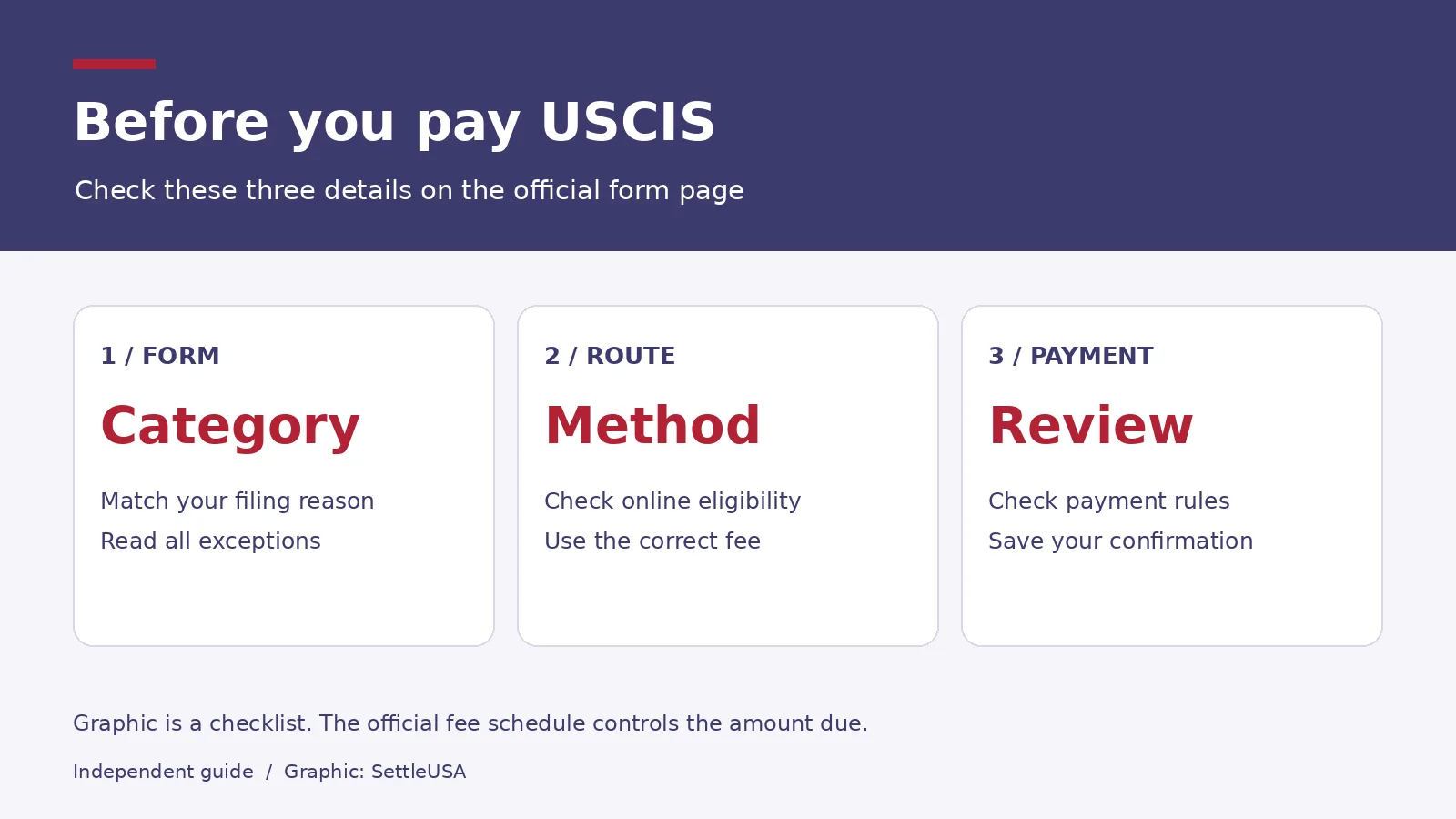
USCIS says an incorrect fee can cause rejection. Before filing, compare the form number, purpose, category, route and payment method with the current official instructions. Check each family member’s application separately; ages and categories can lead to different amounts. Confirm the correct fee.
USCIS describes filing and biometric service fees as final and nonrefundable regardless of the action on the request or a withdrawal. Do not assume a refusal or a change of plan will return your payment. Read the applicable form instructions before sending a fee. Read the refund policy.
Use G-1055 and the calculator immediately before submission. Save a copy of your fee calculation and payment confirmation. If the current form instructions differ from a saved checklist, resolve the difference through USCIS before filing.
Frequently asked questions
Where can I find the current USCIS fee schedule?
Use the official G-1055 webpage and PDF. On November 12, 2026, USCIS identified edition 10/26/26, published October 28, as the current edition.
Is the online USCIS fee always $50 lower?
Do not assume so. Some forms list different online and paper fees, some categories have the same amount, and some have no online amount listed. Check your exact row and online eligibility.
What is the general I-485 fee?
G-1055 lists $1,440 on paper or $1,390 online for the general category. Online filing is limited to eligible applicants, and child rates and other category exceptions exist.
What is the N-400 fee?
The standard fee is $710 online or $760 on paper. Qualifying paper applicants may receive the $380 reduced fee or an approved waiver; specified military applicants are exempt.
Can I pay USCIS by personal check?
Current USCIS guidance generally requires electronic payment methods, including authorizations with mailed forms. Paper payment requires an applicable exemption and the required G-1651 process.
Does I-912 waive every immigration fee?
No. Only eligible fees can be waived, and USCIS must approve the request. Applicable additional fees required by Public Law 119-21 cannot be waived.
Are I-765 and I-131 always included in I-485?
No. Separate fees generally apply, with category-specific and filing-date exceptions. Check the I-765 and I-131 appendices instead of assuming the general I-485 fee includes them.
Official sources
- U.S. Citizenship and Immigration Services — G-1055, Fee Schedule — current edition noticeChecked
- U.S. Citizenship and Immigration Services — G-1055 Fee Schedule, edition 10/26/26Checked
- U.S. Citizenship and Immigration Services — N-400, Application for NaturalizationChecked
- U.S. Citizenship and Immigration Services — Form N-400 instructionsChecked
- U.S. Citizenship and Immigration Services — I-912, Request for Fee WaiverChecked
- U.S. Citizenship and Immigration Services — Additional Information on Filing a Fee WaiverChecked
- U.S. Citizenship and Immigration Services — Filing Fees — payment and refund policyChecked
- U.S. Citizenship and Immigration Services — Calculate Your FeesChecked
- U.S. Citizenship and Immigration Services — Frequently Asked Questions on the USCIS Fee RuleChecked
- U.S. Citizenship and Immigration Services — I-485, Application to Register Permanent Residence or Adjust StatusChecked
- U.S. Citizenship and Immigration Services — I-751, Petition to Remove Conditions on ResidenceChecked
Source review: complete. Last checked .
Independent guide, not affiliated with SSA, VA, USDA or any government agency. Not financial or legal advice. Confirm your circumstances with the responsible agency or service.