
Paint disposal: how to get rid of old paint
How do you dispose of old paint safely?
Read the label first, then check paint recycling or your local household hazardous waste program. Keep oil-based paint and aerosols out of any latex drying plan. Dry latex paint for household trash only when your local collector permits it, following that service’s preparation and container instructions.
Published · Updated
As of November 12, 2026, paint disposal depends on the product and your local collection rules. Start with reuse or an accepted recycling site before drying anything out. SettleUSA is an independent guide; the receiving program decides what it can take.
In this guide
- Paint disposal starts with the label
- How to dispose of paint: choose the right route
- Which states have PaintCare programs?
- What can you take to a PaintCare drop-off site?
- Latex paint disposal: when is drying allowed?
- Oil-based paint disposal: ask about HHW or PaintCare
- What about spray paint and aerosol cans?
- Can you donate or reuse leftover paint?
- Can paint go out with bulk trash pickup?
- Before taking old paint to a collection site
- Frequently asked questions
- Official sources
Paint disposal starts with the label
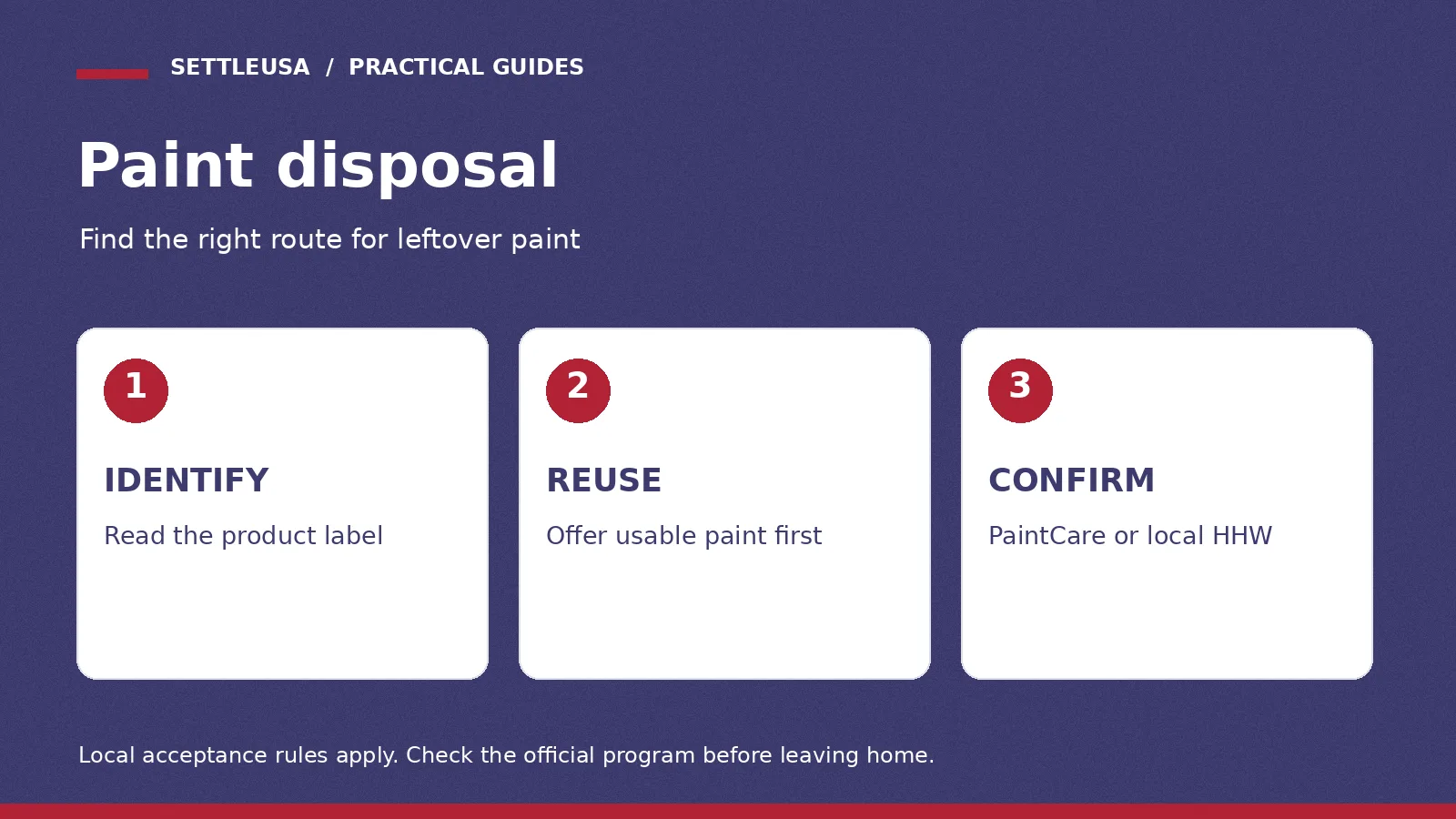
Gather the containers without combining their contents. Make a list of each product, container size and approximate amount left. Photograph readable labels for the receiving program. Keep unknown products on a separate list so you can ask about them without guessing what is inside.
Kalamazoo County’s identification guide says water-based paint labels may mention latex, acrylic latex or soap-and-water cleanup. Oil-based labels may say alkyd or oil-based, or list mineral spirits and petroleum distillates. Use the product’s actual label; container shape and paint color are not a disposal classification.
Ask the manufacturer or local household hazardous waste office if the label is missing or unclear. Explain whether the can is sealed, rusty or leaking. Do not smell or mix an unknown product to identify it, and do not transfer it into a food or drink container.
EPA’s household hazardous waste guidance recommends keeping hazardous products in their original containers with labels intact. For corroding containers it advises contacting local hazardous materials officials or the fire department for instructions. Get that advice before loading a damaged can into your vehicle.
How to dispose of paint: choose the right route
For usable paint, first consider keeping it for a planned touch-up or offering it to someone who has agreed to take it. For leftover architectural paint, check PaintCare where available. For unknown paint or products outside the program, ask the local hazardous waste service what it accepts.
Use separate routes for separate products. PaintCare’s acceptance page includes eligible latex and oil-based architectural paints, primers, stains and certain clear coatings. It excludes aerosol coatings and solvents. A retailer accepting house paint is not automatically a drop-off point for the rest of your workshop chemicals.
For a garage cleanout, sort the booking questions as well as the materials. Our appliance disposal and tire disposal guides cover two other common categories. Confirm each receiving service before combining trips; the most convenient facility may not take everything.
Which states have PaintCare programs?
As of November 12, 2026, PaintCare lists programs in 12 states and the District of Columbia: California, Colorado, Connecticut, Illinois, Maine, Maryland, Minnesota, New York, Oregon, Rhode Island, Vermont and Washington. Use the program’s state page and locator to find a participating site.
Illinois and Maryland are already operating programs. Their official PaintCare pages show Illinois began in December 2025 and Maryland began in April 2026. Older lists that describe either program as forthcoming do not reflect the program pages checked for this guide.
The state list identifies where the program operates, not permission to leave paint at any paint store. Use PaintCare’s drop-off locator and contact the listed site about current availability. Confirm the actual street address and entrance before loading, especially if a store has several branches.
What can you take to a PaintCare drop-off site?
PaintCare requires eligible products in their original containers, no larger than five gallons, with the original manufacturer’s printed label and a secure lid. It does not accept open or leaking cans. Eligible products are accepted at participating sites at no additional drop-off cost.
Keep aerosols, thinners, solvents and other excluded products out of the PaintCare load unless the receiving facility separately confirms it accepts them under another service. Ask about your exact product name. “Paint supplies” is too broad a description for a mixed box of coatings and chemicals.
Call the site with your container count and approximate volume. Ask about the amount it can take that day, whether an appointment is needed and any unloading instructions. PaintCare asks people to confirm hours and availability before visiting; a locator listing is the start of that check.
Tell the operator if the paint came from a business. PaintCare generally requires exempt-generator status for business oil-based paint. Illinois allows all businesses to participate; New York permits non-exempt generators to use pickup only. Confirm your state’s rules with PaintCare before planning a contractor or commercial cleanup.
Latex paint disposal: when is drying allowed?
Drying latex paint for trash is a local option, not a national rule. Kalamazoo County allows completely dried latex paint in garbage and directs residents to remove the lid. Its hazardous waste center does not accept latex paint, so taking a wet can there would not solve the problem.
In Texas, Longview’s paint page permits dried latex paint in trash and describes using absorbent material such as cat litter. It also says to leave the lid off so workers can see the contents are hardened. Use those instructions only for the service and product they cover.
For a county example, Montgomery County, Maryland requires latex and water-based paint to be hardened or dried, with no wet or soft paint that could spill. It publishes its own bagging and collection instructions. Confirm your hauler’s rules rather than applying another jurisdiction’s lid or bag instructions.
Before drying, ask whether recycling is available for the wet paint. If you choose an allowed drying route, follow the product label and local directions, keeping the work away from children and animals. Do not assume a dry surface means the whole container has hardened; ask the collector what condition it requires.
Oil-based paint disposal: ask about HHW or PaintCare
For household oil-based paint, start with an accepting PaintCare location or your local household hazardous waste program. Describe the product and quantity before visiting. Do not apply latex drying instructions to oil-based paint, stains or solvents without specific guidance from the receiving local authority.
Houston’s Environmental Service Centers list oil- and enamel-based paint, paint thinners, turpentine, stains and finishes among accepted supplies. They also list latex paint. That is an example of an HHW service taking several paint-related products; check its current eligibility and quantity requirements before traveling.
If one program refuses a product, ask which local facility handles it. Give the office the exact label wording rather than asking only about “old paint.” Keep the answer with your inventory so a family member helping with the cleanup does not send the rejected product to the wrong destination.
What about spray paint and aerosol cans?
PaintCare excludes aerosol coatings. Ask your local hazardous waste service about partly full spray-paint cans, even when it accepts brush-on paint elsewhere. Houston’s Environmental Service Centers expressly list aerosol cans among workshop and painting supplies, but that does not establish a nationwide aerosol rule.
Ask separately about empty aerosol cans and partly full ones. Describe whether the nozzle works and whether you know the contents. Do not puncture a can or spray out unwanted paint simply to make it qualify for a different collection stream; ask the receiving service for its instructions.
Keep spray paint separate from a latex drying project. A PaintCare booking for several cans of wall paint does not cover aerosols. If you have other pressurized containers from the garage, list those separately too, and confirm each product before adding it to the trip.
Can you donate or reuse leftover paint?
PaintCare’s PaintShare guidance describes reuse as giving away, selling or using up leftover paint, with usable paint available through some reuse stores and hazardous waste facilities. Its locator identifies partners offering reuse paint. Ask the local site what it accepts rather than assuming every donation center takes paint.
If offering paint directly, share the product name, color, finish, amount and a label photo. Ask the recipient to confirm suitability for the intended project. Agree on a handoff time and keep the container sealed; an interested reply is not permission to leave paint on someone’s property.
For paint you keep, follow label storage directions and record where you used it. Save the color information with your home maintenance notes. Before a move, tell the next occupant what each retained can is for and confirm they want it; otherwise complete the disposal plan before handover.
Can paint go out with bulk trash pickup?
For bulk trash pickup Houston, the city’s heavy trash rules exclude wet paint and household hazardous waste and direct those items to an Environmental Service Center. Booking a couch or washer collection does not make a box of paint cans acceptable in the same pile.
For bulky item pickup Los Angeles, LASAN’s bulky collection page prohibits paints, solvents and chemicals and directs residents to S.A.F.E. Centers. Use the linked official instructions from our Los Angeles guide to confirm the appropriate facility before traveling.
Find your city through the bulk trash guides, then check paint-specific instructions. General wording such as “household items” is not enough. If you live in an apartment, ask the manager and waste provider where accepted materials should wait; do not leave paint beside communal bins.
Before taking old paint to a collection site
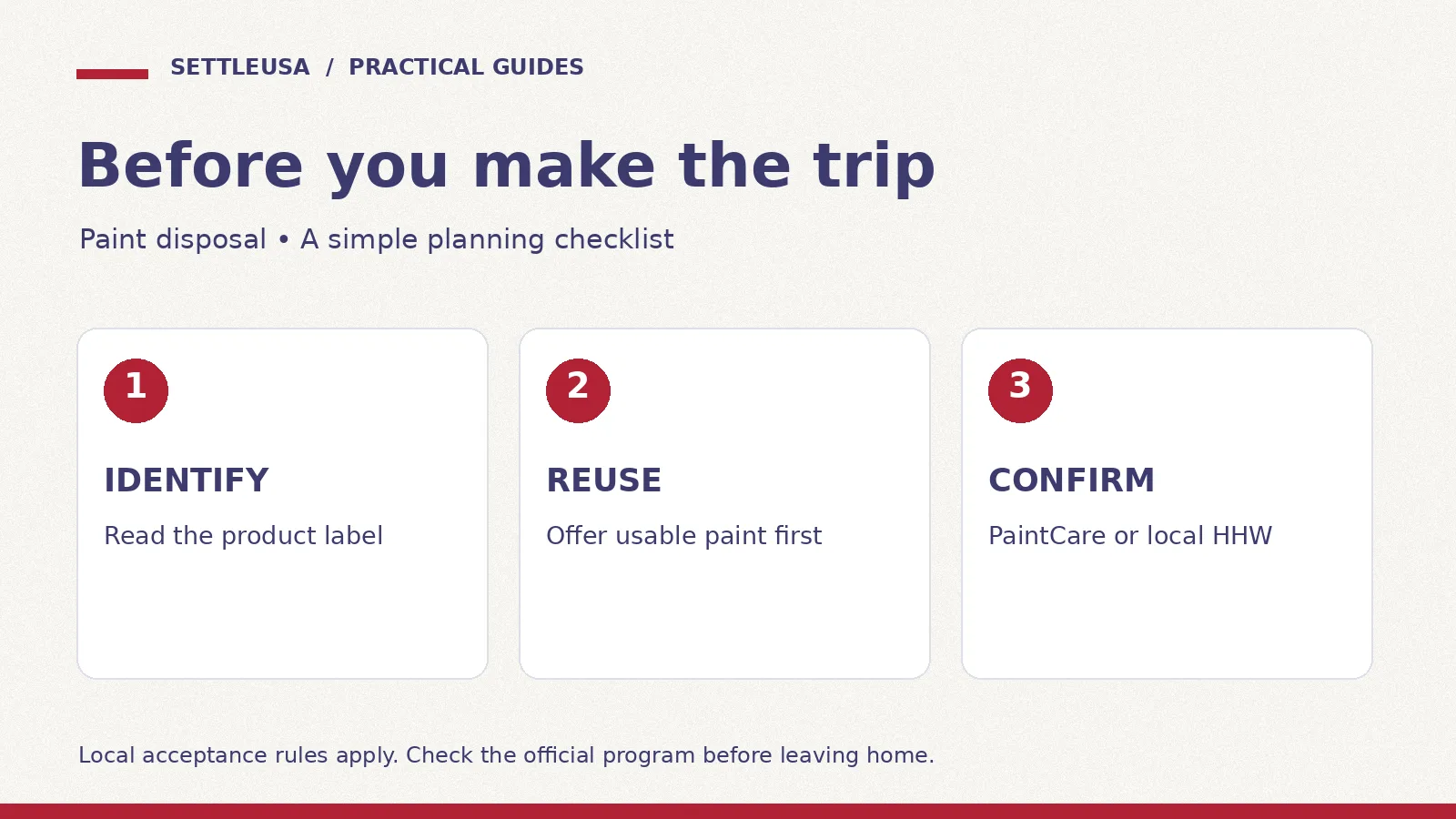
Finish the acceptance check before packing. Confirm the product list, resident or business eligibility, quantity, appointment, opening hours and any fee. Ask how to handle damaged containers and how the facility wants intact cans presented. Keep the inventory available during unloading so you can answer questions.
EPA says not to mix household hazardous wastes and warns against disposal into drains, on the ground or into storm sewers. Read the labels and receiving facility’s directions. If a can is leaking or badly corroded, get instructions rather than trying to solve the problem by transferring it yourself.
If the site refuses a container, ask for an accepted alternative and the reason for refusal. Add that information to your inventory before trying another facility. Keep rejected products separate from cans that have already been cleared for a different route; this prevents the same mistake on the next trip.
Frequently asked questions
Can I put liquid paint in the trash?
Check your collector’s paint-specific rules before set-out. The local examples in this guide require latex paint to be dried or hardened for the trash route; do not use that route for an unknown product.
How do I tell latex paint from oil-based paint?
Read the label. Latex or acrylic latex and soap-and-water cleanup are clues to water-based paint; alkyd, oil-based, mineral spirits or petroleum distillates indicate a different product. Ask the manufacturer or HHW office if unclear.
Is PaintCare available in Maryland and Illinois?
Yes. PaintCare’s state pages show Maryland began in April 2026 and Illinois in December 2025. Confirm a participating site’s availability before visiting.
Does PaintCare take oil-based paint?
Eligible oil-based architectural paints are included, subject to product and container requirements. Business eligibility depends on state generator rules; Illinois allows all businesses, and New York permits non-exempt generators to use pickup only.
Does PaintCare accept spray paint?
No. PaintCare excludes aerosol coatings; ask your local hazardous waste service about partly full cans and ask the collector separately about empty ones.
Can I donate leftover paint?
Ask a reuse program or a willing recipient first. PaintCare identifies some reuse partners through its locator, but not every charity or paint collection location offers reuse.
Can paint go with bulky item pickup Los Angeles?
LASAN’s bulky collection page prohibits paints, solvents and chemicals and points residents to S.A.F.E. Centers. Confirm the receiving center’s product acceptance and current instructions.
Official sources
- US Environmental Protection Agency — Household Hazardous WasteChecked
- PaintCare — PaintCare StatesChecked
- PaintCare — Maryland programChecked
- PaintCare — Illinois programChecked
- PaintCare — Products We AcceptChecked
- PaintCare — Drop-off Site LocatorChecked
- PaintCare — PaintShareChecked
- Kalamazoo County — Latex Versus Oil-Based PaintsChecked
- City of Longview — Disposing of Special Items: PaintChecked
- Montgomery County, Maryland — Latex and water-based paints and stainsChecked
- City of Houston — Environmental Service CentersChecked
- City of Houston — Heavy Trash CollectionChecked
- LA Sanitation & Environment — Schedule a Bulky Item PickupChecked
- PaintCare — Business Limits for Hazardous Program ProductsChecked
Source review: complete. Last checked .
Independent guide, not affiliated with SSA, VA, USDA or any government agency. Not financial or legal advice. Confirm your circumstances with the responsible agency or service.