
Tire disposal: where to take old tires
Where can you take old tires for disposal?
Ask the retailer replacing your tires about take-back, then check your city or county for an accepted drop-off site or tire amnesty event. Confirm quantity, size, rim and residency rules before loading. Curbside acceptance varies: Phoenix and Columbus exclude tires from bulk collection, while Houston permits limited passenger-tire collection.
Published · Updated
As of November 12, 2026, tire disposal is a local decision: retailers, state programs and city services have different requirements. Count the tires and identify their type before choosing a route. This independent SettleUSA guide helps you confirm an accepted handoff.
In this guide
- Tire disposal: start with the retailer or local waste office
- Can a tire shop take your old tires?
- State tire fees: California, New York and Florida examples
- How state scrap tire programs help you find a route
- Look for tire amnesty events, then check the conditions
- Bulk trash pickup Phoenix and Columbus exclude tires
- Bulk trash pickup Houston: a limited passenger-tire exception
- What to ask about rims, size and transporting tires
- Avoid illegal dumping and unconfirmed handoffs
- Your old tire disposal checklist
- Frequently asked questions
- Official sources
Tire disposal: start with the retailer or local waste office
If a shop is replacing your tires, ask about leaving the old ones there before the work begins. Request an itemized estimate that identifies any state tire fee and the shop’s separate removal or recycling charge. Do not assume those charges purchase the same service.
If you already have tires at home, ask the city or county waste office for a receiving facility. EPA’s current tire guidance says many states ban all or whole tires from landfills and recommends checking local and state storage, handling and management requirements. A general landfill listing does not establish tire acceptance.
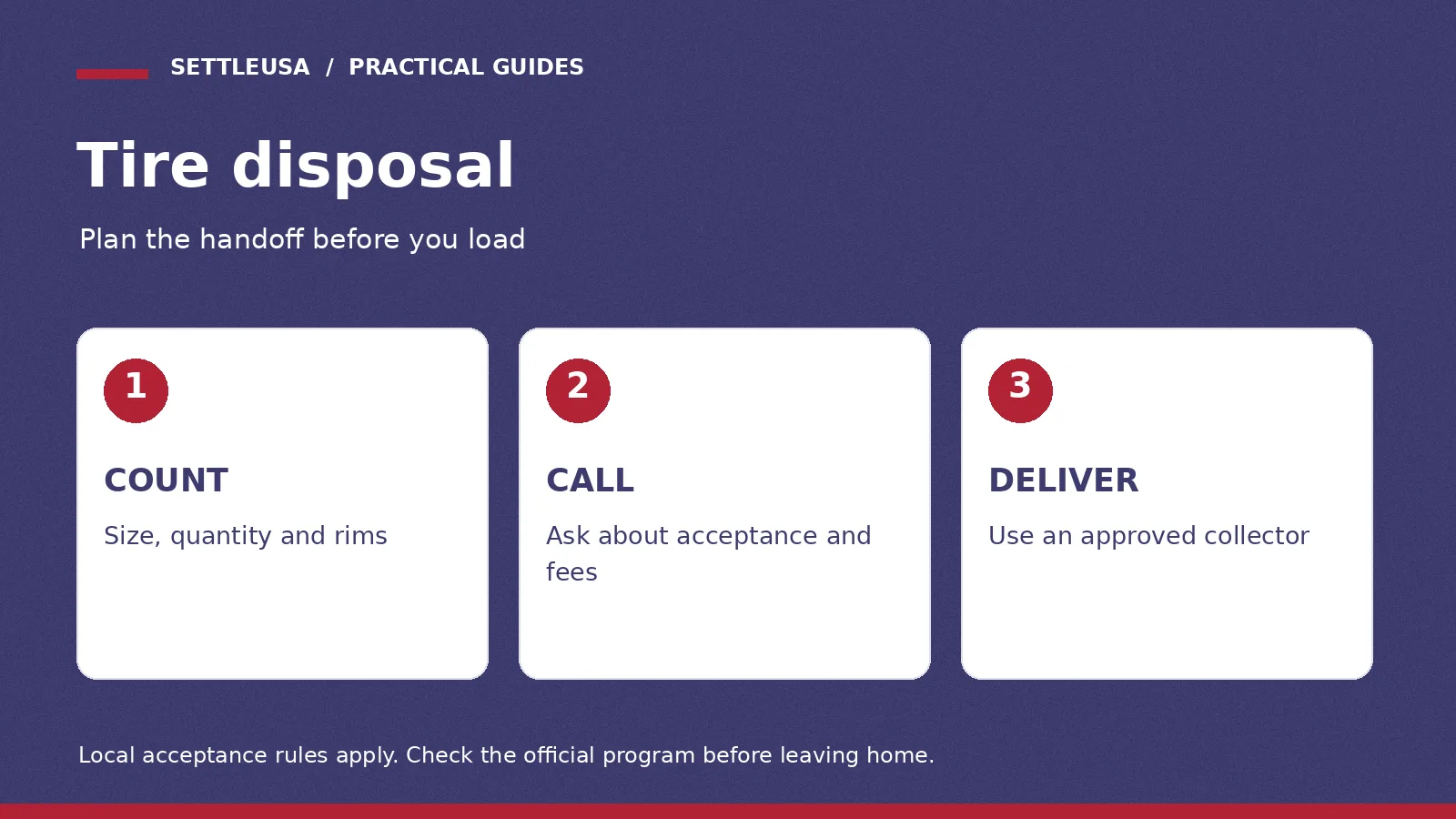
Prepare a short inventory: how many tires, passenger or larger vehicle type, approximate size and whether wheels or rims are attached. Mention bicycle, motorcycle, truck, agricultural or commercial tires explicitly. Ask the receiving operator about each category instead of treating everything made of rubber as one accepted material.
Choose a confirmed destination before borrowing a truck or paying for transport. If a facility redirects you elsewhere, call the second location first. Keep the operator’s response and current instructions with your inventory so the person delivering the tires can explain exactly what has been accepted.
Can a tire shop take your old tires?
Ask the shop whether take-back is connected to buying or installing replacement tires, and whether it takes loose tires from noncustomers. State rules and business services differ. Request the price for your actual quantity and type rather than relying on a general recycling claim on a sign.
New York provides a specific example. The Department of Environmental Conservation says tire service centers must accept used tires approximately the same size and equal in quantity to new tires purchased or installed. It also says a separate recycling-cost charge of up to $2.50 per tire may apply.
That New York take-back rule does not establish free disposal for extra tires, a different size or a customer in another state. Ask the retailer to explain any proposed charge and record the agreed handoff on the work order. If you intend to keep your old tires, say so before service begins.
State tire fees: California, New York and Florida examples
As of November 12, 2026, California’s tax guide lists a $1.75 fee per new tire. New York’s Tax Department lists a $2.50 waste tire management and recycling fee on most new tire retail sales delivered in the state. Check exemptions and covered sales on those official pages.
Florida’s Department of Revenue describes a $1 new motor vehicle tire fee imposed on retail sellers, separately stated on the invoice and included in the amount subject to sales tax. This differs from assuming every state imposes the same charge directly on the purchaser.
These examples explain why a tire bill can contain a state fee. They are not quotes for disposing of a loose tire at a shop or transfer station. Ask for the disposal price separately, including any wheel handling, transport or special tire charge, before deciding which option is cheaper.
For a replacement purchase, compare the entire installed bill and accepted old-tire handoff. A lower advertised tire price may not answer what happens to the old set. If an invoice simply says “environmental fee,” ask which part is required by the state and which part pays for the shop’s service.
How state scrap tire programs help you find a route
Use your state environmental agency’s current scrap tire page as a starting point for local referrals and regulated operators. EPA directs residents to state and local waste officials because tire management requirements vary. A state program is not necessarily a public site where you can arrive with a load.
EPA’s archived state-program directory provides historical background. It is an archive, so do not treat its old summaries or links as current state rules. Follow up with the current state agency before relying on a storage threshold, transporter requirement, collection program or facility listing.
For a current state example, Michigan EGLE’s scrap tire program oversees handling, cleanup of scrap tire piles and expansion of reuse and recycling. Ask your own state agency which local office or approved facility handles household tires. Explain whether you have a few personal tires or a larger property cleanup.
If you inherited a stockpile or found dumped tires, describe the situation before moving them. Ask whether a cleanup program applies and what documentation is needed. Do not assume that a resident drop-off allowance covers tires gathered from several properties or waste generated by a business.
Look for tire amnesty events, then check the conditions
Tire amnesty events offer a local opportunity to dispose of eligible tires, sometimes at no charge. Search the county solid waste or public health website, then read the actual event notice. Check the year, date and current status; a past event page is not a standing disposal service.
For example, Nelson County, Virginia’s November 2026 notice advertises free tire disposal for county residents on November 7 and 14, 2026, from 8 a.m. to 11:45 a.m. It limits participation to 12 tires per household, off rims and free of debris, with a maximum listed rim size of 22 inches.
The same notice excludes oversized, commercial and agricultural tires. As of this guide’s check date, November 14 is the remaining advertised date; confirm the notice before traveling. These conditions belong to that event and do not establish an annual schedule or eligibility for residents of another county.
For your own event, ask what proves residency, whether registration is needed and whether tires attached to wheels are accepted. If the notice says “off rim,” ask a tire service about removing the wheel before the trip. Confirm the extra work and cost before committing to the event.
Bulk trash pickup Phoenix and Columbus exclude tires
For bulk trash pickup Phoenix, the city’s bulk list excludes tires of any shape or size. Do not add tires to a booked furniture pile. Use the Phoenix guide to reach local information, then ask Public Works which tire route applies to your load.
For Columbus bulk pickup, the city’s unacceptable-items list includes auto parts and tires. The page directs residents to a private hauler for excluded items. Check current tire exclusions with Columbus before booking a bulk appointment.
Check the exact service you plan to use. An exclusion from curbside bulk pickup does not by itself tell you whether a separate city drop-off or special event exists. Conversely, a recycling directory entry does not give permission to leave tires by a residential trash cart.
Bulk trash pickup Houston: a limited passenger-tire exception
For bulk trash pickup Houston, the city’s heavy trash page allows up to four passenger tires at the curb for tire collection. It says crews separate tires from the other material and retrieval may take up to one week after the main collection. Confirm address eligibility and your assigned service instructions.
Houston’s residential drop-off centers list up to five passenger tires per visit and a maximum of ten per month. They exclude truck tires and industrial or tractor-trailer tires. Check proof-of-address and vehicle requirements before driving there; a passenger-tire allowance does not cover every tire type.
Do not combine the two services’ allowances into a single assumed entitlement. Tell the city whether you plan curbside collection or a drop-off visit and ask which limit applies. If a scheduled tire collection is delayed, give the city your address, collection date and tire count when asking for an update.
What to ask about rims, size and transporting tires
Use the description on the tire or a clear photo when asking about size. Tell the facility whether a wheel is still attached. If the instructions use “rim” loosely, ask whether they mean the wheel must be removed or whether they are describing the tire’s size category.
Before loading, confirm the allowed vehicle and unloading arrangements. Houston’s drop-off page illustrates why this matters: it publishes vehicle restrictions and makes residents responsible for unloading their own items. Do not assume a rented van, trailer or helper arrangement will be accepted at another site.
Ask the destination how it wants the load prepared and what to do with debris inside tires. Arrange suitable lifting and transport help for your circumstances. If removal from rims is required, have a tire service handle that work rather than trying to dismantle mounted tires solely to meet a disposal rule.
For a hired pickup, request a written scope that lists the tires, attached wheels, collection location and receiving facility. Ask how any final price changes will be approved. Keep a receipt or other confirmation of the handoff, especially when several people are coordinating a property cleanup.
Avoid illegal dumping and unconfirmed handoffs
Phoenix defines illegal dumping as dumping trash without legal permission, including tires in alleys, dumpsters, vacant lots and open desert. Leaving tires beside a closed recycling site or on someone else’s property is not a confirmed disposal arrangement. Use the local authority’s reporting route if you find a dumped load.
If reporting, record the location, approximate quantity and what you can observe without disturbing the site. Ask the local waste office who is responsible for removal and whether a state program can assist. Do not transport the load to a resident event without first confirming that the organizer can accept it.
When comparing private collectors, ask where the tires will go and whether the destination accepts that load. A low pickup quote does not explain the disposal route. If the collector cannot provide a destination or clear service terms, choose another option before handing over the tires.
Your old tire disposal checklist
Before you leave, match your inventory to the receiving site’s confirmation. Check the tire count, type, size, rim condition, accepted vehicle, residency evidence, hours, appointment and complete fee. If any detail changes, call again rather than hoping the operator will make an exception at the gate.
For a broader cleanout, plan appliance disposal and paint disposal separately. A tire destination may not accept either material. Use the bulk trash guides for city services and the disposal guides for other item-specific decisions.
After the handoff, keep the receipt with your cleanup records. If only part of the load was accepted, write down what remains and why. Use that explanation when contacting the next facility so you can resolve the acceptance issue before arranging another trip.
Frequently asked questions
Where can I take old tires without buying new ones?
Ask your city or county waste office about an accepting drop-off site, recycler or amnesty event. Confirm whether a retailer accepts loose tires from noncustomers and what it charges.
Does paying a state tire fee make disposal free?
Do not assume so. State new-tire fees and a shop’s separate old-tire handling charge are different items; ask what each covers and request the full bill.
Can tires go out with bulk trash pickup Phoenix?
Phoenix excludes tires of any shape or size from its bulk trash program. Ask Public Works about an accepted tire route before putting them outside.
Does Columbus bulk pickup accept tires?
No. Columbus lists auto parts and tires as unacceptable for city bulk collection and directs residents to private hauling for excluded items.
Does Houston collect tires at the curb?
Houston’s heavy trash page allows up to four passenger tires and says a separate retrieval may take up to one week after the main collection. Confirm your eligible address and service instructions.
Do tires have to be off the rims?
Check the receiving program. Nelson County’s cited amnesty event requires off-rim tires; do not apply that condition or any other event’s limits nationwide.
Can a business use a residential tire amnesty event?
Only if the organizer expressly accepts that waste. The Nelson County example excludes commercial tires; tell the organizer the source and type of your load before planning a trip.
Official sources
- US Environmental Protection Agency — Automobiles, Tires, and BoatsChecked
- US Environmental Protection Agency — Where You Live: archived scrap tire program directoryChecked
- Michigan EGLE — Scrap TiresChecked
- California Department of Tax and Fee Administration — California Tire Fee: Getting StartedChecked
- New York State Department of Taxation and Finance — Waste tire management and recycling feeChecked
- New York State Department of Environmental Conservation — Waste TiresChecked
- Florida Department of Revenue — Solid waste fee for tiresChecked
- Nelson County, Virginia — Tire Amnesty Days: November 7 and 14, 2026Checked
- City of Phoenix — Bulk TrashChecked
- City of Columbus — Bulk CollectionChecked
- City of Houston — Heavy Trash CollectionChecked
- City of Houston — Residential Drop-Off CentersChecked
Source review: complete. Last checked .
Independent guide, not affiliated with SSA, VA, USDA or any government agency. Not financial or legal advice. Confirm your circumstances with the responsible agency or service.