
Household hazardous waste Los Angeles: S.A.F.E. centers and drop-off rules
Where can I take household hazardous waste in Los Angeles?
As of November 12, 2026, Los Angeles City and County residents can use free S.A.F.E. centers or household hazardous waste collection events. Check the chosen location’s hours before traveling. The published limit is 15 gallons or 125 pounds per visit; staff request the address where the waste originated.
Published · Updated
Clearing a garage can leave you with paint, batteries, pool chemicals and a broken computer, each needing a different check. This independent guide explains the official Los Angeles options, how to prepare your load and which materials need another disposal route.
In this guide
- What counts as household hazardous waste?
- Who can use the free Los Angeles service?
- S.A.F.E. center locations and opening hours
- How do city and LA County HHW events work?
- Accepted and not-accepted items
- Limits and paint disposal in Los Angeles
- Battery recycling and electronics recycling near me
- Sharps, medications and items needing another route
- Step by step: plan and complete your drop-off
- Business waste, reuse and getting help
- Frequently asked questions
- Official sources
SettleUSA does not take bookings or payments.
What counts as household hazardous waste?
LA Sanitation describes household hazardous waste, or HHW, as unwanted household products with hazardous ingredients. Warning words on labels include toxic, corrosive, flammable and poison. Common examples include cleaners, automotive fluids, paint, solvents and pool chemicals. Read LA Sanitation’s HHW explanation.
Keep these products out of the black and blue bins and do not pour them down drains. LA Sanitation also includes batteries and electronic waste in its collection programs. A small item can still need special handling; size alone does not tell you which disposal stream to use. Check the program guidance.
Start with an inventory rather than loading everything together. Write down the product name, container size and whether the original label is readable. If you have an unfamiliar substance, ask the city to identify the appropriate route before making a trip. This checklist is planning advice, not permission to transport an unidentified material.
Who can use the free Los Angeles service?
The city and county programs serve Los Angeles City and Los Angeles County residents without a household disposal charge. The city service page covers both single-family and multi-family residents. A renter should check the same material and location rules rather than assuming the service is only for homeowners. Official eligibility and free-service information.
At S.A.F.E. centers, staff ask for the address where the waste originated. County guidance says a valid address must be provided. At city mobile collection events, the city explicitly says an ID or utility bill is not required, but the originating address is requested. Read the mobile-event requirements.
For a permanent center, have the waste-origin address ready. Ask LA Sanitation & Environment’s Customer Care Center at 1-800-773-2489 about any visit or identification requirements for your chosen location. Business waste follows a separate program. City arrival guidance; county address and business rules.
S.A.F.E. center locations and opening hours
The following addresses and regular hours are listed by Los Angeles County Public Works. They were checked November 12, 2026. Use the linked directory for directions, holiday exceptions and current facility information before traveling. Open the official collection-center directory.
| Center | Address | Regular hours |
|---|---|---|
| Nicole Bernson / Balboa | 10241 N. Balboa Boulevard, Northridge, CA 91325 | Saturday and Sunday, 9 a.m.–3 p.m. |
| Gaffey Street | 1400 N. Gaffey Street, San Pedro, CA 90731 | Saturday and Sunday, 9 a.m.–3 p.m. |
| Los Angeles–Glendale | 4600 Colorado Boulevard, Los Angeles, CA 90039 | Saturday only, 9 a.m.–3 p.m. |
| Hyperion | 7660 West Imperial Highway, Gate B, Playa Del Rey, CA 90293 | Saturday and Sunday, 9 a.m.–3 p.m. |
| Randall Street | 11025 Randall Street, Sun Valley, CA 91352 | Saturday and Sunday, 9 a.m.–3 p.m. |
| Washington Boulevard | 2649 E. Washington Boulevard, Los Angeles, CA 90021 | Saturday and Sunday, 9 a.m.–3 p.m. |
| UCLA | 550 Charles E. Young Drive West, Los Angeles, CA 90095 | Friday, Saturday and first Sunday monthly, 9 a.m.–3 p.m. |
The directory lists UCLA closures on November 27 and December 25, 2026 through January 3, 2027. Those exceptions matter if you are planning a holiday cleanout. Do not assume every S.A.F.E. center opens on Sundays, or that another center follows UCLA’s calendar. Verify location-specific exceptions.
How do city and LA County HHW events work?
County collection events are free drive-through events for Los Angeles County residents, with no appointment needed. Most run on Saturdays from 9 a.m. to 3 p.m.; use the actual event listing for its confirmed date, location and hours. “Most” is not a promise for every event. Find the county event calendar.
The city also offers mobile collection events. Its guidance accommodates residents who arrive using alternative transportation without a vehicle. Events may change because of holidays, weather or operations. If you depend on a lift or transit connection, check the listing again before leaving. City mobile-event guidance.
For a permanent S.A.F.E. center, follow its published hours and arrival instructions. If you need help planning the visit, contact LA Sanitation & Environment’s Customer Care Center at 1-800-773-2489. Contact details and service information.
Accepted and not-accepted items
Use this table to sort your list before choosing a destination. The city and county programs have overlapping services, but their exclusions still matter. Follow the destination’s full list for unusual items. City accepted materials; county event exclusions.
| Material | Route or restriction |
|---|---|
| Paint, stains, solvents, cleaners and pesticides | Listed household HHW at city S.A.F.E. centers; keep within the published load limit. |
| Household batteries, used oil and fluorescent bulbs | Listed city HHW materials; follow battery and container preparation instructions. |
| Computers, televisions and other electronic waste | City centers and collection events offer e-waste disposal; remove personal data first. |
| Explosives, radioactive material and medical waste | Not accepted by the city’s general HHW service. Ask for a separate appropriate route. |
| Business HHW or business electronics | Not accepted at county residential events; eligible businesses need a separate program. |
| Controlled substances, tires, trash and large appliances | Not accepted at county HHW events. Do not bring them as part of a chemical drop-off. |
| Solar panels | County events exclude them; check the manufacturer or the recycler link in the county directory. |
For a sofa, mattress or another bulky household object, start with our Los Angeles bulky item pickup guide. Keeping that job separate makes it easier to check the chemical load against the HHW limit. An HHW event is not a general trash or appliance disposal service.
Limits and paint disposal in Los Angeles
The published city disposal limit is up to 15 gallons or 125 pounds per visit. County guidance uses the same quantities per trip. Count the planned load before traveling and check the official page if you are near a limit; do not interpret the two measures as separate extra allowances. City limit; county limit.
Paints, stains and solvents appear on the city’s accepted list. For a garage cleanout, separate the cans you intend to discard from products you are keeping, then make an inventory of container sizes. Ask the city how to handle a larger accumulation rather than arriving with an unconfirmed oversized load. Paint and solvent guidance.
Our paint disposal guide explains how to approach the wider disposal task. The Los Angeles facility rules remain the final check for this trip. Do not substitute another city’s paint allowance or drying instructions for the local accepted-material list.
Battery recycling and electronics recycling near me
For battery recycling, LA Sanitation recommends taping terminals whenever possible, using a non-metal container or plastic bag, and keeping damaged or swollen batteries separate. S.A.F.E. centers accept batteries. Some public libraries also collect small household batteries, but their battery buckets do not accept all electronic products. Battery preparation and collection options.
The city lists computers, televisions, phones, printers and cables as examples of e-waste. Before recycling a device, remove personal or sensitive information; the city cautions that simply deleting files may not erase it permanently. A search for electronics recycling near me should end with checking the official facility’s accepted list. Electronic waste guidance.
Library battery buckets are not a substitute for a full HHW center: the city excludes vape pens, bulbs, phones, e-waste and trash from those library collections. Keep your destination matched to the specific item rather than taking a mixed electronics box to the first battery drop-off you find. Library collection restrictions.
Sharps, medications and items needing another route
LA Sanitation gives sharps their own instructions: use an approved sharps container or a rigid puncture-resistant plastic container with a secure lid. Loose needles do not belong in bags, trash or recycling. The page links public kiosks and mail-back or take-back options. Read the sharps disposal instructions.
Do not read the broad HHW description as permission to bring every medication to every center. County events exclude controlled substances, while the city general service excludes medical waste. Check the city’s linked options for your exact medication or sharps container before taking it to a chemical collection. County exclusions; city specialist routes.
Tires also need another route at county events. Our tire disposal guide can help you plan the questions to ask, but it does not authorize a tire drop-off at a S.A.F.E. center. Confirm the destination separately for tires, appliances and other excluded materials.
Step by step: plan and complete your drop-off
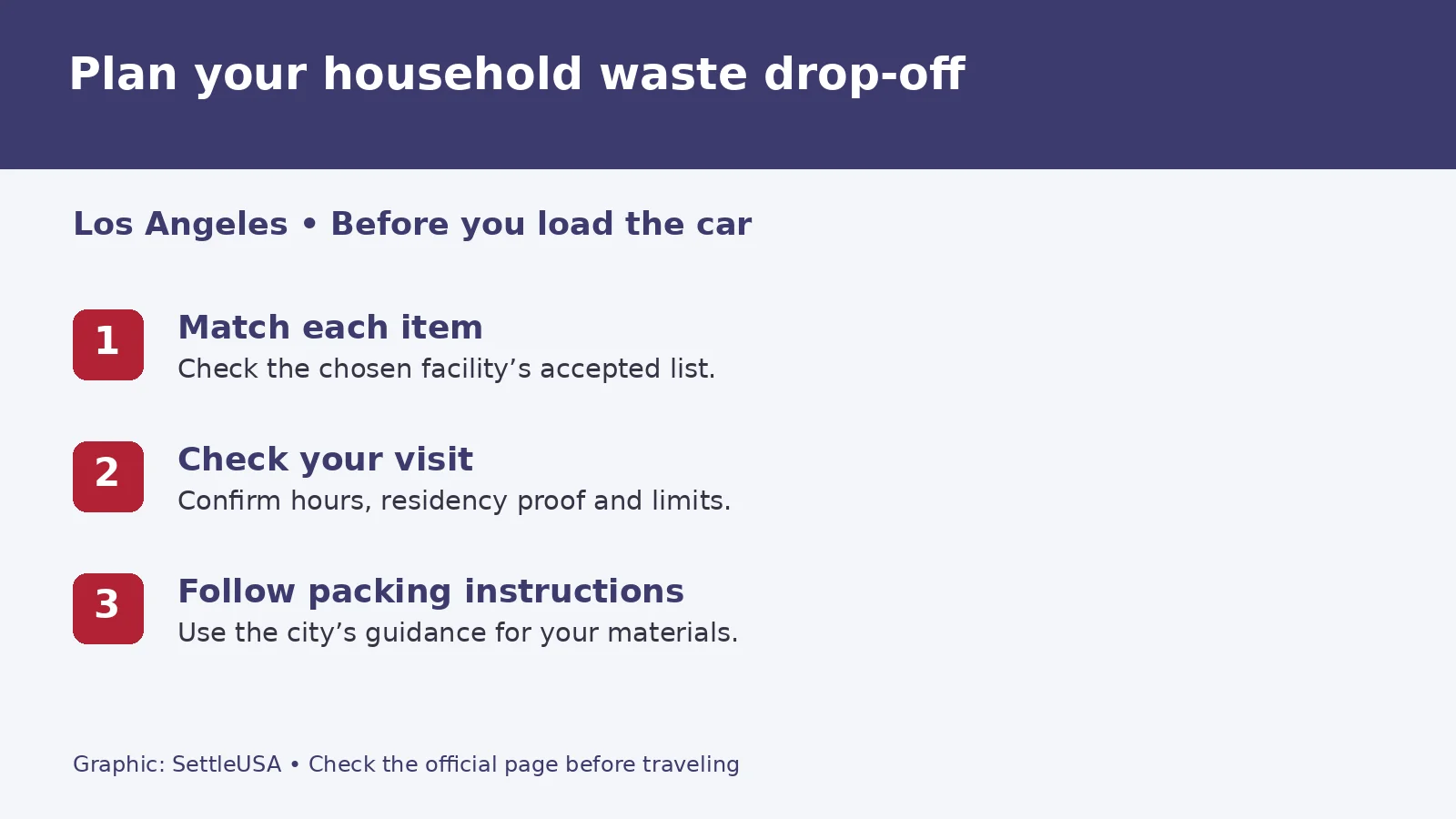
- List the products, electronics and batteries you want to discard. Match each item to the chosen city or county accepted list.
- Choose a S.A.F.E. center or a dated collection event. Recheck hours, closures and arrival instructions; ask LASAN about any visit requirements you need clarified.
- Check the 15-gallon or 125-pound load limit and have the waste’s originating address ready.
- Follow the official packing instructions: keep products separate, close lids tightly and secure upright containers. Put a leaking container inside a larger plastic bucket or bin.
- At city drive-through unloading areas, remain in the vehicle, turn the engine off, do not smoke and let trained staff unload. Follow on-site directions.
These steps follow the city mobile collection instructions and S.A.F.E. arrival guidance. Plan the visit before packing so you are not trying to sort exclusions or resolve a residency question at the entrance. If staff cannot accept an item, ask which official disposal route to check next.
Business waste, reuse and getting help
County residential events exclude business waste. The county directory describes a separate, fee-based Very Small Quantity Generator program for qualifying small businesses at S.A.F.E. centers, by appointment. Check that program’s eligibility and paperwork rather than taking business leftovers through the residential queue. Business program information.
The county also lists reuse centers at its Antelope Valley and EDCO facilities, where residents can obtain usable products collected through the program. This is a distinct service with its own hours and limits. Check the directory before making a separate reuse trip. County reuse-center information.
For an uncertain item, prepare a short question containing its name, quantity, packaging and household or business origin. That gives the department something concrete to assess. SettleUSA is independent; an official department answer and the destination’s current rules should guide your final plan.
Frequently asked questions
Is household hazardous waste disposal in Los Angeles free?
Yes, the official city and county programs provide household disposal without charge for eligible Los Angeles City and County residents. Business waste follows a separate process.
Do I need an appointment for an LA County HHW event?
County collection events do not require an appointment. Check the actual event listing for its date and hours; confirm instructions separately for a permanent center.
How much paint or hazardous waste can I bring?
The city publishes a limit of up to 15 gallons or 125 pounds per visit. Check with the destination if your planned load is close to the limit.
Can I use S.A.F.E. centers if I rent an apartment?
The city service covers single-family and multi-family residents. Staff request the address where the waste originated; check the selected location for any additional requirements.
Can I put household batteries in the recycling bin?
LA Sanitation says not to place batteries in household trash or recycling bins. Use its battery collection options and follow terminal-taping and packaging instructions.
Are all S.A.F.E. centers open on Sundays?
No. The county directory lists Los Angeles–Glendale as Saturday only, and UCLA has a different schedule. Check your chosen location before traveling.
Can I bring medicines and tires to an HHW event?
Do not assume they are accepted. County events exclude controlled substances and tires; check the city’s specialist disposal options for medication and sharps.
Official sources
- LA Sanitation & Environment — S.A.F.E. centers: accepted items, limits and preparationChecked
- LA Sanitation & Environment — S.A.F.E. Centers and Household Hazardous WasteChecked
- LA Sanitation & Environment — Mobile Collection EventsChecked
- Los Angeles County Public Works — CleanLA — Collection centers, events, reuse and business wasteChecked
- LA Sanitation & Environment — 2026 S.A.F.E. Center flyer: address survey and arrival instructionsChecked
Source review: complete. Last checked .
Independent guide, not affiliated with SSA, VA, USDA or any government agency. Not financial or legal advice. Confirm your circumstances with the responsible agency or service.