
Household hazardous waste San Jose: appointments and disposal rules
Where can San José residents take household hazardous waste?
San José residents can schedule a free household hazardous waste drop-off through Santa Clara County. Make an appointment before visiting; the county sends the location afterward. Bring proof of residency and follow the vehicle quantity limits. Medications are no longer accepted at county HHW facilities or events and need a separate route.
Published · Updated
As of November 12, 2026, San José directs residents to Santa Clara County’s free household hazardous waste program. This independent guide explains how to book, what to bring and which materials need another destination, including the county’s updated medication exclusion.
In this guide
- Household hazardous waste San Jose: which service do you need?
- Who can use the free county household service?
- Drop-off locations, operating dates and appointment times
- How to book hazardous waste disposal San Jose
- Quantity limits and container sizes
- Accepted and not-accepted items at county HHW
- How to pack and arrive at your appointment
- Paint, batteries and recycling San Jose alternatives
- Sharps and medications: two different routes
- Business waste, unclear items and help before you travel
- Frequently asked questions
- Official sources
SettleUSA does not take bookings or payments.
Household hazardous waste San Jose: which service do you need?
The City of San José directs residents to Santa Clara County for free household hazardous waste appointments. It identifies paint, batteries, cleaners and propane tanks as examples. The city also lists take-back options for individual materials, which may suit a small amount of one product.
Plan a chemical cleanout separately from a furniture pickup. A search for San Jose bulk pickup may lead to a service for large objects, but it does not establish acceptance of old paint or garden chemicals. List the actual products you need to remove, then check a receiving route for each.
Before selecting a date, mark your list with three columns: product, approximate amount and destination. Keep medications on a separate line. This simple planning step helps you avoid bringing an excluded material to an otherwise valid HHW appointment.
Who can use the free county household service?
The County of Santa Clara household drop-off page describes free disposal for county residents and requires proof of residency. Bring that proof to your appointment. For help choosing a document, call the county Household Hazardous Waste Program at (408) 299-7300 before traveling.
Do not confuse where you live with where a business generated its waste. Your household appointment should cover household material. A landlord, apartment manager or business may need the separate commercial route even when the chemicals look similar to products in a home garage.
San José residents are directed to this county program. The county appointment page says Palo Alto residents must instead use Palo Alto’s own program. If you are helping someone elsewhere in the county, check that person’s eligibility rather than assuming the San José instructions cover every address.
For an apartment cleanout, distinguish your own household batteries or paint from materials generated by the building’s maintenance operation. Ask the program if the origin is unclear. That question is more useful than relying on the size of the container or the type of vehicle carrying it.
Drop-off locations, operating dates and appointment times
The county operates permanent facilities in East San Jose and San Martin, plus temporary events in other cities. Its drop-off instructions explain that exact facility locations are provided after booking to discourage dumping when sites are closed. Use your appointment confirmation for the destination.
The operating schedule lists service days and holiday gaps, but it is not an invitation to arrive without a time slot. Facility access is only available when staff are onsite, and appointments are required. Check the booking system for an available location and time.
As of November 12, 2026, the posted schedule shows no events on November 26–28 for Thanksgiving. It lists San Jose service on December 26, 2026, and January 2, 2027. Those dates differ from some other cities’ closure patterns; do not copy a holiday assumption from a neighboring program.
A calendar entry does not guarantee an unreserved opening. If the system offers a different date or city than you expected, use the confirmation details or call for clarification. No street address is reproduced here because the county intentionally supplies it after booking.
How to book hazardous waste disposal San Jose
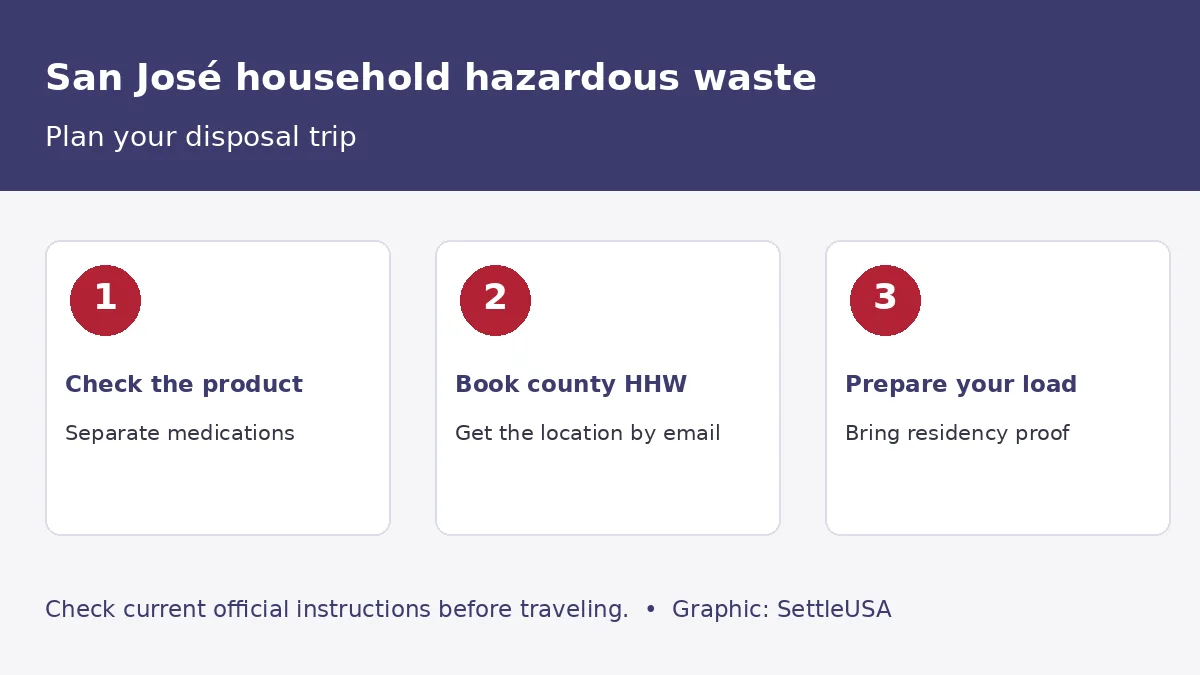
- Review the county’s hazardous waste classifications and list the materials and amounts you plan to bring.
- Open Make a household hazardous waste drop-off appointment on the official county website.
- Follow the appointment system to select an available city, date and time.
- Save the confirmation email containing the drop-off address. Check it before planning your route.
- Prepare proof of residency and check the load limits. Call (408) 299-7300 if an item, document or booking detail is unclear.
- Arrive at your confirmed time, following the county’s packing and onsite instructions.
The county drop-off locations page confirms that you select a date, time and city, then receive the address by email. Do not substitute an address from a map search for the location attached to your appointment.
If you are helping a relative move, make the appointment before the final cleanout day. You may need separate arrangements for medications, treated wood or commercial waste. Keep confirmation details alongside your item list so whoever transports the materials knows what was planned.
Quantity limits and container sizes
The appointment instructions set maximum quantities per vehicle of 15 liquid gallons or 125 solid pounds. Containers larger than 5 gallons are not accepted. Check the total amount you intend to transport, not just whether each individual bottle is small enough.
If one product alone exceeds the container allowance, contact the program before handling or repacking it. For an unfamiliar or deteriorated container, ask what to do rather than trying to make it fit the appointment rules yourself. Keep product names and quantities ready for that conversation.
These are household booking and transport limits. They do not describe the fees or allowances for a business load. Where a material has a separate restriction in the county’s classifications, follow that item-specific instruction as well. A general appointment is not blanket approval for any hazardous material.
Accepted and not-accepted items at county HHW
Use this table as a starting point, then check the county classifications for the exact product. Some hazardous items have a separate disposal route. Do not infer that something is accepted just because it is dangerous or because another California city collects it.
| Item | County HHW route | Important condition |
|---|---|---|
| Paint, cleaners, solvents and garden chemicals | Accepted household categories | Check labels and vehicle limits before booking. |
| Household and vehicle batteries | Accepted | Check unusual or damaged batteries with the program. |
| Computers, TVs and cell phones | Accepted e-waste category | County HHW or a suitable e-waste recycler. |
| Fluorescent tubes and compact bulbs | Accepted | Keep them separate from ordinary household trash. |
| Home-generated sharps | Accepted with packaging rules | Use an approved sharps container. |
| Medications | Not accepted at facilities or events | Use the separate medication disposal options. |
| Treated wood and railroad ties | Not accepted | Ask for an appropriate permitted receiving facility. |
| Ammunition and fireworks | Separate route | Contact the relevant sheriff or police service. |
| Business-generated waste | Separate program | Check VSQG eligibility and fees. |
| Oxygen cylinders | Unclear across county pages | Call before transporting; do not assume acceptance. |
The current county homepage explicitly excludes medications. It also lists additional waste categories such as propane and smoke detectors. For uncommon tanks or hazardous devices, confirm the exact product and condition before adding them to your booked load.
How to pack and arrive at your appointment
The county’s drop-off instructions say to place waste in the trunk, truck bed or rear of an SUV or hatchback. Remove non-waste items from that area so staff do not unload something you meant to keep. Containers brought for disposal cannot be returned.
The county also says not to bring pets. Arrive on time: if you are more than 15 minutes late, staff may not be able to accommodate you. Keep your residency proof available and follow the instructions in your confirmation.
A practical final check is to compare the loaded items with your written list. Check that you have not added medication, commercial materials or an unconfirmed cylinder during the last stage of a move. If the load has changed substantially, contact the program before traveling.
Do not leave waste at a facility outside an appointment. The county withholds exact addresses until booking for a reason. If you cannot attend, use the official booking service or HHW contact number for instructions about your appointment.
Paint, batteries and recycling San Jose alternatives
The county neighborhood drop-off directory links to separate recyclers for e-waste, automotive batteries and tires, household batteries and bulbs, motor oil and filters, paint, thermostats and large appliances. Use those categories to check whether a nearby specialist can handle a small single-material load.
The directory’s links are starting points. Before traveling, confirm the destination’s current hours, the product type and the amount it accepts. Do not assume a shop will take the full contents of a garage just because it accepts one kind of battery or paint.
Our paint disposal guide can help organize leftover paint; the county’s local instructions govern the appointment. Our tire disposal guide covers questions to ask a tire recycler. Keep tires on their own disposal plan rather than assuming they belong in the chemical load.
For furniture or large appliances, check the appropriate city collection route separately. A bulky item pickup San Jose booking should not be treated as permission to attach paint cans or loose chemicals to the item. Confirm each material through its own receiving service.
Sharps and medications: two different routes
Santa Clara County’s sharps guidance says used needles, lancets and similar home medical sharps must be placed in an approved sharps container. The county HHW program accepts sharps, and the page also links to drop-off and mail-back services.
An approved container must be rigid, puncture-resistant, unbreakable and leak-resistant, with a tightly sealed lid and the appropriate sharps or biohazard label. The county says not to use glass jars, soda bottles or milk jugs. Check its instructions before packing a collection of used needles.
Medications are different. The appointment page’s current notice says medications are no longer accepted at any county HHW facility or event. Do not rely on an older leaflet or a past appointment when planning a medicine cleanout.
Use the county medication disposal page for pharmacy and mail-back options. Keep the medication packaging and receiving program’s instructions together while planning the trip. A confirmed HHW appointment does not override the medication exclusion.
Business waste, unclear items and help before you travel
The Very Small Quantity Generator business program is separate from household disposal. The county specifically includes nonprofits, landlords and apartment managers among businesses that may have disposal fees. Business, government-agency or property-maintenance waste should be checked through that route.
The business page publishes (800) 207-8222 for inquiries. Eligibility and fees must be confirmed before taking a commercial load. The fact that a business produces only a small amount does not automatically make its waste household waste or qualify it for a free resident appointment.
The county overview lists small oxygen tanks, while its classifications page excludes oxygen tanks and refers readers to a medical-waste hauler or supplier. Ask the County of Santa Clara HHW Program at (408) 299-7300 about your cylinder before transporting it; acceptance is not confirmed.
For reuse, start by asking a potential receiving organization what it accepts. Do not leave usable chemicals at a donation doorway without agreement. If the product is unwanted and no suitable reuse arrangement exists, keep following the county’s material-specific disposal instructions.
Frequently asked questions
Is household hazardous waste San Jose disposal free?
The county household service is free for eligible county residents with appointments. Business-generated waste follows a separate program and may involve fees.
Where is the San José hazardous waste drop-off address?
The county sends the exact drop-off location after you book. Select an available city, date and time, then use the address in your confirmation email.
Do I need proof of residency?
Yes. Bring proof of residency as required by the county. If you need help choosing an acceptable document, call the County of Santa Clara Household Hazardous Waste Program at (408) 299-7300 before your appointment.
How much waste can I bring?
The county appointment page lists maximum amounts per vehicle of 15 liquid gallons or 125 solid pounds. Containers larger than 5 gallons are not accepted, and individual materials can have additional restrictions.
Does county HHW take medications?
No. The current county notice says medications are no longer accepted at facilities or events. Use the linked county medication disposal page for pharmacy and mail-back options.
Can I bring sharps or electronics?
The county lists both categories for HHW disposal. Sharps must be in an approved container; check the separate sharps guidance and the classifications before booking.
Can a landlord use a resident appointment for maintenance waste?
The county treats landlords and apartment managers generating hazardous waste as businesses. Ask the business program about eligibility and fees rather than placing that waste in a household appointment.
Official sources
- County of Santa Clara Household Hazardous Waste Program — Make a household hazardous waste drop-off appointmentChecked
- City of San José Environmental Services Department — Household hazardous wasteChecked
- County of Santa Clara Household Hazardous Waste Program — Drop off household wasteChecked
- County of Santa Clara Household Hazardous Waste Program — Household hazardous waste classificationsChecked
- County of Santa Clara Household Hazardous Waste Program — Operating scheduleChecked
- County of Santa Clara Household Hazardous Waste Program — Neighborhood drop-off locationsChecked
- County of Santa Clara Household Hazardous Waste Program — Sharps disposalChecked
- County of Santa Clara Household Hazardous Waste Program — Medication disposalChecked
- County of Santa Clara Household Hazardous Waste Program — VSQG business waste drop-off programChecked
- County of Santa Clara Household Hazardous Waste Program — Homepage: medication exclusion and accepted categoriesChecked
Source review: complete. Last checked .
Independent guide, not affiliated with SSA, VA, USDA or any government agency. Not financial or legal advice. Confirm your circumstances with the responsible agency or service.