
Household hazardous waste Seattle: drop-off, booking and rules
Where can I dispose of household hazardous waste in Seattle?
King County residents can take accepted household hazardous waste to North or South Seattle without an appointment and at no charge. Check each site’s opening days before leaving. Latex paint, electronics, medicines and sharps need other routes; product-specific limits apply, so check the official item guidance before loading.
Published · Updated
As of November 12, 2026, Seattle’s two household hazardous waste sites offer free drop-off for King County residents. This independent guide helps you separate chemicals from paint, electronics and medical waste, then check the right official destination.
In this guide
- Household hazardous waste Seattle: start with the product
- North and South Seattle drop-off locations and hours
- Who can use the service, and what should you bring?
- Accepted and not-accepted items
- Quantity limits, containers and fees
- How to arrange hazardous waste disposal Seattle
- Pack the load before you leave
- Paint and recycling Seattle: what needs a different trip?
- Sharps, medications and tires need separate routes
- If you cannot get to a site, or need another option
- Frequently asked questions
- Official sources

SettleUSA does not take bookings or payments.
Household hazardous waste Seattle: start with the product
A garage cleanout can leave you with several disposal routes. Oil-based paint, old gasoline and household pesticides can go to hazardous waste collection. Latex paint, an unwanted laptop and a box of prescription medicine need other routes. Check the product before choosing a destination. King County’s product directory separates accepted and excluded materials.
Read the label without opening or testing the contents. Tell the help line the product name, container size and approximate amount. An unmarked bottle is a reason to ask for advice: unknown or unlabeled waste is not accepted at the hazardous waste sites.
This guide covers waste from your home. For a move, make separate lists for chemicals, paint, electronics, medicine and bulky furniture. That makes it easier to check each destination and avoids loading everything into one vehicle before discovering that some items are excluded.
North and South Seattle drop-off locations and hours
As of November 12, 2026, Seattle Public Utilities lists two household hazardous waste facilities. They are free for all King County residents and do not require appointments. Their opening days differ, so pick the facility first and then check the day.
| Facility | Address | Published hours |
|---|---|---|
| North Seattle | 12550 Stone Avenue North, Seattle, WA 98133 | Sunday–Tuesday, 9 a.m.–5 p.m. |
| South Seattle | 8100 2nd Avenue South, Seattle, WA 98108 | Thursday–Saturday, 9 a.m.–5 p.m. |
Both listings show closures for July 4, Thanksgiving Day, Christmas Day and New Year’s Day. King County’s facility directory also lists Factoria and Algona alternatives. Check that directory immediately before traveling, especially if a holiday falls on your chosen day.
The SPU hazardous-waste directory and King County facility directory both list South Seattle HHW at 8100 2nd Avenue South. The ordinary transfer-station page describes separate garbage facilities. Use the HHW-specific directions and hours, and call 206-296-4692 if your map shows a different destination.
Who can use the service, and what should you bring?
The Seattle Public Utilities page makes household drop-off available to all King County residents. Seattle’s page does not restrict this service to homes receiving city garbage collection. If you rent an apartment, use the household guidance for your own household products; do not apply a furniture collection rule to chemical disposal.
For residency-document questions, contact the King County Hazardous Waste Management Program at 206-296-4692 before visiting. Describe your household products and ask what to bring. This guide does not specify an ID requirement or promise that no documentation will be requested.
Businesses have separate requirements. King County’s business program requires eligible businesses to complete a disposal form and bring two printed copies. Business eligibility, visit limits and quantities differ from household rules. Waste from a paid job should be checked through that program rather than combined with your personal household load.
Accepted and not-accepted items
Use the table to split a household cleanout into the right streams. These are examples, not permission to bring every variation of a product. The official product directory includes separate instructions for individual materials and should be your final check.
| Material | HHW route | Check before loading |
|---|---|---|
| Oil-based paint | Accepted | Use containers of 5 gallons or less; check total load limits. |
| Household pesticides | Accepted | Professional-grade pesticides and herbicides are excluded. |
| Household and car batteries | Accepted with limits | Battery type, weight and count restrictions apply. |
| Fluorescent tubes and lamps | Accepted with limits | Combined limit of 15 per vehicle per visit. |
| Latex, water-based or acrylic paint | Not accepted | Use the county’s paint recycling guidance. |
| Electronics | Not accepted | Use a separate electronics recycling route. |
| Medicines and sharps | Not accepted | Use medication or sharps collection locations. |
| Tires | Not accepted | Check tire dealers or the county’s tire guidance. |
| Unknown or unlabeled chemicals | Not accepted | Call the help line for advice. |
The details come from the county pages for oil-based paint, pesticides, batteries and fluorescent lighting. If your exact product is not covered, call before adding it to the load.
Quantity limits, containers and fees
The county’s oil-based paint guidance lists a total waste limit of 50 gallons per trip and containers no larger than 5 gallons. Gasoline and fuel have a lower 25-gallon trip limit and require an approved safety can labeled “gasoline.” Product-specific restrictions matter.
For batteries, the published limits are five lead-acid auto or marine batteries per visit, 25 pounds for a single non-auto or marine battery, and 50 pounds total for those non-auto batteries. Electric-vehicle batteries are excluded. Do not use a general liquid limit to judge a battery load.
The household drop-off service has no fee, according to Seattle Public Utilities. That does not make every alternative service free. Before using a retailer, electronics recycler or transfer station, check that operator’s own acceptance conditions and charges. For a large mixed load, describe each product and quantity to the county first.
How to arrange hazardous waste disposal Seattle
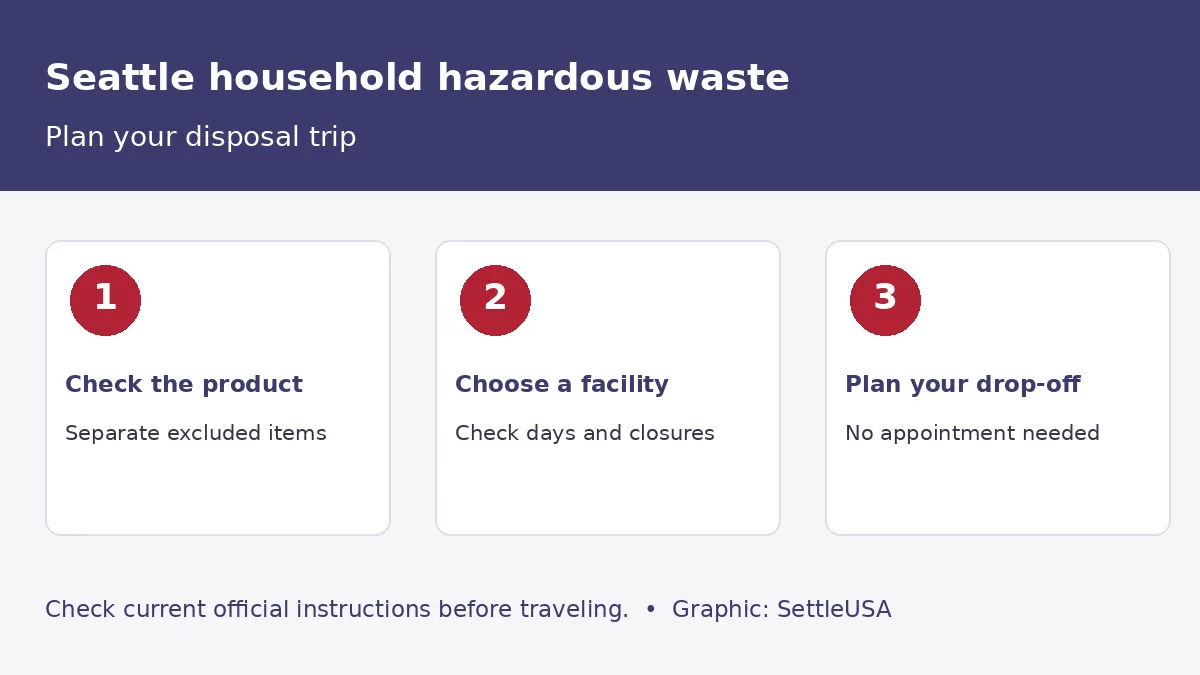
- List the products and approximate quantities, keeping labels available.
- Check each material in King County’s household product directory and separate anything excluded.
- Choose North Seattle or South Seattle using the official facility directory. No routine household appointment is needed.
- Check the operating day and holiday closures before departure. Ask the help line about unusual waste or uncertain documentation.
- Pack to the county’s transport instructions and take only an accepted load during opening hours.
Call 206-296-4692 for advice. The county help line operates Monday through Saturday, 9 a.m.–5 p.m., except holidays. Have your product list beside you so staff can help with the exact items rather than a vague description such as “garage chemicals.”
There is no address-based HHW collection day to infer here. Searching for a trash pickup schedule Seattle result will not tell you when these drop-off sites open. Use the location table and the current official directory, then plan the trip around the site’s actual operating days.
Pack the load before you leave
The county’s transport safety instructions say not to mix products, to keep original containers when possible, to secure products against tipping or leaking, and to cover and tie down the load. They also say not to transport products in the passenger compartment.
For lithium or rechargeable batteries, King County says to package them individually or tape the ends to prevent a fire hazard. Check the weight and type restrictions before bringing a large battery. A battery removed from a device and the device itself may have different disposal routes.
If the container is damaged, the contents are unknown, or you cannot package the load as instructed, ask the help line what to do before traveling. A practical inventory can include a photo of the label, but you do not need to open a bottle to make your list.
Paint and recycling Seattle: what needs a different trip?
Latex, water-based and acrylic paint are not accepted at county hazardous waste collection sites. The county directs residents to PaintCare recycling locations and also explains specific conditions for disposing of dried paint. Read that guidance before deciding whether paint is suitable for another route.
Oil-based paint is accepted at hazardous waste sites and can also be handled through listed paint recycling options. Check the paint type on the label. See our paint disposal guide for the wider planning steps, while keeping the local county instructions as the final authority.
Computers, monitors and other electronics are excluded from the HHW sites. The county points residents to electronics recycling and Seattle special-item options. A search for bulky item pickup Seattle may help with a large household item, but do not assume that service accepts the chemicals beside it.
Sharps, medications and tires need separate routes
The county’s sharps guidance says needles, syringes and other sharps are not accepted at household hazardous waste sites and should never go in the garbage. Follow its link to safe disposal locations. Do not put a sharps container in a chemical drop-off box without checking the receiving program.
Medicines are also not accepted at these facilities. The county provides a medicine drop-box locator and says medicines should not go in the garbage or down the drain. Check the receiving location’s instructions for your medication type and packaging before making a separate trip.
Tires are not accepted as HHW. The county points to tire dealers and transfer-station options. Use our tire disposal guide to organize that part of a cleanout. Keep tires off the HHW load unless the county specifically directs you to a different receiving service.
If you cannot get to a site, or need another option
King County’s Home Collection Program serves residents age 65 or older, or residents with a disability, who lack a vehicle or otherwise cannot access a hazardous waste site. Call 206-296-4692 with your contact details and the types and amounts of waste. Eligibility must be confirmed through the program.
Home collection does not include latex paint, tires, electronics or medications, and the county says not to put hazardous waste on the curb. Do not interpret a bulky collection booking or a request for help as permission to leave chemicals outside for a routine garbage crew.
As of November 12, 2026, the Wastemobile page says its season has ended and asks readers to check back in February 2027 for the full schedule. Use the permanent facility listings now; do not rely on a past event date when planning a new trip.
For reuse, ask whether an unopened usable product can be taken back by its seller, an option noted by Seattle Public Utilities. Confirm acceptance directly before transporting it. Do not leave leftover chemicals at a donation site without an agreed receiving arrangement.
Frequently asked questions
Do I need an appointment for household hazardous waste in Seattle?
No. The city and county list household drop-off without an appointment. Use the linked official facility directory for current opening days and holiday closures.
Is hazardous waste disposal Seattle free?
Yes, the listed household collection sites are free for King County residents. Separate retailers, recyclers and transfer stations may have their own conditions.
Can I bring latex paint to North Seattle HHW?
No. King County excludes latex, water-based and acrylic paint from its hazardous waste sites. Follow the linked county paint page for recycling and other disposal instructions.
Can batteries and electronics go together?
They have different routes. Accepted household batteries have count and weight limits; electronics are not accepted at HHW sites. Check the linked battery and electronics pages.
Can I drop off medicine or a sharps container?
Neither is accepted at the Seattle HHW facilities. Use the county’s separate medicine and sharps disposal guidance to find an appropriate receiving location.
Does bulk trash pickup Seattle include chemicals?
Do not treat a bulky item booking as a chemical collection booking. Use the HHW drop-off service or ask the county whether you qualify for its separate Home Collection Program.
Official sources
- Seattle Public Utilities — Where to dispose of household hazardous wasteChecked
- King County Hazardous Waste Management Program — Disposal facilities and home collectionChecked
- King County Hazardous Waste Management Program — Household hazardous product directoryChecked
- King County Hazardous Waste Management Program — Oil-based paint disposalChecked
- King County Hazardous Waste Management Program — Latex paint disposalChecked
- King County Hazardous Waste Management Program — Battery disposalChecked
- King County Hazardous Waste Management Program — Electronics disposalChecked
- King County Hazardous Waste Management Program — Sharps disposalChecked
- King County Hazardous Waste Management Program — Medicine disposalChecked
- King County Hazardous Waste Management Program — Tire disposalChecked
- King County Hazardous Waste Management Program — Pesticides disposalChecked
- King County Hazardous Waste Management Program — Fluorescent tube disposalChecked
- King County Hazardous Waste Management Program — Gasoline and fuel disposalChecked
- King County Hazardous Waste Management Program — Unknown waste disposalChecked
- King County Hazardous Waste Management Program — Wastemobile and transport guidanceChecked
- King County Hazardous Waste Management Program — Business waste eligibilityChecked
- Seattle Public Utilities — Transfer Stations — separate garbage facilitiesChecked
Source review: complete. Last checked .
Independent guide, not affiliated with SSA, VA, USDA or any government agency. Not financial or legal advice. Confirm your circumstances with the responsible agency or service.